Why is the sky blue? Rayleigh checked it against white paper
Some questions get asked by four-year-olds and still took science a long time to settle. The question “why is the sky blue” is one of them, and NASA says so itself. The short answer fits in a line, but the story of how people got there has a lovely moment: a physicist looking at the sky through an instrument, comparing it with a scrap of white paper in the sun, and admitting in print that he hadn’t expected such an exaggerated result.
Before Rayleigh: thin plates and lab clouds
The paper that changed everything came out in 1871 in the Philosophical Magazine, in two installments, under the title “On the light from the sky, its polarization and colour.” Rayleigh wrote it, and years later he reprinted it in the first volume of his collected scientific papers.
It opens with a survey of what people believed. According to Rayleigh, it was by then generally admitted that light from the clear sky is due, one way or another, to small suspended particles that divert light from its regular course. He cites Tyndall’s experiments with clouds precipitated in the lab as quite decisive: whenever the particles are fine enough, the light sent out sideways is blue.
There was another idea going around, with a famous name attached. As Rayleigh tells it, many physicists from Newton onward had supposed that skylight was reflected from thin plates, and that its color was the blue of the first order on Newton’s scale. Rayleigh warns that the two explanations look alike but predict different things. And he offers a way to choose between them.
Particles smaller than the wave
Rayleigh’s reasoning is the kind that makes you jealous. Before touching the equations, he asks what the light scattered by a tiny particle could possibly depend on. The particle’s volume, the distance you look from, the wavelength of the light, the speed of light, and the densities of the particle and the medium. Nothing else, apart from plain numbers and angles.
Then he uses dimensional analysis, the trick of making sure the units fit. Speed is the only quantity involving time, so it can’t appear. The densities can only show up as a ratio. That leaves volume, distance and wavelength. Since the scattered amplitude grows with volume and falls with distance, the only combination that works forces you to divide by the square of the wavelength.
Out of that comes what he calls an important law. When light is scattered by particles very small compared with its wavelength, the scattered amplitude goes as the inverse square of the wavelength, and the intensity as the inverse fourth power. Running the numbers myself: if one wave is half as long as another, it gets scattered sixteen times as much.
With the thin-plate theory, the same kind of reasoning gives something else. Rayleigh works out that light reflected from a very thin plate would go as the inverse square of the wavelength instead of the inverse fourth power. Two different predictions. Measuring the sky would show which one was right.
The sky against white paper
Rayleigh says that before he had the theory, he had already tried to measure what colors the blue of the sky is made of. His instrument was good at comparing two lights. The problem was what to compare the blue with.
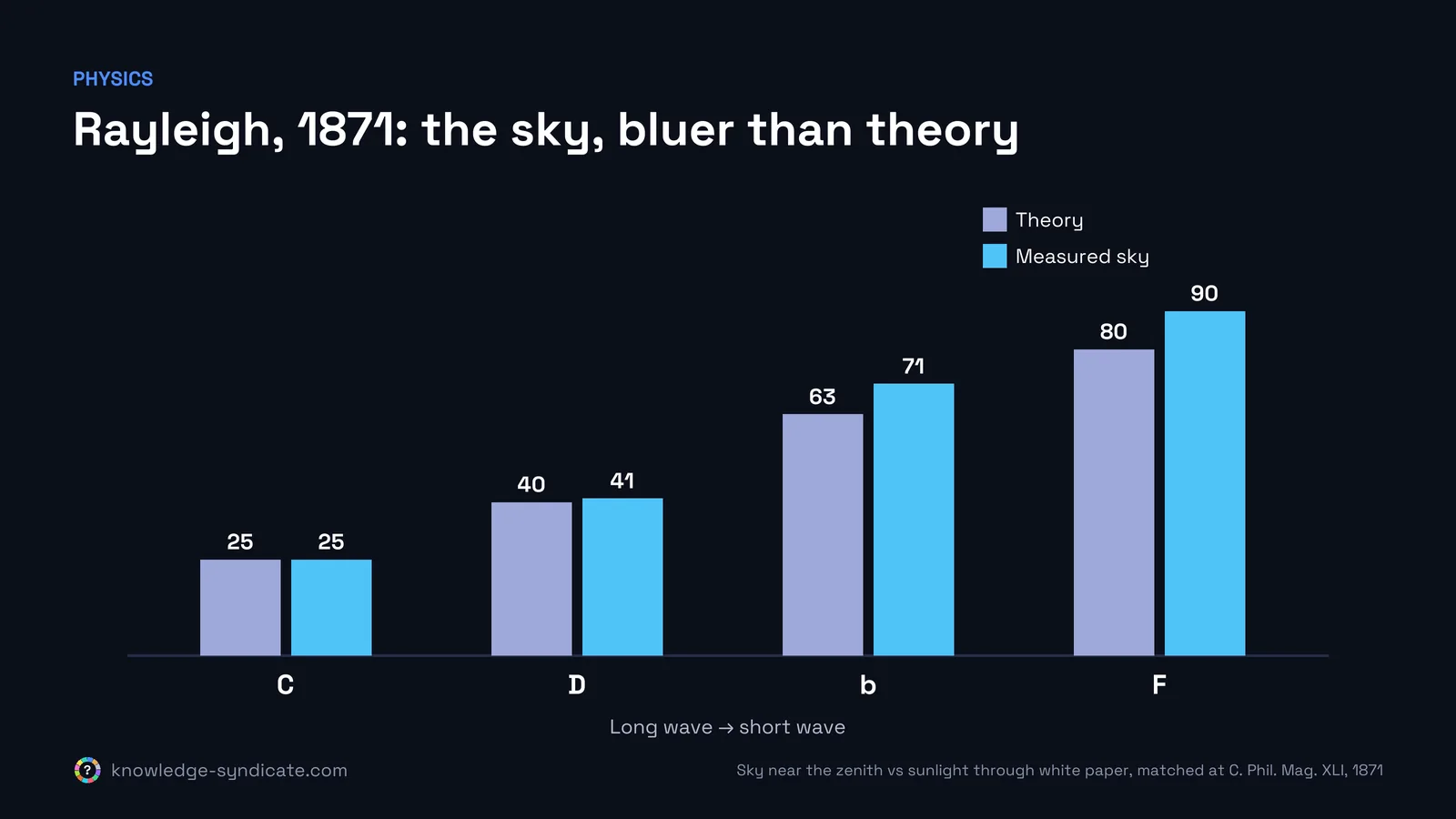
In the only complete set of observations he had managed, he compared the blue sky near the zenith, a very good one by his account, with sunlight diffused through white paper. He made about thirty comparisons, from line C to beyond line F of the spectrum. And he left four numbers for four reference lines in the spectrum, called C, D, b and F, running from long waves to short ones.
Theory predicted, with everything matched at C, 25, 40, 63 and 80. The observations gave 25, 41, 71 and 90. The sky was even bluer than the math said. Rayleigh points to two possible culprits: the paper might have been slightly yellow, or sunlight might reach the ground yellower than it is in the upper atmosphere.
And then he writes a confession you rarely see in a scientific paper. He says he doesn’t know how it may strike others, but that he personally was not prepared for so great a difference: the ratio for F was more than three times that for C. Even so, he asks readers not to lean too hard on incomplete observations. What they do show, he says, is that a color much like the sky’s comes from taking the parts of white light in proportion to the inverse fourth power. The thin-plate law came off worse.
Skylight is polarized
The other half of the title was about polarization, and that was the part that bothered people. Tyndall had seen that light scattered by his clouds of fine particles was most strongly polarized at right angles to the beam lighting them. He presented it as a puzzle for the wave theory to solve.
Rayleigh replies that the difficulty is imaginary and comes from misusing the word reflection. The laws of reflection, he points out, only apply when the surface is much bigger than the wavelength. With particles smaller than the wave, talking about reflection makes no sense. And with a symmetry argument he shows that light scattered at right angles must come out fully polarized, and that backward from the cloud the light is twice as bright as at right angles.
In the real sky, polarization at ninety degrees from the Sun is incomplete. Rayleigh offers an explanation: each particle gets direct sunlight and also light already scattered by other particles, and that second round mixes up the directions. He admits that particles not quite fine enough would have the same effect.
Sunsets come from the same math
The same law explains sunsets. Rayleigh puts it in terms of energy: the light sent out sideways isn’t newly created, it’s taken from the main beam. If blue gets scattered more, the beam that carries straight on keeps less and less blue. Light crossing a turbid layer tends to turn yellow and finally red as the layer gets thicker.
In the paper he draws a set of curves for thicknesses in the ratio 1, 2, 4, 8, 16 and 32, and asks the reader to notice how little violet remains while red is still at nearly full strength. He gives an example with two ends of the spectrum as known in his day: line A, at the extreme red, and line R, near the limit of the photographic spectrum, with wavelengths of 7,617 and 3,108 in his units. The ratio of their fourth powers, he calculates, is about 36 to 1.
NASA, on its Space Place outreach site, tells it almost the same way. As the Sun gets lower, its light passes through more atmosphere to reach you. Even more blue gets scattered, letting the reds and yellows pass straight through to your eyes.
Why is the sky blue even without dust?
In 1871 Rayleigh was talking about suspended particles. Twenty-eight years later, in another Philosophical Magazine paper published in 1899, he asked a more radical question: do you need dust at all, or are the molecules of the air enough?
The push had come long before. Rayleigh reprints a letter from Maxwell dated August 28, 1873. Maxwell asked him to plug some data into his formula, because, he joked, that would be less of an expense to the energy of the race than digesting the papers himself. He wanted to know how much light air would scatter if it were made of tiny spheres, to get at the size of molecules.
Rayleigh ran the numbers. Using Maxwell’s estimate of about 19 × 10¹⁸ molecules per cubic centimeter, he found that light would have to travel 83 kilometers through air at normal pressure for its intensity to drop to a bit over a third. Then he compared that with real data: Bouguer and others estimated that the whole atmosphere lets through about 80% of the light from a star at the zenith, equivalent to 8.3 kilometers of air at normal pressure. At that rate, 83 kilometers would let through 11%, against the 37% he had calculated. Real transmission was only about three times lower than what the molecules alone would give.
His conclusion: the light scattered by the molecules would be enough to give us a blue sky not much darker than the one we actually enjoy. And he flipped the argument around. If the number of molecules were unknown, the transparency of air would force it to be not much smaller than Maxwell’s, with a lower limit of about 7 × 10¹⁸ per cubic centimeter. The color of the sky could be used to count molecules.
Rayleigh adds a traveler’s detail. Mount Everest looks fairly bright from 100 miles away, seen from near Darjeeling. Even so, he grants that the atmosphere can’t be as transparent as his numbers imply, because there is always suspended matter to reckon with.
Why the horizon looks whiter
NASA’s explanation adds a detail anyone can check from a window. Near the horizon, the sky fades to a pale blue or white. Light reaching you from low in the sky has crossed much more air than light from overhead. The molecules have scattered and rescattered the blue many times in many directions, and the Earth’s surface reflects and scatters light too. All that mixing puts the colors back together, so you see more white and less blue.
And the same mechanism gives different skies on other planets. According to NASA, Mars has a very thin atmosphere, mostly carbon dioxide and full of fine dust that scatters light differently. By day the Martian sky looks orange or reddish. At sunset, around the Sun, it turns a blue-gray. The Mars Pathfinder lander photographed it: a sunset that runs the opposite way to ours.
Rayleigh ended his 1871 paper thinking about the Sun. He wrote that he couldn’t help thinking this rapid diversion of short waves had a good deal to do with the absence of the bluest light from the Sun’s direct rays. For him, the blue sky and the yellowish Sun were two sides of the same calculation. What the air takes from the Sun along the way is exactly what it hands back to you from every direction when you look up.