Foucault pendulum: watching the Earth turn with a ball and a wire
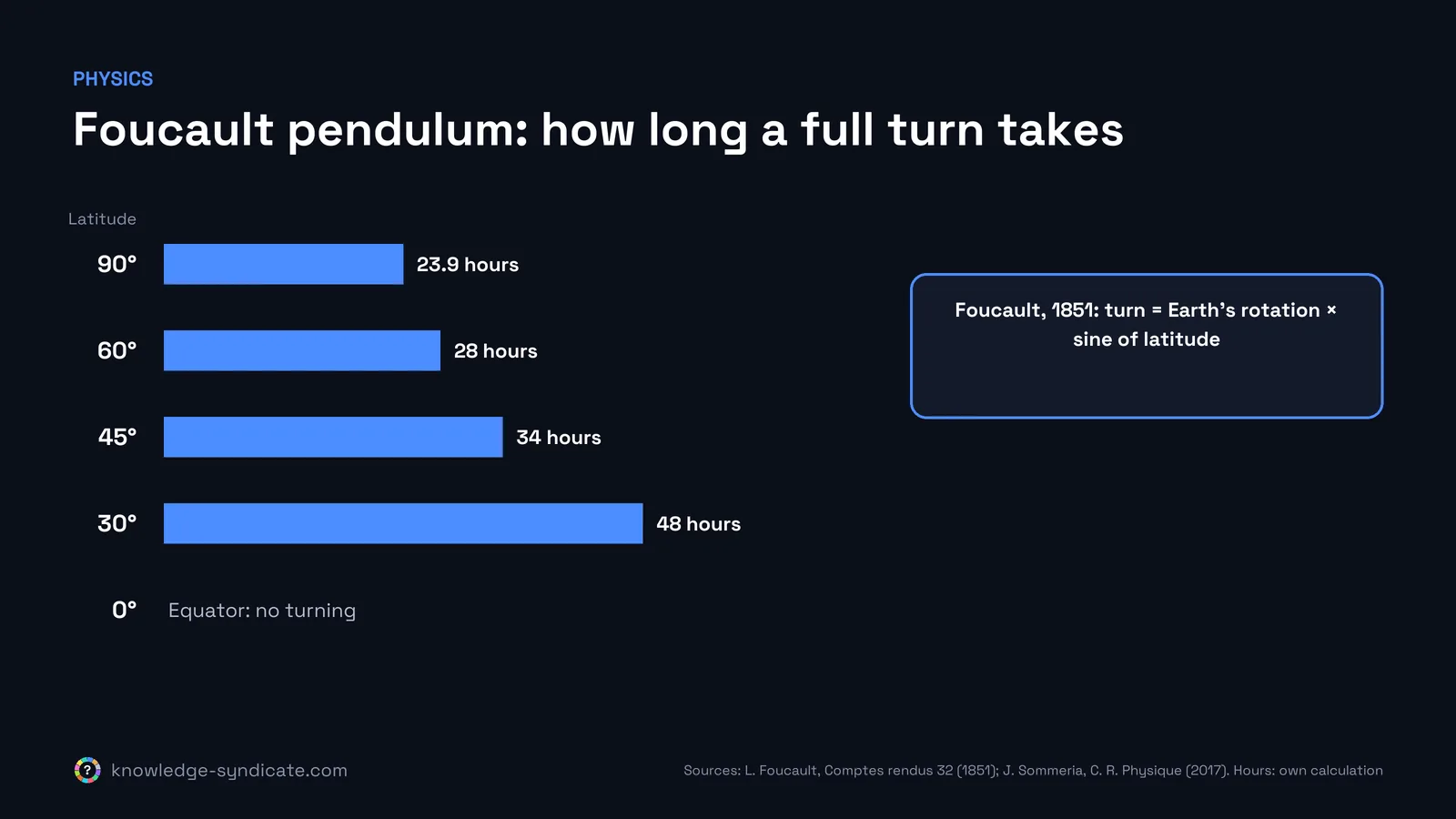
Everyone knows the Earth spins. Seeing it is harder. From the ground everything looks still, and it’s the sky that goes round. The Foucault pendulum is the trick that let anyone, with no telescope and no maths, watch the planet turn in an afternoon. A heavy ball, a long wire and some patience. And an idea so simple it’s surprising nobody turned it into an experiment before 1851.
A four-page note
On 3 February 1851 Léon Foucault presented a note to the Paris Academy of Sciences titled Physical Demonstration of the Earth’s Rotation by Means of the Pendulum. It was published in the Academy’s Comptes rendus, volume 32, pages 135 to 138. The commissioners appointed to examine it were Arago, Pouillet and Binet.
Foucault begins by noting that observations of the pendulum had so far focused on how long its swings lasted. His own focused instead on the direction of the plane of swing, which shifts gradually from east to west and gives, in his words, a perceptible sign of the daily motion of the globe.
The Foucault pendulum at the pole
To explain it, Foucault takes himself, in thought, to the pole. There he hangs a pendulum reduced to its simplest form: a spherical, uniform mass hanging from a flexible wire at a fixed point, right on the extension of the Earth’s axis. Pull the mass away from its rest position and let it go without any sideways push, and it swings along an arc whose plane is clearly defined. According to Foucault, the inertia of matter keeps that plane in an unchanging position in space.
Then comes the central idea. Since the Earth keeps turning from west to east, the still plane of the pendulum will seem to move across the floor, just as the celestial sphere appears to move. If the swings could last twenty-four hours, Foucault writes, the trace of their plane would make a complete turn around the point below the suspension.
A sidereal day
A 2017 paper by Joël Sommeria, of Université Grenoble Alpes and the CNRS, in Comptes Rendus Physique, refines the figure: at the pole the plane turns a full 360 degrees relative to the Earth in a sidereal day, 23 hours 56 minutes, in the opposite direction to the rotation.
My own reading, which is my reasoning: the day we measure by the Sun lasts 24 hours because the Earth, as well as spinning, moves along its orbit. Relative to the stars, a full turn takes about four minutes less. The pendulum doesn’t see the Sun; it responds to the real spin.
The problem of the support
Foucault anticipates an objection. In reality you can’t hang the pendulum from a point that doesn’t turn with the Earth: the parts holding the wire share in the daily motion. Wouldn’t they drag the plane of swing with them? According to his note, theory sees no serious difficulty there, and experiment showed him that if the wire is round and uniform it can be twisted fairly quickly without affecting the plane.
In a footnote he describes the experiment that put him on the track. He fixed a round, flexible steel rod along the axis of a lathe and set it vibrating. The persistence of vision drew the plane of vibration in the air. When he turned the lathe by hand, the plane didn’t move. Sommeria cites this same anecdote as the inspiration for the pendulum.
Harder away from the pole
Coming down to latitudes like France’s, Foucault admits, things get complicated, and he expressly asks the geometers, as mathematicians were then called, to look into it. The closer to the equator, the more slanted the horizon is to the Earth’s axis. That slows the apparent turning of the plane, which vanishes at the equator and reverses in the other hemisphere.
According to the note, the angular shift of the plane should equal the Earth’s turn in the same time multiplied by the sine of the latitude. Sommeria writes that Foucault rightly convinced himself of this law, although the point was puzzling.
My own calculation, which is plain arithmetic: the sine of 90 degrees, at the pole, is 1, so the plane turns round in one sidereal day. The sine of 0, at the equator, is 0, and there’s no turning. At 45 degrees of latitude the sine is 0.71, and a full turn takes about 34 hours.
A cellar and a five-kilo ball
Foucault describes his first set-up. At the top of a cellar vault he fixed a cast-iron piece to hold the wire. The wire was a thin steel one, hardened by being drawn through the die, and it was 2 metres long. At its end hung a polished brass sphere weighing 5 kilos, with a point that seemed to continue the wire. Sommeria dates this test to January 1851.
To release it without giving it a push, Foucault looped a thread of organic fibre round the sphere and tied it to the wall. Once the ball was still, he burned the thread. When it snapped, the pendulum set off on its own, driven only by gravity, with swings of 15 to 20 degrees.
Under a minute
After half an hour, Foucault says, the shift of the plane is obvious. But to follow it closely he placed a vertical point on the floor so that the pendulum’s tip would graze it at the end of each swing. In less than a minute the two points stopped meeting: the pendulum’s tip kept moving to the observer’s left. The average measurement matched what theory said: at these latitudes the plane doesn’t make a full turn in twenty-four hours.
Eleven metres at the Observatory
Thanks to François Arago, director of the Paris Observatory, and the instrument maker Froment, Foucault repeated the test on a larger scale in the Meridian room of the Observatory, with an 11-metre wire. The swing became slower and wider, and between two consecutive passes of the pendulum over the mark the drift to the left could already be seen.
Foucault ends by linking his finding to a paper by Poisson from 1837: projectiles fired at our latitudes veer to the right of the person firing them. The pendulum’s mass, moving away, behaves like a projectile veering right, and coming back, the other way. The pendulum has one advantage, Foucault says: it accumulates the effects and moves them from the realm of theory to that of observation.
Sixty-seven metres in the Panthéon
According to Sommeria, in March 1851 the experiment was repeated in the Panthéon in Paris with a 67-metre pendulum and a hollow brass sphere 17 centimetres across, filled with lead to weigh 28 kilos. A heavy, compact mass reduces air drag. A long pendulum reduces disturbances and increases the drift on each swing, which in the Panthéon reached 2.3 millimetres. A stylus attached to the pendulum left marks in small piles of sand.
My own calculation, which is arithmetic with the simple pendulum formula: a 2-metre pendulum takes about 2.8 seconds to swing there and back; an 11-metre one, about 6.7; and the 67-metre one, about 16 seconds.
Two centuries of searching
Sommeria explains why the experiment made such an impact. Since Newton nobody seriously doubted that the Earth spins, and there was indirect evidence: in 1672 an astronomer found that a pendulum swung more slowly in French Guiana than in France, and in 1738 Maupertuis measured the Earth’s flattening. But a direct proof was missing, and Laplace had said as much in his treatise on celestial mechanics.
There were attempts with falling bodies, which should drift slightly east. According to Sommeria, Ferdinand Reich’s experiments in a 158-metre mine shaft at Freiberg gave an average drift of 2.8 centimetres over 106 drops, but with so much scatter that they didn’t convince. The pendulum, by contrast, could be seen with your own eyes, and by the summer of 1851 it had been repeated in at least 25 cities in the United States.
What came next
Foucault wasn’t entirely satisfied, Sommeria says, because the public found the sine-of-latitude part hard to grasp. The following year he designed a more direct device, which he named the gyroscope. My own reading, which is my reasoning: the Foucault pendulum still hangs in museums and universities because it makes visible something nobody feels. The Earth turns under your feet, and a ball that simply swings back and forth gives it away.