How is a rainbow formed? Descartes worked it out with a glass ball full of water
A rainbow looks like an arc of colors hanging in one spot in the sky, but if you move, it moves with you. How is a rainbow formed? It was a mystery for centuries, and the answer came, one after another, from an archbishop, a philosopher with a glass ball full of water and a physicist with a prism. The odd thing is that the hardest part wasn’t the colors. It was the angle.
A big drop to see a small one
Descartes devoted the eighth discourse of his Meteors to the rainbow. He presents it as the best showcase for his method: a marvel of nature whose cause, he says, had been sought so eagerly by good minds and was so little understood that he couldn’t pick a better subject.
His reasoning starts with what anyone can see. The bow doesn’t only appear in the sky: it also appears in the air close by, whenever there are lots of water drops lit by the Sun, as happens at some fountains. So it had to depend on how rays of light act on those drops. The drops are round, and the bow doesn’t change whether they’re bigger or smaller.
Then came the central idea for the experiment: make an enormous drop so it could be examined. He filled a large glass flask with water, perfectly round and very transparent, and set it in the sun.
Red at 42 degrees
He describes what he saw precisely. With the Sun behind him and the ball in front, one part of the sphere looked entirely red, far brighter than the rest. And it didn’t matter whether he brought it closer, moved it away, put it to the right or left, or even swung it around his head: as long as the line from that part to his eye made an angle of about 42 degrees with the line from his eye toward the Sun, it looked just as red.
If he made the angle slightly larger, the red vanished at once. If he made it smaller, the red didn’t disappear so suddenly: first it split into less brilliant zones where yellow, blue and other colors appeared.
And there was more. Looking at another part of the ball, at an angle of about 52 degrees, red appeared too, though less brilliant. A bit larger, other fainter colors. A bit smaller or much larger, nothing.
From this he drew the conclusion that explains the shape of the bow. If all the air in that direction is full of drops, every drop that sits at about 42 degrees will look red and bright. And since those points are seen together, by their angle alone and not by their distance, they form a continuous circle. The main rainbow. The 52-degree one forms the second bow, the fainter one.
Two bends and a bounce
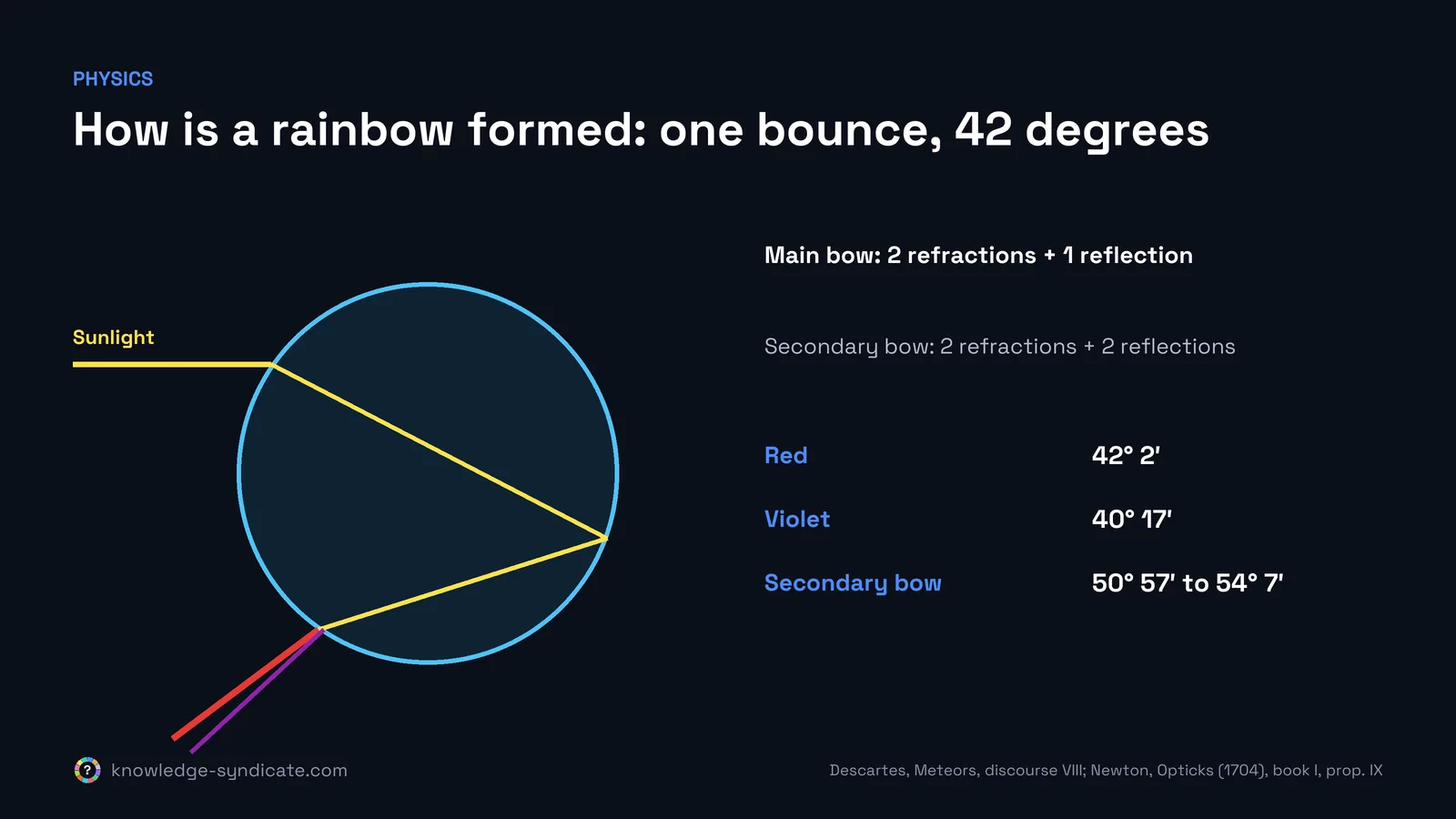
Descartes wanted to know which path the light took. He covered parts of the ball with opaque bodies. He found that the red at 42 degrees came from sunrays that bent on entering the water, reflected off the back of the sphere and bent again on the way out toward his eye. If he blocked any point along that path, the red disappeared. If he covered everything else and left only the entry and exit points free, the red stayed.
The second bow followed a longer path: two bends and two reflections inside the drop. And that, he explains, is why it shows less than the first.
The mystery of the angle
The main difficulty remained. Lots of rays, after two bends and one or two bounces, can reach the eye from the ball in any position. So why do only the ones at 42 and 52 degrees give color?
To solve it he did something that now looks like a textbook exercise. He took up his pen and worked out by hand the rays falling on different points of a drop, one by one. He split the drop’s radius into equal parts, one ray per part, to give each the same amount of light. For the bending of water he used a ratio he had measured himself, 187 to 250, a little more than three to four. And he worked out the angle at which each ray comes out.
The result explained everything. After one bounce and two bends, far more rays come out at an angle of 41 to 42 degrees than at any smaller one, and none come out at a larger one. After two bounces, they pile up between 51 and 52 degrees, and none come out at a smaller angle. The light concentrates at those angles. Outside them, much less arrives. And receiving much less light from one place than from the one next to it, he writes, is seeing shadow.
Correcting the ancients
From his calculations, Descartes got about 41 degrees 47 minutes for the largest radius of the inner bow and about 51 degrees 37 minutes for the smallest of the outer one, allowing for the size of the Sun. And he used the occasion to criticize the common belief that gave the inner bow 45 degrees. He recalls that Maurolycus, in his view the first to fix those 45 degrees, gave about 56 to the outer one. That shows, he concludes, how little faith observations deserve when they aren’t backed by the true reason.
He also explained why red is on the outside of the main bow and on the inside of the secondary. And he mentioned oddities he’d been told about: bows that aren’t quite round when the wind distorts the drops, an upside-down bow with its tips pointing up, which he puts down to sunlight reflected off a calm sea or lake, and a third bow, much fainter, above the usual two.
Newton and the colors
Descartes had explained the angle, but not fully the colors. Newton did that in his Opticks, whose first edition is dated April 1704. In the ninth proposition of the first book he sets out to explain the colors of the rainbow from the properties of light he had discovered.
He starts by giving credit. He acknowledges it was agreed that the bow is made by refraction of sunlight in raindrops. That some of the ancients understood this, and that it was explained more fully by the archbishop of Spalato, Antonius de Dominis, in a book published in Venice in 1611 and written over twenty years earlier, with experiments using a flask of water and glass globes filled with water. And that Descartes followed the same explanation and improved that of the outer bow. But, Newton says, they didn’t understand the true origin of colors.
That origin was the one from his prism experiments: white light is made of rays that bend by different amounts. The least bendable, which give red, leave the drop at a maximum angle of 42 degrees 2 minutes. The most bendable, which give violet, at 40 degrees 17 minutes. Each color forms its own circle, which is why the inner bow runs from violet inside to red outside: violet, indigo, blue, green, yellow, orange and red. In the outer bow, with two bounces, the order flips.
Newton’s measurements
Newton also works out the widths. If the Sun were a point, the inner bow would be 1 degree 45 minutes wide, the outer one 3 degrees 10 minutes, with 8 degrees 15 minutes between them. Allowing for the Sun’s real size, half a degree, the inner one becomes 2 degrees 15 minutes and the outer one 3 degrees 40.
And he says he measured it in the sky, with the means he had: the largest radius of the inner bow, about 42 degrees; the gap to the outer bow, about 8 and a half degrees. The violet he admits he couldn’t measure, because the brightness of the clouds hid it. He adds that, mixed with the white light of the clouds, the violet looks faint and tends toward purple.
He ends by confirming the explanation with the same experiment as Antonius de Dominis and Descartes: hang a glass globe full of water in the sunshine and look at it so its rays make an angle of 42 or 50 degrees with the Sun’s rays. At about 42 or 43, the side away from the Sun looks a full red. Lowering the globe brings up yellow, green and blue.
How is a rainbow formed: what you can check
Put the two together and the rainbow stops being a mystery. You need the Sun behind you and drops in front. Each drop sends a color toward your eye depending on the angle it makes with the direction of the Sun’s rays passing through your head. At about 42 degrees the one-bounce rays gather and the main bow appears, with red on the outside. Further out, around 51, the two-bounce rays form the second bow, paler and with the colors reversed. Between them is a darker band, because less light comes from there.
That’s why you never reach a rainbow. It isn’t anywhere: it’s at an angle. And everyone looking at it sees their own, made by different drops. Descartes found that out by swinging a ball of water around his head.