Doppler effect: why a siren changes pitch as it passes
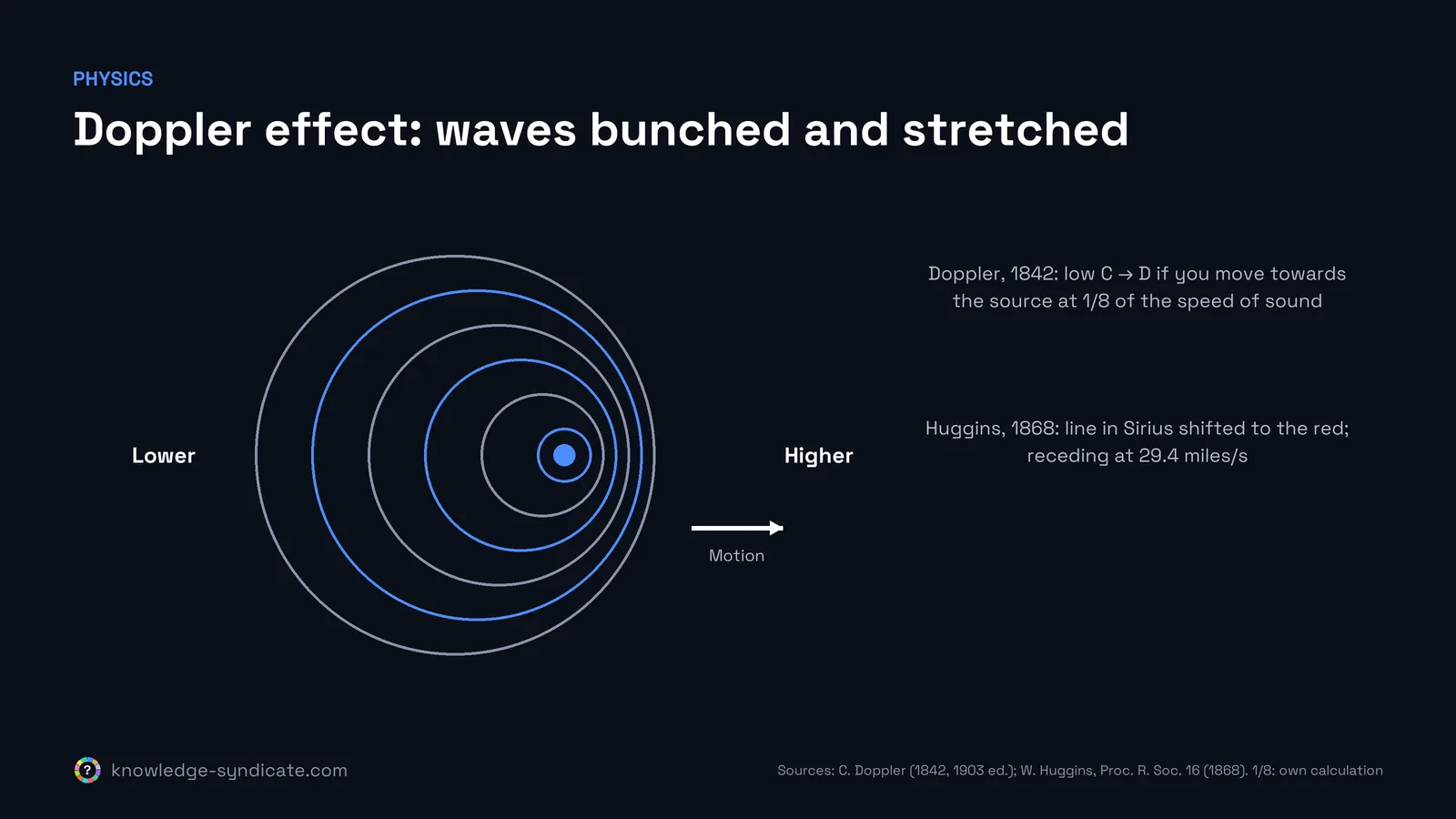
You’re on the pavement, an ambulance goes by and the siren does that familiar thing: high while it’s coming, lower as soon as it has passed. Nobody has touched the siren, which sounds the same the whole time. What changes is what reaches your ear. That’s the Doppler effect, and its story starts with a mathematics professor in Prague who wanted to explain something quite different: why some stars look coloured.
What the Doppler effect is, according to its author
In 1903 the Royal Bohemian Society of Sciences reprinted the original paper word for word to mark its author’s centenary. According to the preface of that edition, Christian Doppler was professor of mathematics and practical geometry at the Prague polytechnic, and the text had been published 60 years earlier in the society’s proceedings. The heading says it was read at the natural sciences session of 25 May 1842.
The preface also recalls that Doppler had to fight for his idea, and cites as an example Professor Petzval, who argued for a “principle of conservation of the period of vibration”. The title already announces the goal: On the coloured light of double stars and some other heavenly bodies.
Doppler sets up the idea with a question. While the observer and the source of the waves stay still, what is perceived matches what is emitted. But what if one of them, or both, moves, approaching or receding at a speed comparable to that of the waves? Doppler doubts the reader would dare say nothing changes without thinking about it first.
A ship against the waves
To convince you, Doppler turns to common experience. A ship sailing straight into the waves takes, in the same time, more wave strikes, and harder ones, than a ship lying still or moving along with the waves. And he asks: if that happens with water waves, why shouldn’t it happen, with the necessary adjustments, with waves in air and waves of light?
By his reasoning, the time between two wave strikes gets shorter if the observer runs towards the incoming wave, and longer if the observer runs away from it. With the source moving, something similar happens in the same sense.
Doppler sets up some simple formulas and, before turning to light, tries them on sound. In doing so, he writes, he hopes to do acoustics a small service.
It matters who moves
His formulas reveal a subtle point. Even under equal circumstances, it is not the same whether the observer moves or the source does. Doppler illustrates it with extreme cases. If the observer moves away from the source at the speed of sound, the waves never catch up and, for that observer, there is no sound. If the source is the one moving away at that speed, the observer hears the same note an octave lower. And if the source approaches at the speed of sound, all the waves arrive at once, which would amount to an infinitely high note that could no longer be heard.
My own reading, which is reasoning from those cases: Doppler was describing, in his own way, what happens when something moves as fast as the sound it makes.
How fast you’d have to go to go out of tune
Doppler runs numbers for sound. He takes the speed of sound as 1,024 Paris feet per second. To hear a low C as a D, he calculates that the observer would have to move towards the source at 128 feet per second. For a trained ear to notice a quarter tone, about 17 feet per second would do. And if source and observer both move, each approaching the other, 8 feet per second at most each could already make a small change noticeable.
My own calculation from his figures: 128 divided by 1,024 is one eighth. You’d have to move at an eighth of the speed of sound for a note to rise a whole tone.
The coloured-star mistake
Then Doppler turns to light, which was what he cared about. He takes the speed of light as 42,000 miles per second. If a white star approached or receded at about 33 miles per second, he calculates, it would already look noticeably green in the first case and orange in the second. And he proposes this as the explanation for the colours of some double stars, which orbit one another.
The calculation has its charm. Doppler starts from the idea that the coloured light we see in stars is mixed with a lot of white light, something he attributes to the younger Herschel, and that the eye notices colour differences once a hundredth of the red, yellow or blue rays is missing. Since yellow rays are the most abundant in white light, and they’re exactly the ones that shift towards blue or red, a small change is enough to tint the star. For a very strong colouring, on the other hand, he calculates about 187 miles per second.
My own calculation from Doppler’s figures: those 33 miles per second are roughly 1/1,270 of the speed of light. For a star to change colour noticeably, it would have to move very fast.
Huggins and the line in Sirius
The principle found its astronomical use another way. In April 1868 William Huggins sent the Royal Society a paper with a long title: further observations on the spectra of the Sun and of some stars and nebulae, with an attempt to determine whether these bodies are moving towards or away from the Earth.
In the published abstract, Huggins cites Doppler as the first to suggest that relative motion between the luminous object and the observer would change the wavelength of the light. He also mentions others who had written on the subject, among them Ballot, Fizeau and Secchi.
His method didn’t look at colour. It compared the position of the dark lines in a star’s spectrum with the bright lines of substances on Earth. If the star is moving, those lines don’t quite line up.
With a new spectroscope of great dispersive power, he compared a line in Sirius with a hydrogen line. He found the star’s line shifted towards the red by 0.109 millionths of a millimetre. That indicated Earth and star were separating at 41.4 miles per second. Since Earth’s motion in that direction accounted for about 12, there remained 29.4 miles per second that, according to Huggins, could be attributed to Sirius.
What Doppler couldn’t see
My own calculation from Huggins’s figures: 29.4 miles per second, with the speed of light he uses, 185,000 miles per second, is roughly 1/6,300 of the speed of light. About five times less than the minimum Doppler calculated for a colour change to show. At those speeds a star doesn’t change colour to the eye. But a specific line in its spectrum does move, and a good spectroscope picks it up.
Huggins also reports that he had examined the spectra of about seventy nebulae, and that roughly a third gave a spectrum of bright lines. He re-examined some with the new spectroscope to see whether they were moving, among them the Great Nebula in Orion, and compared their lines with those of hydrogen and nitrogen.
The siren on the corner
My own reading, which is reasoning from the sources: the Doppler effect is one of those ideas born to solve one problem that ends up serving another. Doppler wanted to colour in stars, and what he left behind was a way to measure speeds at a distance. The ambulance proves it on every corner. As it comes, the siren’s waves crowd together and it sounds high. As it goes, they stretch out and it sounds low. And the siren, all the while, keeps playing the same note.
What’s left
My own reading, which is reasoning from the texts: Doppler’s stroke of genius was to ask whether what we perceive depends on how we move. His mistake was thinking a look at the colour would be enough. It took a spectroscope for the idea to work with stars. And next time an ambulance goes by, you’ll know what is happening to its sound between the siren and your ear.