Why do things look darker when wet? The light gets trapped
Spill a little water on a gray T-shirt and you get a dark patch in the exact shape of the accident. Nothing colored went in. So why do things look darker when wet? The short answer is that water sets a trap for light. The long answer starts more than a century ago with a scientist pointing an instrument at the ground, runs through two rival theories, and ends, for now, in a lab in Miami where carefully measured sand refused to agree with either of them.
Light that gets in and can’t get out
You see an object because light leaves it and reaches you. A pale shirt looks pale because it sends back much of the light that hits it. A dark one keeps it. So the real question is why the same fabric keeps more light when it’s wet.
Fabric, sand and a classroom blackboard share one feature: they’re rough. A smooth surface such as a mirror sends light off in one direction. A rough one sprays it all over the place, because every tiny facet points somewhere different.
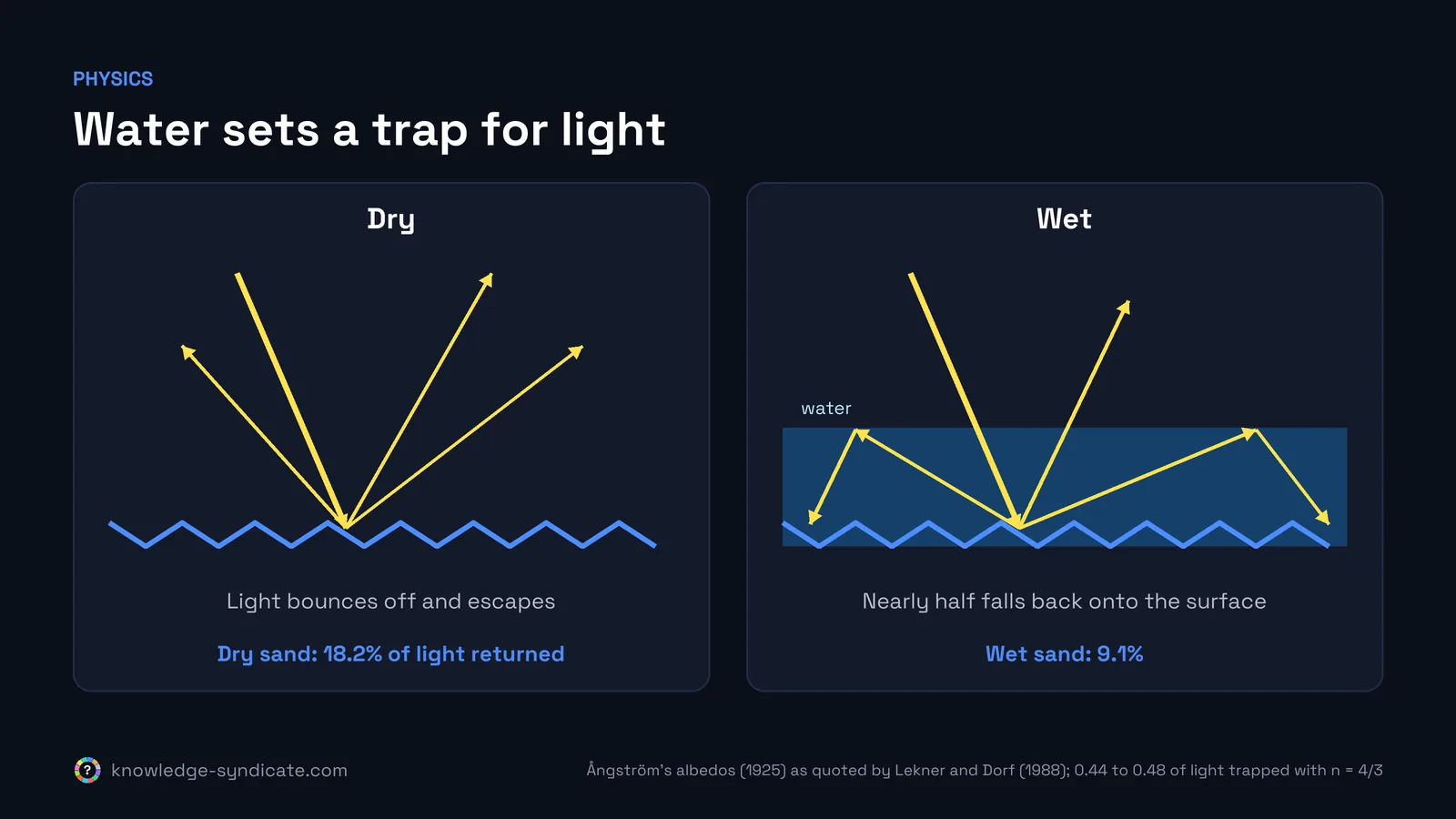
Now cover that rough surface with a thin layer of water. Light passes through the water, hits the surface, some is absorbed and the rest scatters in all directions. Part of that scattered light heads up at such a shallow angle that, when it reaches the boundary between water and air, it can’t get out. It reflects completely back down onto the surface. That’s total internal reflection, and each time the light comes back the surface gets another shot at absorbing it.
That’s the explanation John Lekner and Michael Dorf of Victoria University of Wellington, New Zealand, laid out in 1988 in Applied Optics, in a paper whose title gets straight to the point: “Why some things are darker when wet.” They built on a model Ångström had published in 1925 and sharpened it.
Why do things look darker when wet? Almost half the light is stuck
The trap can be measured. Light going from water into air stays inside if it arrives at a steeper slant than the critical angle. With a refractive index of 4/3 for water, the value Lekner and Dorf use, that angle works out to about 48.6 degrees from the vertical. Anything leaning further over than that bounces back in.
Ångström worked out what share of the light leaving an ideal rough surface falls outside that escape cone. His formula is one minus one over the index squared, which for water gives 0.437. In other words, of the light scattered by a wet surface, nearly 44% is sent back down instead of escaping. Lekner and Dorf did the sum more carefully, allowing for the small reflection that even steeply rising light suffers at the boundary, and got 0.475. Close to half.
The trapped light doesn’t simply vanish. It hits the surface again, part is absorbed, part bounces, some of that is trapped again, and so on. In the paper this back-and-forth becomes an infinite series of smaller and smaller bounces. Add it up and the wet surface absorbs a good deal more than it would dry.
There’s a quieter second effect. When light crosses from air into a solid, some of it reflects at the boundary, and the more the two media differ optically, the more reflects. Water is closer to a mineral or a fiber than air is, so a wet surface reflects less on first contact and lets more light in, where it can be absorbed. Lekner and Dorf estimated that for weakly absorbing materials with refractive indices between 1.5 and 2.5, which they say covers most minerals, absorption on that first hit rises by 7% to 10% when wet.
Beach sand, measured in 1925
The number that puts all this in scale is old. Ångström measured albedo, the share of light the ground sends back, with a pyranometer: first pointing it at the sky, then at the ground, then dividing one reading by the other. Lekner and Dorf quote his results. Dry sand returned 18.2% of the light. Wet, 9.1%. Exactly half. A black soil went from 14.1% to 8.4%, a drop of about four tenths.
The paler sand lost proportionally more than the dark soil, and that fits another finding in the 1988 paper: darkening is strongest when the material absorbs weakly. If a surface already swallows most light on the first hit, extra chances change little. If it’s pale and sends a lot back, every extra bounce the water hands it counts. That’s why a splash shows up so loudly on a light gray shirt and much less on a black one.
The rival theory: light that goes deeper
Here’s where it gets complicated, and it’s the part that usually goes untold. Ångström’s trap has a competitor. In 1986, Twomey, Craig Bohren and Mergenthaler published another explanation in the same journal, aimed at materials made of grains, such as sand and soil.
Their idea plays out inside the material. In dry sand, there’s air between the grains, and each time light passes from grain to air it bends and bounces a lot, because the contrast is large. Much of the light turns around early and comes out without going deep. Fill the gaps with water and the contrast drops, so light is deflected less and keeps heading forward. As Hao Zhang and Kenneth Voss of the University of Miami later summarized it, this lets light penetrate farther into the sediment and raises the chance that it’s absorbed before it can get out.
Both theories end up at darker, by different roads. One puts the trap at the water’s surface, the other inside the material. Lekner and Dorf called it surprising that two such different models both fit the data, adding in brackets that the data were very limited. They suggested a sensible split: Ångström’s trap for rough solid surfaces like blackboards, asphalt and concrete, Twomey’s for finely divided media like sand. Clothing fabric, they wrote, is an intermediate case, and they closed by calling for more experimental and theoretical work on this everyday phenomenon.
Bahamas sand, crushed glass and an eyedropper
That work arrived in 2006. Zhang and Voss, funded by the US Office of Naval Research’s ocean optics program, measured how layers of grains returned light when dry, wet and fully submerged. Their instrument lit each sample from eight angles and recorded the reflected light in 107 directions at once.
The samples were a motley crew: ooid sand from the Bahamas, made of round, smooth, lustrous grains; broken shell fragments; black volcanic sand from Hawaii; sand from two Miami beaches; soil from the university’s own arboretum; black silica sand of the kind used in cigarette urns; and crushed microscope slides, a glass that barely absorbs light at all. The wetting method was kitchen-grade: water from an eyedropper, starting at the edge, until air bubbles stopped coming out.
The first result runs against everyday experience. Some samples hardly looked darker when wet, the ooid sand above all, even though the instrument picked up changes in how the light was spread out. And when they wet it with glycerin, a liquid with a refractive index of 1.47, higher than water’s, Twomey’s theory said it should darken further. To the naked eye, it didn’t darken noticeably.
Glass that brightens dry and darkens wet
The second result is the elegant one. Zhang and Voss mixed the ooid sand with increasing amounts of crushed glass. Dry, the more glass, the brighter the mixture. Wet, the more glass, the darker. The same ingredient pushed in opposite directions depending on whether air or water filled the gaps.
It makes sense in light of the rest. Glass is transparent. Dry, light keeps bouncing off the faces of the fragments, because the glass-air contrast is large, and much of it heads back out, so the mix looks bright. Surrounded by water, the contrast collapses, light carries on downward and gets lost in the depths or in grains that do absorb. The authors concluded that the share of translucent grains accounts for a large part of the darkening. Grain roughness matters too: strongly absorbing grains with rough surfaces tend to darken more when wet.
To separate the mechanisms, they compared wet samples with the same samples under a thick layer of water. They found fingerprints of both theories. In some cases light came out more forward and less backward, the signature of Twomey’s model. And the difference between wet and submerged showed that the air-water boundary matters too, which is Ångström’s piece. Their verdict, in the abstract: neither the prediction of Twomey and colleagues nor that of Lekner and Dorf is sufficient.
They also pointed to a practical use. If a grainy surface changes a lot in brightness between dry and wet, it probably contains translucent particles such as quartz sand. For remote sensing, water turns from a nuisance into a clue.
A headache for industrial dyers
If physicists argue about sand, fabric, that intermediate case of rough fibers with gaps full of air or water, is harder still. For the textile industry, this gets measured in money.
Warren Jasper, of the Department of Textile Engineering, Chemistry and Science at North Carolina State University, set it out in a 2025 paper in the journal Fibers, written with Samuel Jasper. Most dyeing happens while the fabric is wet, since water is the solvent that carries dye into the fiber. But color is matched against the target with the fabric dry. In continuous dyeing, fabric runs through the machine at 50 to 250 meters per minute, and that method accounts for about 60% of all dyed fabric. If the shade drifts and nobody notices in time, hundreds of meters can be wasted.
The striking line is how they justify the work: there has been no reliable model or theory that predicts the final shade of a dry fabric from its wet state. Classic color theories have been tried and don’t settle it. So they went for brute force: they dyed cotton, measured it wet and dry, and trained several machine-learning models to learn the relationship without understanding it.
The best, a neural network, predicted the dry color to within one color-difference unit 63.9% of the time. That unit is the practical limit of what a normal eye can tell apart: below 1, two colors are hard to distinguish. Put another way, the machine guesses right nearly two times out of three, and getting there meant giving up on explaining the effect with equations.
What happens in your T-shirt
Put the pieces together and the dark patch on your shirt has a fairly complete explanation, if not a closed one. Water works its way between the fibers and replaces the air. Light bounces less off each fiber and goes in further. Whatever scatters back up from the fabric hits the water-air boundary, and nearly half is turned back down. Each return trip is another chance for dye and fiber to keep the light. Less reaches your eye, and your brain reads it as a darker color.
When the shirt dries, air moves back into the gaps, the trap disappears and the usual color returns. The only thing that changed was the route the light took.
And if you’ve ever wondered why the sand at the waterline looks dark exactly where the wave reaches, it’s the same answer, with a twist the Miami team measured grain by grain: the more translucent quartz in that sand, the bigger the jump between dry and wet. Ångström saw it with a pyranometer in 1925, half the light gone. In 2006, eighty-one years later, the question of which trap matters more still had no winner.