Whale ancestors: how we know they walked on land
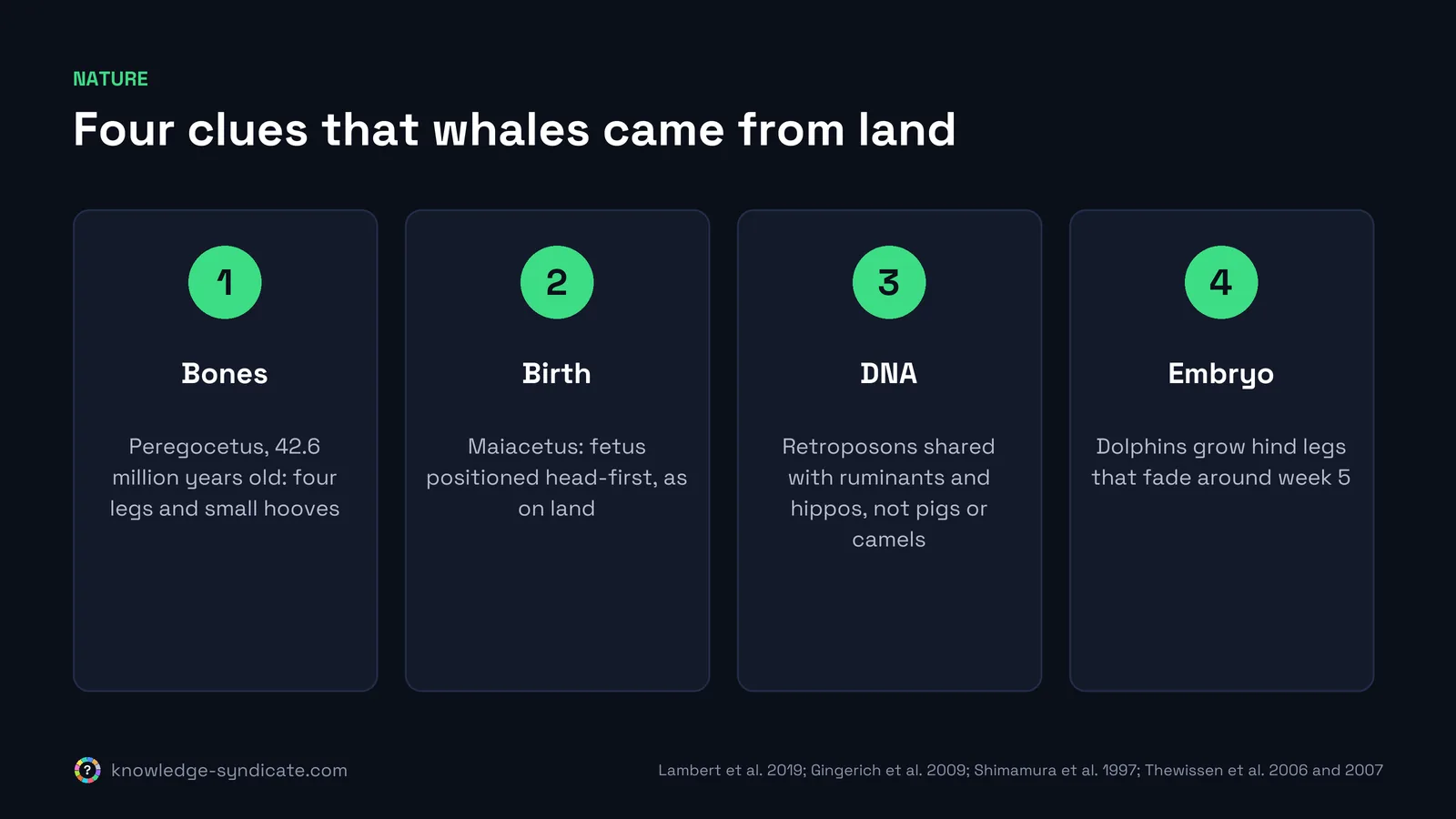
A blue whale has no legs. Neither does a dolphin. And yet, look at one of those dolphins when it’s an embryo just a few weeks old and you’ll see two small bumps on its sides that are on their way to becoming hind legs and never get there. It’s the most intimate reminder that whale ancestors walked on land. It isn’t the only one. There are bones, there’s DNA, and there’s a fossil that was, quite literally, about to give birth.
Whale ancestors with hooves
Start with the hardest evidence: bones. In 2019, a team led by Lambert described in Current Biology a fossil whale found in marine sediments on the coast of Peru, 42.6 million years old. They named it Peregocetus pacificus.
What made it remarkable was how much survived: the jaws and most of the skeleton below the skull. It had four legs, with proportions similar to those of older whales from India and Pakistan. The pelvis was firmly attached to the sacrum, the part of the spine the hips rest on. The thighbone had a pit where a round ligament anchored. And its fingers and toes still carried small hooves with flat tips.
For the authors, all of that means it could stand and even walk on land. At the same time, its tail vertebrae had side projections like those of beavers and otters, suggesting the tail did a lot of work in swimming. It was an animal of two worlds. According to the same paper, it’s the first indisputable record of a four-legged whale in the Pacific Ocean and in the Southern Hemisphere.
A whale born head-first
The second fossil has an even more surprising story. In 2009, Gingerich and colleagues described in PLoS One two adult skeletons of Maiacetus inuus, a whale about 2.6 meters long found in Pakistan. It belonged to the protocetids, a group of predators from 49 to 37 million years ago that turn up in marine rocks but still had four legs.
One skeleton was a female. Inside it lay the skull and part of the skeleton of a single large fetus, close to full term. What caught the eye was its position: it was lined up to be born head-first. According to the authors, head-first delivery is typical of land mammals, not of living whales. Their conclusion: these whales gave birth on land.
The fetus also had well-mineralized permanent first molars, a sign that calves were born fairly mature, which at the boundary between land and sea could make the difference between surviving and not. The other skeleton, a male, is the most complete protocetid known, with all four legs, hands and feet included. It was 12% bigger than the female in linear dimensions and had canines 20% larger. The authors themselves compare specimens this complete to Rosetta stones. The male’s backbone was preserved in articulation: 7 vertebrae in the neck, 13 in the chest, 6 lumbar, 4 sacral and 21 in the tail. The moderate size gap between the sexes told them something else too. According to the authors, it points to little competition among males for mates, which in turn suggests an environment without big concentrations of food or shelter.
The whale’s cousin was a wading animal
The fossils show what the first whales looked like. But a question remained: what animal did they come from? In 2007, Thewissen and colleagues published the most concrete answer yet in Nature. Whales were known to be related to artiodactyls, the even-toed hoofed mammals such as cows, camels and pigs. What was missing was a fossil artiodactyl that looked like the early whales.
They found it in a group of small animals from Eocene south Asia, the raoellids. One of them, Indohyus, resembles whales, and not other artiodactyls, in the structure of its ears, in its premolars, in the density of its limb bones and in the chemistry of its teeth. According to the authors, raoellids waded in water. In other words, aquatic life began before whales as such existed.
Lambert’s team sums up the starting point in a single line: cetaceans arose in south Asia more than 50 million years ago from a small four-legged artiodactyl. And in under ten million years, their four-legged descendants had crossed the South Atlantic and reached the coast of Peru. The same paper notes that amphibious whales had gradually spread west along North Africa and arrived in North America before 41.2 million years ago, but that the fossil evidence for when and how they reached the New World had been patchy and disputed.
The DNA that pointed to the hippo
The third line of evidence has no bones. In 1997, Shimamura and his team published a clever study in Nature. Over the course of evolution, certain short pieces of DNA, called retroposons, copy themselves and land in random places in the genome. When an insertion shows up in the same spot in two species, it’s almost certain they inherited it from a common ancestor.
The team found two families of these sequences present in the genomes of whales, ruminants and hippos, but not camels or pigs. They analyzed nine specific insertions. Their conclusion: whales, ruminants and hippos form a group with a common ancestor of their own. Put another way, a whale is more closely related to a cow or a hippo than a cow is to a pig.
The nice part is that fossils and genes reached the same family by independent routes. The genes say whales are artiodactyls. The Indohyus fossil puts a face on one of their closest cousins.
Legs that form and fade
That leaves the most intimate evidence, the embryo. In 2006, Thewissen, Cohn and other researchers published a study in PNAS using embryos of the pantropical spotted dolphin. Modern cetaceans have no hind limbs, but their embryos start to build them. In dolphins, the limb bud stops growing and breaks down around the fifth week of gestation.
The team went looking for why. In animals with legs, limb growth depends on two signaling centers. One, at the tip of the bud, does form in the dolphin, sends its signal at first and then shuts down. The other depends on a gene called Sonic hedgehog, and in the dolphin’s hind-limb bud that gene doesn’t show up at all. Neither does Hand2, the gene that normally switches it on.
Combining those data with the fossils, the authors propose a timeline. A reduction in Sonic hedgehog may have begun about 41 million years ago and removed the outer parts of the leg, and its total loss, around 34 million years ago, near the origin of the modern whale groups, may have erased almost everything else.
The part hardly anyone tells: they stopped using them first
Here’s the detail that flips the story. It might seem that a change in one gene made the legs vanish at a stroke and pushed whales into the sea. According to the 2006 study, it went the other way. Hind-limb size shrank bit by bit, through small, gradual changes. Long after the legs had stopped being any use for getting around, changes in the genes that control development removed most of the skeleton. The big genetic change came at the end, to finish the job.
The fossils match that sequence. According to the same paper, the earliest cetaceans, the pakicetids and ambulocetids, had big feet they used for swimming. Later groups drove themselves with the tail, and the hind limbs became rudiments once tail flukes appeared, in the dorudontids and basilosaurids. In most modern toothed whales, all that’s left of the leg is a hip bone. The authors add that otters and their relatives are good models for how whales swam at each stage, that losing the hind limbs made the body more streamlined, and that the pressure to lose them must have been strong once whales became, in the late Eocene, fluke-powered predators chasing down their prey.
A puzzle whose pieces fit
None of this evidence alone would be so convincing. Together, it tells the same story from four angles. A small artiodactyl that waded into water. Hoofed whales that came ashore to give birth. DNA that shares markers with hippos and cows. And embryos that still start building legs that evolution no longer finishes.
Next time you see a dolphin leap, remember that in its fifth week of life it had two bumps where its ancestors had legs. Its genome still gives it a go, every single time.