Why do zebras have stripes? Ask the horseflies
A horse in striped pyjamas looks like a joke. It’s actually a serious experiment, and it has helped answer a question that has been going round for more than a century. Why do zebras have stripes? There is a favourite answer, and it isn’t the obvious one. They aren’t camouflage. They don’t dazzle lions. The useful clue came from insects that reach a zebra and can’t work out where to land.
Three species and a puzzle
There are three species of zebra: the plains zebra, Equus quagga, Grévy’s zebra, Equus grevyi, and the mountain zebra, Equus zebra. That’s how a 2025 review by H. M. Ireland and G. D. Ruxton in Biological Reviews lists them.
A 2022 paper by Kaia J. Tombak and colleagues in Scientific Reports explains why the question is so odd. The trait is rare, conspicuous and intense, so it seems to beg for an explanation. Males and females are striped with similar intensity, which makes it unlikely the stripes arose through sexual selection alone, although in plains zebras the males’ stripes are closer to true black than the females’. Nor are they a warning signal, and they don’t provide camouflage in either the woodland or the savannah where zebras live.
Four suspects
A 2020 study by Martin J. How and colleagues in Proceedings of the Royal Society B groups the explanations put forward over the last 150 years into four themes.
The first is camouflage against predators. According to that paper, it was dropped because large carnivores can only make out the stripes very close up, and because experiments show the stripes are highly conspicuous to human observers.
The second is confusing a predator during a chase. According to How, observations of fleeing plains zebras don’t back this up: the way they run doesn’t make them less predictable or blur their outline, and lions don’t misdirect their attacks. The hardest fact: across 40 study sites in Africa, lions kill more zebras than their numbers would predict.
The third is heat. The idea is that black and white bands warm up differently and set up air currents that cool the animal. According to the same study, it could only work along the back, not on the flanks or legs, and wind or movement would cancel it. Experimental tests also find no cooling benefit for striped objects or pelts.
The fourth is biting flies. Here there is evidence: according to How, stripes reduce fly landings in experiments with artificial targets, horse models, people, painted cows, and comparisons between live zebras and domestic horses.
Why do zebras have stripes? The flies’ view
Tombak and colleagues sum up the fly problem. Zebras, like most hoofed mammals, are harassed by horseflies, tsetse flies and stable flies, which can cause significant blood loss, spread disease and weaken an animal when swatting them cuts into feeding time. Yet zebras are attacked far less than other hoofed animals living alongside them, and less than other members of the horse family.
The Ireland and Ruxton review adds a caveat about disease. Several of the infections these flies carry do little harm to zebras, which mostly act as reservoirs, and are serious for domestic animals. So the benefit may lie more in blood and grazing time than in infection, a point the authors leave open.
Horses in pyjamas
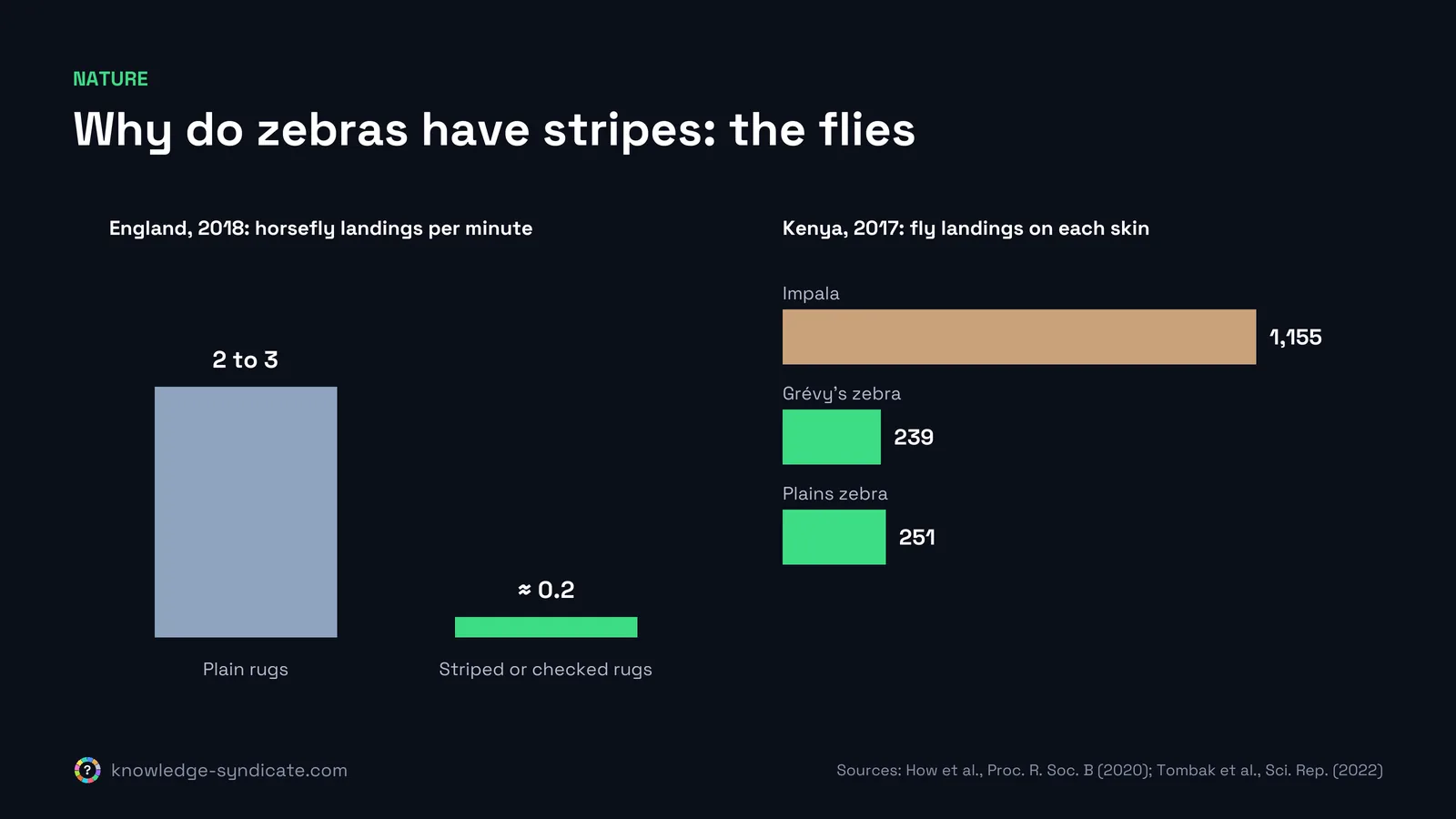
From 13 to 20 June 2018, How’s team put printed rugs on 22 horses at a livery yard in Dundry, North Somerset, England. There were five designs: plain black, plain grey, vertical stripes 3.5 centimetres wide, horizontal stripes and a checkerboard. Each rug stayed on each horse for 20 minutes. One person counted the horseflies landing on one side, while another filmed the other side with two cameras to rebuild each insect’s flight in three dimensions.
The result was clear-cut. On the black and grey rugs, an average of 2 to 3 horseflies landed per minute. On the patterned ones, about 0.2. There was no difference among the three patterns. And the footage showed why: near the striped or checked rugs, the flies flew faster and didn’t get as close. Fewer of them came within 30 centimetres.
Stripes that don’t have to be stripes
That checkerboard mattered. A popular explanation held that parallel stripes trick the system insects use to slow down for landing, because a moving straight edge gives false motion cues. If so, checks shouldn’t work as well. They did. The study counts that as a refutation of that particular idea.
How and colleagues also recall earlier work of theirs: horseflies approached horses in striped rugs as often as horses in plain ones, but landed far less, and near zebras they didn’t slow down the way they did near horses. Some, they report, bumped into the coat or flew straight past.
Skins in a box
It still had to be tested with real hide. From 20 to 22 July 2017, Tombak’s team worked at the Mpala Research Centre in Laikipia County, Kenya. They took pieces of about 400 square centimetres of skin from a plains zebra, a Grévy’s zebra and an impala, all three found dead in the field. They cleaned them, salted them and dried them in the sun.
The flies were stable flies of the genus Stomoxys, caught with a bait of fresh camel urine and milk. They spent the night without food so they would arrive hungry. Then they were released into a Plexiglas box 120 by 30 by 30 centimetres, with a skin at each end. Trials ran in the morning, from 8:30 to 10:00, and in the afternoon, from 15:00 to 16:30, the hours when these flies are active. Researchers from an insect research institute were on site to confirm the flies really were Stomoxys.
They preferred the impala by a mile. Flies landed on the impala skin 1,155 times; on the zebra skins, about 240 times each, roughly a quarter. And when they did land on a zebra, 75.4 per cent of the time it was on a black stripe. Between the two zebras, one with broad stripes and one with narrow, there was no preference. Since the box was short, the authors conclude that stripes repel flies at close range, so several mechanisms proposed to work at a distance aren’t needed.
Contrast and dark patches
In 2023 Tim Caro and his team, with How among the authors, published another round of rugs in the Journal of Experimental Biology, this time eleven designs with the same average brightness. On the plain grey rug, horseflies landed 13 times more often than on a regular checkerboard, and 4 times more than on an irregular one.
Then they tested stripes of different contrast, up to a value of 0.86, the one that best mimicked a zebra. For every hundredth of extra contrast, landings fell by about 1.2 per cent. They found no evidence that polarised light mattered. Their working hypothesis: zebra stripes are thin and sharply edged because that removes large, uniform dark patches, which strongly attract horseflies at short range.
My own reading, which is reasoning from that study and the Kenyan one: it fits with flies almost always choosing the black stripe when they finally land on a zebra. They’re looking for dark, and a zebra only offers narrow strips of it.
What is still unexplained
The 2025 review by Ireland and Ruxton puts things in proportion. Fly deterrence is the theory with the strongest empirical support. But on its own it struggles to explain why striping is so strong in zebras and not in other African mammals, and how the stripes are spread over the body.
The authors go through the other ideas of the last decade: air movement that cools, three anti-predator versions, and one about signals between species that draw other grazers into protective mixed herds. That last one, they say, would explain some of the gaps, but nobody has tested it.
Tombak and colleagues leave a question too. Since the flies didn’t tell broad stripes from narrow ones, the variation in stripe width between species must be down to pressures other than flies.
The short answer
Why do zebras have stripes? For now, the answer with data behind it is: so that biting flies don’t land. It was shown by English horses in rugs, Kenyan skins in a box and thousands of landings counted by hand. Exactly how stripes fool a fly, and why only zebras ended up with them, is still up in the air.