Tardigrades: how they survive dried out, frozen and in a vacuum
Put a scrap of dry moss under the microscope, add water and wait. With luck, something that looked like a speck of dust will stretch out eight tiny legs and start walking. It will be a tardigrade that had been dry for who knows how long. Tardigrades have a reputation for being nearly indestructible, and it’s worth separating the exaggerated from the measured. What has been measured is striking enough to need no embellishment.
Eight legs and a nickname
A 2026 review by M. Kamilari and colleagues in Molecular Ecology describes them as microscopic, eight-legged aquatic organisms, also known as water bears or moss piglets. According to the review, some live on the sea floor and in tidal zones, and others in freshwater and land habitats such as mosses and lichens.
The review lists their resilience: they withstand near-complete desiccation, severe levels of radiation, the vacuum of space and extremely low temperatures. And it adds a caveat: marine tardigrades are thought to be far less tolerant than those living in changeable places like tidal zones, mosses and lichens, though little is known about them.
The 2013 paper by Halberg and colleagues, which comes up later, calls them microscopic ecdysozoans, well known for enduring hostile conditions such as complete desiccation.
Tardigrades on pause
Everything revolves around cryptobiosis. According to the Kamilari review, it is a state of metabolic arrest that lets them survive otherwise lethal conditions until better ones return. It comes in variants depending on the trigger: anhydrobiosis, from drying out; cryobiosis, from freezing; osmobiosis, from high osmotic pressure; and chemobiosis, from environmental toxicants.
A 2023 paper by M. Roszkowska and colleagues in PLOS ONE defines anhydrobiosis as the ability to survive almost complete loss of body water without damage. It notes that tardigrades, roundworms and rotifers are the animals that do it best, at any stage of their lives.
Cryptobiosis isn’t limited to animals. According to the same paper, it has been seen in bacteria and protists, in lichens, liverworts and vascular plants, and in some invertebrates. In most multicellular organisms it appears at particular stages of development and rarely in adults. Entering anhydrobiosis, it adds, is a costly strategy: it requires energy stored in special reserve cells.
The tun
To enter cryptobiosis, tardigrades form what’s called a tun. According to Halberg and colleagues, that state marks the entry into anhydrobiosis in both tardigrades and rotifers. According to the review, they contract their bodies sharply and pull in their heads and legs. When water returns, the tun soaks it up, the body stretches out and the animal becomes active again.
The Roszkowska paper divides the process into three stages: dehydration; the tun, which is the fully dried animal; and rehydration, when water becomes available again.
Drying out takes muscle
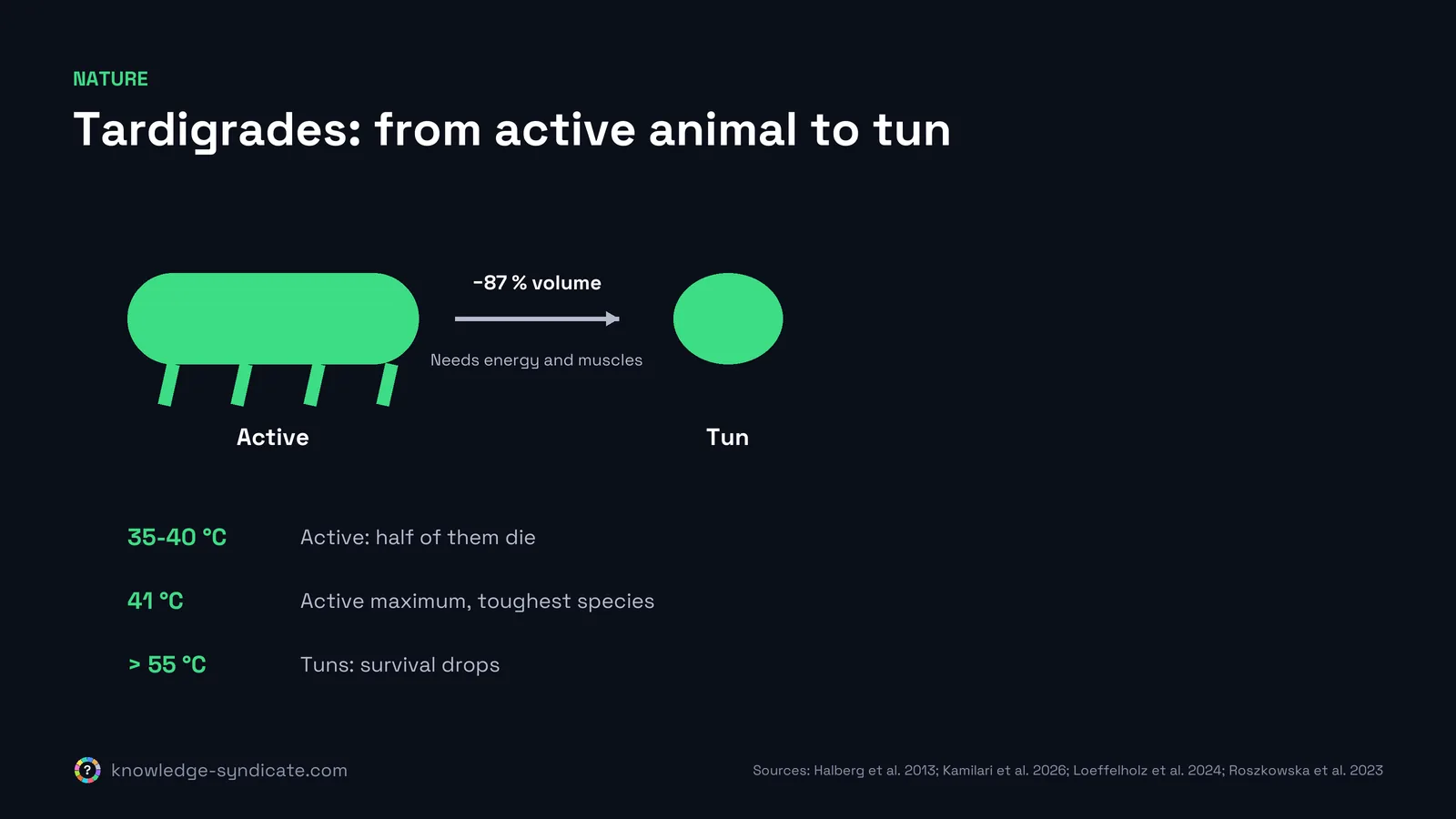
A 2013 study by K. A. Halberg and colleagues, also in PLOS ONE, asked whether the tun is something the tardigrade actively makes or simply what happens to it as it dries. According to the authors, nobody had clearly settled whether that reorganisation was a regulated event or a passive side effect of losing water. They measured the body volume of the species Richtersius coronifer and found it shrank by 87 per cent from the active state to the tun.
Then they tried drugs. Blocking energy production by the mitochondria meant the tardigrades didn’t survive drying out. Uncoupling the mitochondria stopped them forming a tun at all. And inhibiting the muscles left them unable to form viable tuns. To see this, they combined confocal microscopy, 3D reconstructions and scanning electron microscopy. Their conclusion: the musculature drives a body reorganisation that is vital for survival, and keeping the structure intact is necessary for coming back to life.
My own reading, which is reasoning from that study: drying out properly is work for a tardigrade. It needs energy and muscles to fold itself the right way before it goes still.
How long can they stay dry?
According to the Kamilari review, the tun lets dried tardigrades suspend their metabolism and keep their structure intact for decades before coming back to life in water. The Roszkowska paper gives more concrete figures from the literature. Most studies test short periods, from hours to three days, with high survival, 80 to 90 per cent. In one long-term experiment, tardigrades dried inside lichen samples were checked 20 times over 1,604 days, more than four years, and their survival fell over time. Another study cited by Roszkowska put one species through dozens of cycles of rehydration and seven-day drying, and the animals survived them.
Roszkowska’s own study compared four species from different genera, with different diets and habitats: Echiniscus testudo, Paramacrobiotus experimentalis, Pseudohexapodibius degenerans and Macrobiotus pseudohufelandi. For Echiniscus testudo it also compared two populations, one urban and one from a natural habitat. It found clear differences between species that seemed to depend more on habitat than on diet. And it found that the longer anhydrobiosis lasts, the more time the animals need to become active again.
The study used 490 individuals of each species or population in total and measured seven parameters, from how many formed a proper tun to how many never fully recovered their activity.
The heat myth
This is where to slow down. The Kamilari review is blunt: even the most tolerant tardigrades are very sensitive to high temperatures, and active ones have 50 per cent mortality between 35 and 40 °C.
A 2024 study by J. Loeffelholz and colleagues in Biology Open compared six species. The authors note that earlier reports of heat tolerance had almost always used a single species, and that drying and heating methods varied from one study to another, which made comparisons shaky. Each test used three groups of ten animals, and survival was checked one hour and three days after heating. They heated active tardigrades from about 21 °C to final temperatures of 34 to 47 °C over 45 minutes. The toughest species, Viridiscus viridianus, survived active up to 41 °C, but only as a brief stress. And they confirmed that dried tardigrades tolerate more heat. They also found that species differ from one another in heat tolerance, both when active and when dry. They also found that in that species mild prior heating didn’t protect against stronger heating, unlike what happens with drying in some species. Their conclusion: surviving high temperatures in the dry state is a by-product of the ability to survive desiccation.
Roszkowska cites another figure: in tuns of Ramazzottius varieornatus, survival dropped drastically if they were kept above 55 °C.
Protective molecules
What protects them on the inside? According to the Kamilari review, the genes linked to their resilience encode proteins for antioxidant defence, DNA protection and repair, protein folding and preserving structure, from molecules up to the whole animal. The review highlights filament-forming proteins that probably help sustain the tun. The authors also contribute a new gene-expression dataset for Echiniscus testudo, the same species Roszkowska tested in two populations, and review which species already have their genome or transcripts read.
A 2022 study by K. Nguyen and colleagues in Communications Biology found a curious piece. Many drought-tolerant organisms pile up large amounts of trehalose, a sugar, to protect themselves when drying. Tardigrades accumulate little or none. Even so, trehalose turned out to be a main marker of their hydration state, and in its natural proportions it works together with tardigrade-specific proteins called CAHS, multiplying the protection.
Not all the same
The review flags something important. In one particular species, some eye-catching genes were described, such as one called Dsup, short for damage suppressor, and they drew a lot of attention. But in a 2019 study the review’s own authors found no transcripts of several of those genes in another tardigrade species. According to the review, the mechanisms are now studied across the whole group, because not all tardigrades use the same tools.
What’s left
My own reading, which is reasoning from the sources: tardigrades have very clear limits. When active, they die in heat a person can bear in summer. What makes them special is knowing when to stop, folding up properly and waiting. While dry and still, they wait for things to improve. And when water returns, they stretch out and keep walking.