How did Latin sound? The clues Romans left by accident
Nobody has heard Cicero. Or Caesar, or a shopkeeper in Pompeii. The earliest surviving sound recordings are traces on smoked paper from the mid-nineteenth century. Even so, specialists talk with real confidence about how Latin sounded. So how did Latin sound, and where do they get the sound of a language nobody has heard? From clues the Romans left by accident: jokes, complaints, spelling mistakes and superstitions. And the most charming one starts with a fig seller.
A cry in the harbor at Brindisi
In his treatise On Divination, Cicero mocks people who see omens in any phrase said by chance. He gives a famous example. When Marcus Crassus was embarking his army at Brindisi, on a campaign he wouldn’t come back from, a man selling figs from Caunus at the harbor kept shouting: “Cauneas, cauneas,” that is, Caunian figs.
Cicero suggests, tongue in cheek, taking it as a warning. According to the Loeb translation on LacusCurtius, the cry could be heard as cave ne eas, “beware of going.” Had Crassus heeded the omen, Cicero says, he wouldn’t have died. And he adds that if we’re going to take remarks like that seriously, we’d better watch out every time we stumble, break a shoelace or sneeze.
What Cicero found a silly superstition is gold for linguists. For the joke to work, cauneas and cave ne eas had to sound almost the same. The translator’s note says so: that identity of sound between cavneas, meaning cave ne eas, and cauneas has been the subject of discussion in Latin phonetics. The pun suggests the v in cave sounded very much like the u in cauneas, and that the e in cave, followed by ne, was probably mostly swallowed in quick speech.
Cicero gives in to the street
Cicero is also the best witness that Latin wasn’t a frozen language. In the Orator, a treatise on how the ideal speaker should talk, he describes a small personal defeat. He knew the old Romans only used aspiration, the sound of h, next to vowels. So for a while he insisted on saying pulcros, Cetegos, triumpos and Cartaginem, without the h that people on the street were already putting into pulcher, Cethegus, triumphus and Carthago.
It didn’t last. In his own words, in the end, and late, when the ears’ reproach wrung the truth from him, he granted the people their usage in speaking and kept the knowledge for himself. In other words, he pronounced like everyone else even though he knew the old Romans hadn’t. He adds that people still said sepulcra, coronas and lacrimas without aspiration, because the judgment of the ear allowed it, and that the poet Ennius always wrote Burrum and never Pyrrhum.
The same passage shows something writing hides: vowel length. Cicero explains that you say indoctus with a short first syllable and insanus with a long one, inhumanus short and infelix long. Words that start like sapiens and felix lengthen that first vowel. The same goes for con-: consuevit versus composuit. And he drops a line that sums up how the language worked: consult the rule and it will object; take it to the ear and the ear will approve.
What a teacher of rhetoric taught
Later on, Quintilian, who already spoke of Cicero’s time as another age, wrote a manual for training orators that starts with the basics: the letters. And he scatters sound clues all along the way. He warns that not every ear can tell the correct sound of letters, just as not every ear can tell musical notes apart. He says that in words such as seruus and uulgus one misses the Aeolic digamma, an old Greek letter, and that there’s a sound halfway between u and i, because optimum isn’t pronounced like opimum.
On k he’s blunt: it’s superfluous except in a few abbreviations, because c keeps its force in front of every vowel. That’s one of the most direct clues that c sounded the same before any vowel. He adds that in optinuit, logic calls for a b, but to the ear it sounds more like a p. And he says that in Cicero’s day almost everyone wrote a double s between long vowels, as in caussae, and that the autograph manuscripts of Cicero and Virgil prove it.
Arrius and the extra h’s
If, in Cicero’s time, adding fashionable h’s was correct, some people overdid it. Catullus aimed one of his sharpest poems, number 84, at a man called Arrius. Arrius said chommoda when he meant commoda, “advantages,” and hinsidias instead of insidias, “ambush.” And he thought he was speaking beautifully when he let rip a hinsidias with all the force he could.
Catullus piles on. That’s how his mother talked, he says, and his uncle, and his grandfather and grandmother on his mother’s side. When Arrius left for Syria, everyone’s ears got a rest and heard the same words gently and lightly. Until dreadful news arrived: the Ionian Sea, ever since Arrius had sailed across it, was no longer Ionios but Hionios.
For a linguist, Arrius is a lovely case of what’s called hypercorrection. If someone drops h’s in where they don’t belong to sound educated, that points to two things: the aspirated h carried prestige, and plenty of ordinary people no longer pronounced it.
An emperor who wrote as he spoke
Official spelling and real speech drifted apart, and even an emperor noticed. Suetonius, in his life of Augustus, says the emperor didn’t strictly follow orthography, that is, the grammarians’ theoretical spelling rules, and seemed to share the view of those who believe we should write exactly as we pronounce.
Suetonius adds a story that’s pure phonetic gold. Some people wrote that Augustus dismissed a governor of consular rank as an uncultured, ignorant fellow because he’d noticed the man had written ixi instead of ipsi. Suetonius is surprised that this was given as the reason and doesn’t explain the slip. But mixing up ps and x is exactly the kind of mistake made by someone who writes by ear, which is why such slips matter so much to anyone trying to rebuild a sound.
Suetonius also records that when Augustus wrote in cipher, he put B for A, C for B and so on, with AA for X. A detail that has nothing to do with pronunciation, but says a lot about the emperor’s interest in letters.
Cicero’s chickpea
Even names leave clues. Plutarch, who wrote in Greek, explains in his life of Cicero where the family nickname came from. Cicer, he says, is the Latin word for chickpea, and that ancestor had a faint dent at the tip of his nose like the cleft of a chickpea. When the young Cicero went into politics and his friends suggested changing the name, he replied that he’d make the name of Cicero more famous than those of Scaurus or Catulus.
Plutarch adds that as quaestor in Sicily, Cicero dedicated a piece of silver plate to the gods with his first two names, Marcus Tullius, and in place of the third, as a joke, had the craftsman engrave a chickpea. A signature with a picture. The joke only lands if everyone instantly connected the name with the sound of cicer.
How did Latin sound? What we can and can’t know
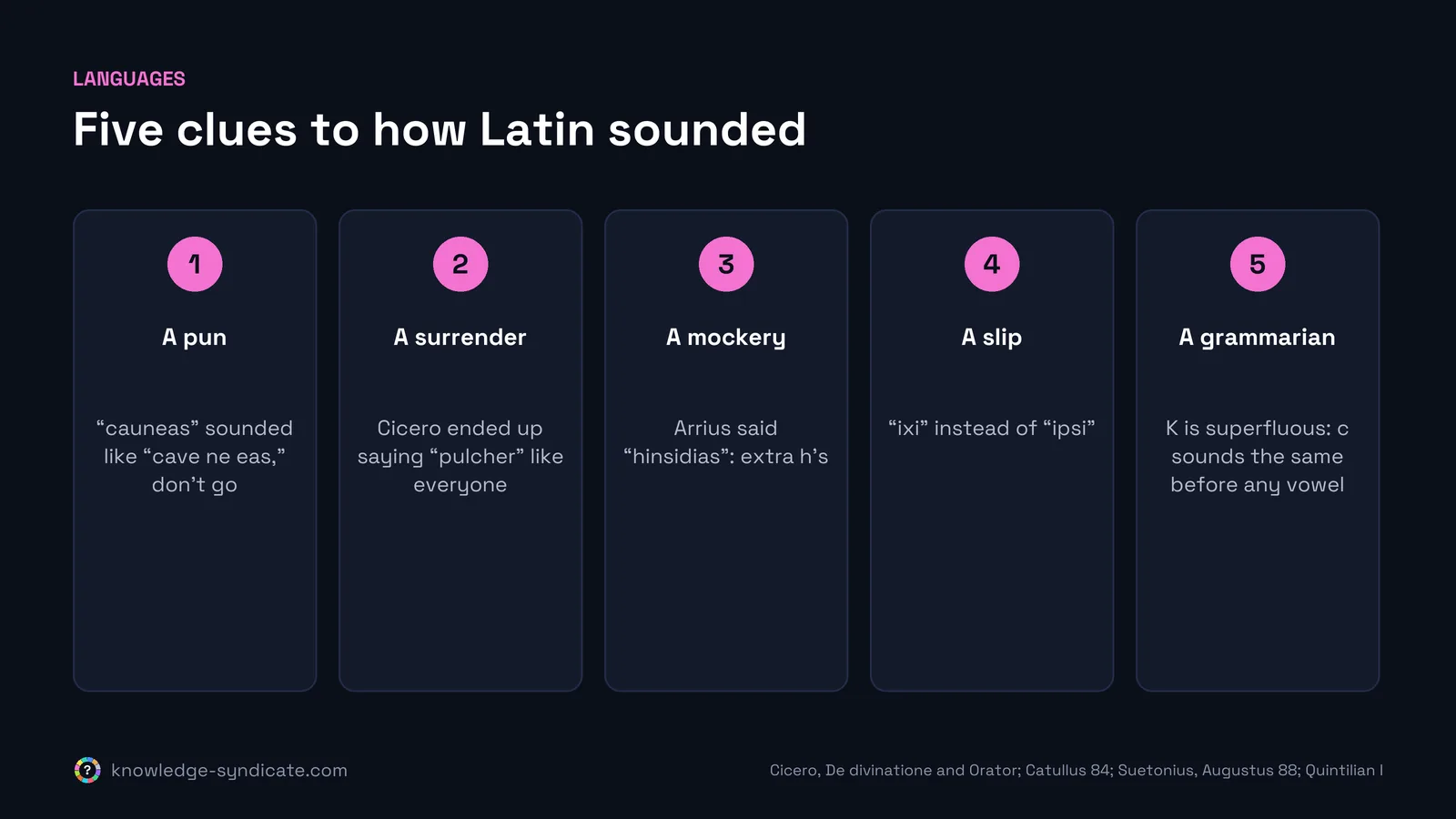
Put these pieces together and the sound of Latin looks like a police sketch. There’s no single decisive proof, just many small ones pointing the same way. A pun shows two sequences sounded almost alike. A complaint by Cicero shows that people’s ears beat the rulebook. A poem by Catullus gives away that h carried prestige and was fading on the street. A grammarian’s aside shows how c behaved before every vowel. A governor’s spelling slip hints at how a cluster of consonants sounded.
What these sources don’t give is a complete accent. We don’t know the melody of a sentence in detail, or how Latin varied from one neighborhood to another, or between Rome and the provinces. And they show the language changing while it was being written down: Cicero watched a pronunciation he thought newfangled win out over the old one, and had to accept it.
Any Latin you hear read aloud is, then, a reconstruction, closer or further from what a fig seller heard in Brindisi. He shouted cauneas, and someone on the quay heard “don’t go.”