Louis Braille: six dots that fit under a fingertip
Run a finger over a page of braille and you’ll feel little bumps that seem scattered at random. They aren’t. The system Louis Braille built is so orderly that a simple neural network can almost learn it whole. Almost: four letters trip it up. Let’s look at where this dot alphabet came from, how it’s put together and what science says about how fingers read it.
Louis Braille, a boy from Coupvray
According to a 2022 article by M. Sen and S. G. Honavar in the Indian Journal of Ophthalmology, Louis Braille was born on 4 January 1809 in Coupvray, son of the village cobbler. At three he injured his right eye with a sharp tool in the harness shop. The other eye then became inflamed, and by five he was blind in both.
According to the same article, at ten he entered the Royal Institute for Blind Youth in Paris. Teaching there was rudimentary: staff talked and read aloud, and there were a few enormous books with raised letters. And Louis, the article says, wanted to read more and learn to write.
Barbier’s night writing
Sen and Honavar tell how Charles Barbier, a retired artillery captain, had devised “night writing” so soldiers could communicate in the dark. It used 12 raised dots standing for sounds rather than letters. According to the article, the soldiers found it too hard, and Barbier took his invention to the school for the blind.
That’s where Louis saw it, aged twelve, according to the same source. He spent the next two years improving it: he cut it to six dots and swapped sounds for letters. Fewer dots made it easier to learn and faster to read, and a sign fitted under a fingertip.
The little book of 1829
In 1829 Braille published in Paris his Method of Writing Words, Music, and Plainsong by Means of Dots, for Use of the Blind and Arranged for Them. I read it in the English translation by Philip M. Kaufer, and what follows comes from that.
On the title page Braille signs himself as a tutor at the Royal Institute for Blind Youth. And the preface opens with rare candour. Barbier’s method, it says, is so easy to learn that there’d have been no need to publish another one, had they not needed three things: signs that took up less room, enough signs for every character in ordinary writing, and something that worked for music and plainsong.
Then it shows off, with numbers. Two of Braille’s signs take up exactly the same space as one of Barbier’s. There are signs to spare for simple and accented letters, punctuation, numbers and mathematical signs. And at the end comes a kind of shorthand in which twenty signs are enough to write every word of French.
And the preface closes like this: having pointed out the advantages of his method over the inventor’s, Braille says that in tribute to Barbier it is to Barbier’s method that he owes the initial idea of his own.
Ten signs and a rule
The 1829 system starts from ten basic signs. Each is made from two columns of dots set upright side by side, and each column holds one or two dots. Braille describes them one by one. The first is a dot at the top of the first column. The second, a dot in each position of the first column. The third, a dot at the top of each column. And so on up to the tenth.
From those ten, Braille builds nine series. The second adds a dot below the first column. The third, a dot below each column. The fourth, a dot below the second column. Up to here, it’s all dots.
Here comes the surprise. The sixth, seventh, eighth and ninth series of 1829 carried, as well as dots, a horizontal line, below, above or across the middle of the sign. According to the note in Kaufer’s edition, Braille kept revising his system over the years, and one of the things he dropped was those lines, because they read well by touch but are hard to mark with a stylus.
Writing backwards
The little book also explains how to write. You use a slate with a grid over it, and each cell of the grid holds one sign. According to Braille, his slate differed from Barbier’s only in that Barbier’s had six concave lines on its surface and his only three.
The stylus pushes the paper from above and the bump comes out on the other side. So, Braille explains, to read from left to right you have to write from right to left, and the first column of each sign, which ends up on the left when reading, is marked on the right. The first sign goes in the cell furthest to the right of the slate, the second to its left, and so on to the end of the line.
My own reading, which is reasoning from the source: anyone writing braille by hand is thinking in mirror image the whole time. Without seeing it.
The six-dot cell
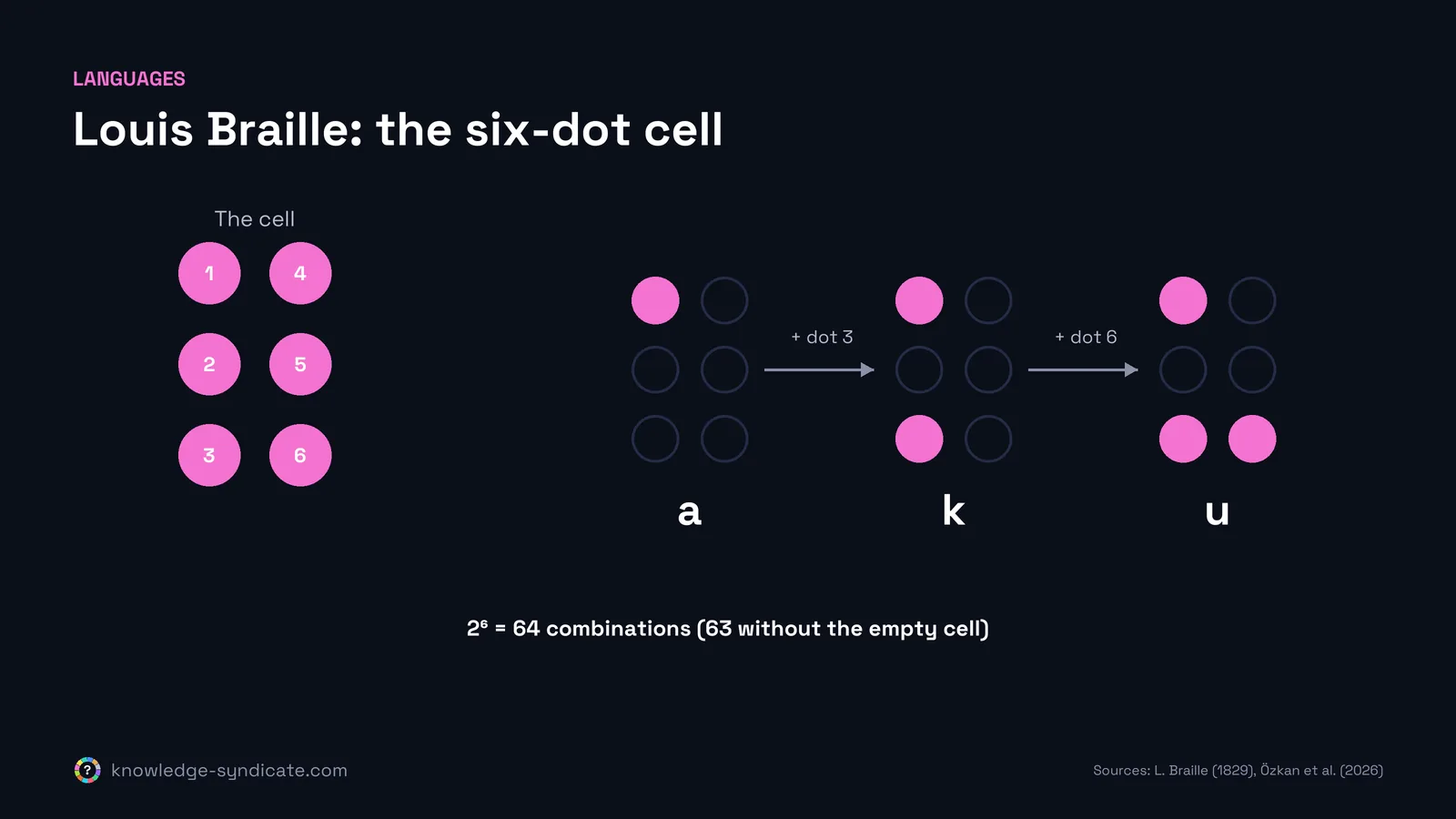
Modern braille uses a six-dot cell, three high and two wide. A 2026 study by Z. G. Özkan and colleagues in Cognitive Research: Principles and Implications puts numbers on it. With six dots there are 2 to the power of 6, that is 64 possible combinations, 63 if you don’t count the empty cell.
The same study explains how the alphabet fits, and you can see what it inherited from 1829. The first ten letters, a to j, use only the top two rows. The next ten, k to t, repeat those patterns and add dot 3, bottom left. The next ones, u, v, x, y, z, repeat again and add dot 6 as well, bottom right. And w? According to the study, it wasn’t in the French alphabet when Braille created the system, so it was later given a sign that is a rotation of r.
What fingers feel
The study by Özkan and colleagues was done with 24 blind people who read braille fluently, all native Spanish speakers. Their task was simple: feel two letters in a row with the tip of the index finger and say whether they were the same or different, as fast as possible. The letters appeared on a refreshable braille display, the kind whose dots rise and fall, mounted on a platform that slid it under the finger. According to the study’s table, on average they were right 92.7 per cent of the time with identical letters and 96.6 per cent with different ones.
Before that, the team did a mathematical analysis of the alphabet. They worked out how much information each dot carries. A dot that appears in half the letters splits them best, and one that’s in almost all or almost none helps little. Dots 5 and 2 came out as the most informative, and dot 1 as the least.
Then they tried a very simple neural network, with no hidden layers, to see whether it could tell the 26 letters apart using only whether each dot was there or not. It couldn’t manage four: f, g, o and p. However the training was run, it always failed on those. According to the team, this shows that recognising braille letters can’t rest on adding up single dots alone.
My own reading, which is reasoning from the study: fingers don’t count bumps one by one. They feel shapes.
A slow ending
According to Sen and Honavar, the students at the institute loved the new system, but the teaching staff were slow to accept it. Braille ended up teaching at the same school, algebra, grammar, music and geography. He died on 6 January 1852, aged 43. According to the same article, the French government approved his system two years later, in 1854, and in 1952 his remains were moved to the Panthéon in Paris, except for his hands, which stayed in his original grave in Coupvray.
What’s left
My own reading, which is reasoning from the sources: braille is a rare case of an invention that names its forerunner on the first page. Braille named Barbier, then shrank the idea until it fitted under a finger, sorted it into series and dropped the lines when the stylus complained. Nearly two centuries on, it still works.