Esperanto: the language a Warsaw eye doctor gave away
Picture a town where every street speaks a different language and people eye each other with suspicion because they can’t understand one another. That, according to one of its supporters, is what pushed a boy, still almost a child, to dream up a new language. Esperanto has a reputation as a quirky thing, a dinner-table utopia. But its author’s original texts are surprisingly practical, close to an instruction manual. Let’s read them.
What Esperanto is and who made it
In 1907 Walter J. Clark published a book on the international language that sums it up like this. The word Esperanto is the present participle of the verb esperi, to hope, used as a noun. It was under the pseudonym Dr. Esperanto that Zamenhof published his scheme in 1887 in Warsaw, and the name stuck to the language.
Clark adds that Zamenhof looked after eye patients in Warsaw and always refused to make money out of his language. He even turned down a sum some enthusiasts had collected as a testimonial.
Seven years later, in Washington, the Committee on Education of the House of Representatives heard an Esperanto supporter, Professor A. Christen, at a hearing on a resolution to study it as an auxiliary language. Christen presented it as the work of a Polish scholar, Dr. Zamenhof, who by this account had grown up in a town where several languages were spoken and had suffered daily from the evils of that Babel.
The renunciation on page one
A French edition of that first book, from 1887, has been digitised. On its first page the author declares that the international language, like every national language, is public property, and that he gives up forever all personal rights to it.
My own reading, which is reasoning from that text: there is no brand behind it. Esperanto was born as a gift.
In the preface Zamenhof anticipates the reader’s reaction: they will assume this is an impossible utopia. He asks them to drop that prejudice and study the matter seriously. Then he explains his motive. How much time and effort it takes to learn foreign languages, and even so, when you cross the border, you can’t always make yourself understood. How many literary works of other nations never get translated.
And he writes something that explains the rest: the difference of languages is one of the main sources of hostility between nations, because the first thing that strikes people when they meet is that they can’t understand each other.
A grammar you can learn in an hour
In the same book Zamenhof explains how he solved the first problem, making the language easy. He says he simplified the grammar to an unheard-of degree without robbing it of clarity or precision, and that it can be learned entirely in an hour.
The second piece is the rules for forming words. With prefixes and suffixes that work as independent words, a single root yields many others without having to learn them separately. According to the book, it’s enough to learn about 900 words, including endings, prefixes and suffixes, to be able to build all the others needed in daily life. Study, he promises, takes not years but a few days of work.
At the 1914 hearing, when asked about the original vocabulary, Christen answered offhand that it was about 963 words, and that by then it was around 3,000. So two similar figures, one from the author and one from a supporter speaking without notes.
Where the words come from
Clark says the project went through many versions before publication. Zamenhof began with the idea of a language invented from scratch, with made-up words and arbitrary grammar, and gradually moved to one that took its roots from those shared by several existing languages.
Christen explained it this way in Washington. First, the words that are already international: names of animals and products that travel with their names, like rose, orange, tea, coffee or tobacco. Then, for everyday home words, Zamenhof laid out the equivalents in the European languages and picked the root that appeared most often, the aim being that it should be common to at least four or five. Hence, according to Christen, its Latin flavour.
It wasn’t the first attempt. Clark gives a list of earlier artificial languages, headed by Schleyer’s Volapük of 1879, and devotes a chapter to its rise and fall as a warning.
The 16 rules
In 1905 Zamenhof gathered the foundations of the language in the Fundamento de Esperanto, signed in Warsaw in July of that year. It contains the 16-rule grammar, translated into five languages. A few of the rules give a sense of the style.
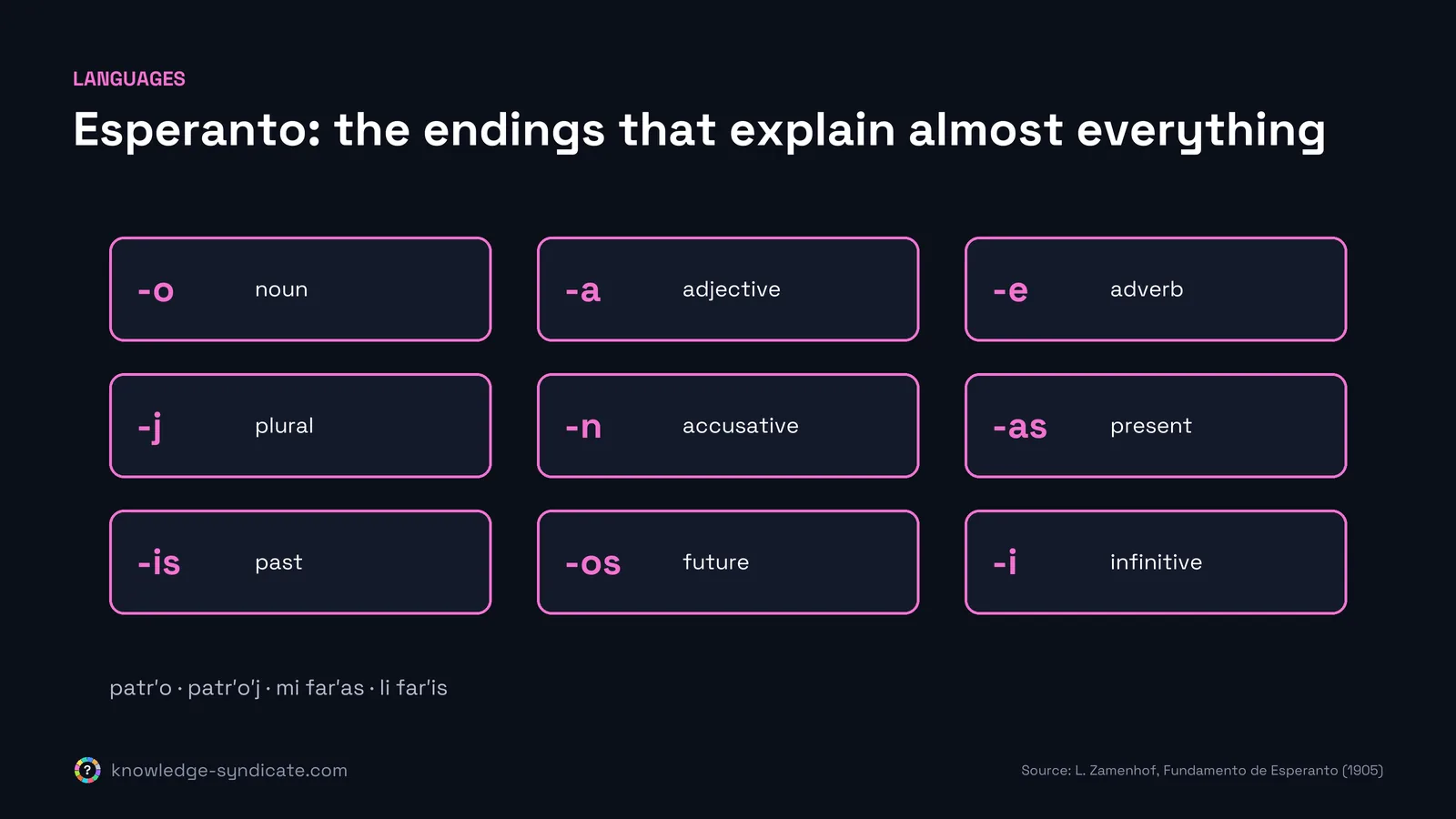
There is only one article, la, for all genders, numbers and cases. There is no indefinite article. Nouns are formed by adding -o to the root, and the plural by adding -j. There are two cases: the nominative and the accusative, which adds -n. The others are formed with prepositions. Adjectives end in -a. Adverbs in -e.
The verb doesn’t change for person or number. The present ends in -as, the past in -is and the future in -os. The infinitive ends in -i. So mi faras is “I do”, li faris is “he did” and ili faros is “they will do”.
And the general rules: every word is read exactly as written, with no silent letters. The stress always falls on the second-to-last syllable. Compound words are formed by joining roots. And if a clause already has one negative, a second isn’t allowed.
My own reading, which is reasoning from those rules: anyone who has suffered the irregular verbs of any European language will quickly see the appeal.
A foundation nobody touches
The preface of the Fundamento has an almost constitutional tone. Zamenhof writes that, for the language to progress safely, it needs a clearly defined base that is never touched or changed. Until the governments of the main countries adopt it officially and appoint a shared authority, the foundation must remain absolutely unchanged. No person and no society, he adds, has the right to make even the smallest change to it.
That foundation is three works: the 16-rule grammar, the universal vocabulary and the book of exercises. According to the preface, the author himself always regarded them as laws for himself.
Clark highlights another point from the same text: Zamenhof declared that his own works had no legislative power and were merely those of one more Esperantist.
The ten-million promise
The 1887 book came with a curious mechanism to get things going. It asked readers to sign a promise: they would learn the language if ten million people promised the same. Signing cost nothing and bound you to nothing if the venture failed. Once ten million promises had been gathered, all names and addresses would be published in a book. Anyone who wanted to learn it regardless could cross out the condition and write “absolutely”. And anyone against it could send the slip back marked “against”.
My own reading, which is reasoning from that text: it’s a very modern way of solving the problem every network has, that nobody wants to be first.
Boulogne, 1905
According to Clark, the first international congress of Esperantists was held in Boulogne, on the north coast of France, in August 1905. People from more than twenty different nations came together, most of whom had learned the language at home and had hardly spoken it with anyone from another country.
On Saturday 5 August, at eight in the evening, the town theatre was full. Zamenhof stood up to address the audience in Esperanto. Clark describes the tension in the hall and how, as the speech went on, the audience realised they were all following an international speech in an international tongue.
In 1914, before the committee in Washington, Christen was already talking of nine annual congresses, from Boulogne to Berne, with between 800 and 1,500 delegates from 20 to 30 countries spending a week together in that language.
What’s left
My own reading, which is reasoning from the sources: Esperanto was presented from the start as a second language for everyone, never as a replacement for any other. Its author gave it away, locked it down with an untouchable foundation and took the last word away from himself. You may think it was a utopia. But few utopias come with 16 rules, a 900-word vocabulary and a form to sign.