How do vinyl records work? Music turned into a trembling groove
Drop the needle on a record and, a second later, an orchestra plays. No chips, no ones and zeros, nothing to read in the modern sense of the word. Just black plastic with a groove in it. How do vinyl records work? In one sentence: the sound is stored as the shape of that groove. The interesting part is everything around that sentence. The first recorded voice in history was silent for almost 150 years, stereo was invented almost a quarter of a century before it went on sale, and the record that reaches the shop doesn’t sound like the sound that was recorded, on purpose.
Before playback, there was drawing
The story starts with a machine that recorded but couldn’t play back. According to the recorded sound timeline of the US Library of Congress, in 1857 Édouard-Léon Scott de Martinville invented the phonautograph, which traced sound waves onto soot-covered paper. The aim was to see sound, not hear it.
The First Sounds project, which recovered those recordings, is clear: Scott didn’t intend his phonautograms to be played back. One of them, from 9 April 1860, captures the folk song “Au clair de la lune,” and Scott deposited it with the French Academy of Sciences in 1861. There it stayed, wavy lines on smoked paper, until in 2008 the First Sounds collaborative released sound files made with a virtual-stylus technique from Lawrence Berkeley National Laboratory. They scanned the paper and software tracked the lines as if they were the groove of a record.
Something else needed fixing. Scott’s cylinder was hand-cranked and its speed was irregular. Luckily, his 1860 recordings include the trace of a 250-hertz tuning fork that serves as a reference for correcting it. Even so, according to First Sounds, on 9 April Scott let the cylinder slow down, possibly to a full stop, near the word “Pierrot.”
The trembling groove
The principle of Edison’s 1877 phonograph is the same as that of a modern record. The Thomas Edison National Historical Park puts it in schoolroom terms: your voice made the needle shake, and those vibrations went through the needle and made a line, a groove, in the tinfoil. According to the Library of Congress, the first tinfoil phonograph was built by an Edison machinist, John Kruesi, from Edison’s sketches, and a verse of “Mary had a little lamb” was reportedly the first recording made and played back.
In Edison’s groove the needle went up and down: sound was recorded in depth, as hills and valleys. Ten years later, Emile Berliner patented the gramophone, which traced the groove from side to side at an even depth. Shortly afterwards the disc replaced the cylinder. That lateral groove is the direct ancestor of a vinyl record’s.
In between came wax and electricity. According to the same timeline, in 1886 Chichester Bell and Charles Tainter replaced tinfoil with engraved wax cylinders, which made recordings more durable, and Edison returned to his invention after a decade of neglect with wax cylinders of his own, which became the first format for commercial recordings. With portable cylinder recorders, Jesse Fewkes recorded the Passamaquoddy people of Maine in 1890, the earliest known recordings of Native Americans. And in 1925 two record companies introduced electrical recording, which greatly widened the range of tones a disc could hold.
Reading the groove means making the trip in reverse. The turntable’s stylus runs along the spiral and has to follow every curve in the walls. That way it moves exactly as the stylus that carved the groove moved. The cartridge turns that motion into a small electrical signal, which is amplified on its way to the speakers.
How do vinyl records work in stereo? One channel per wall
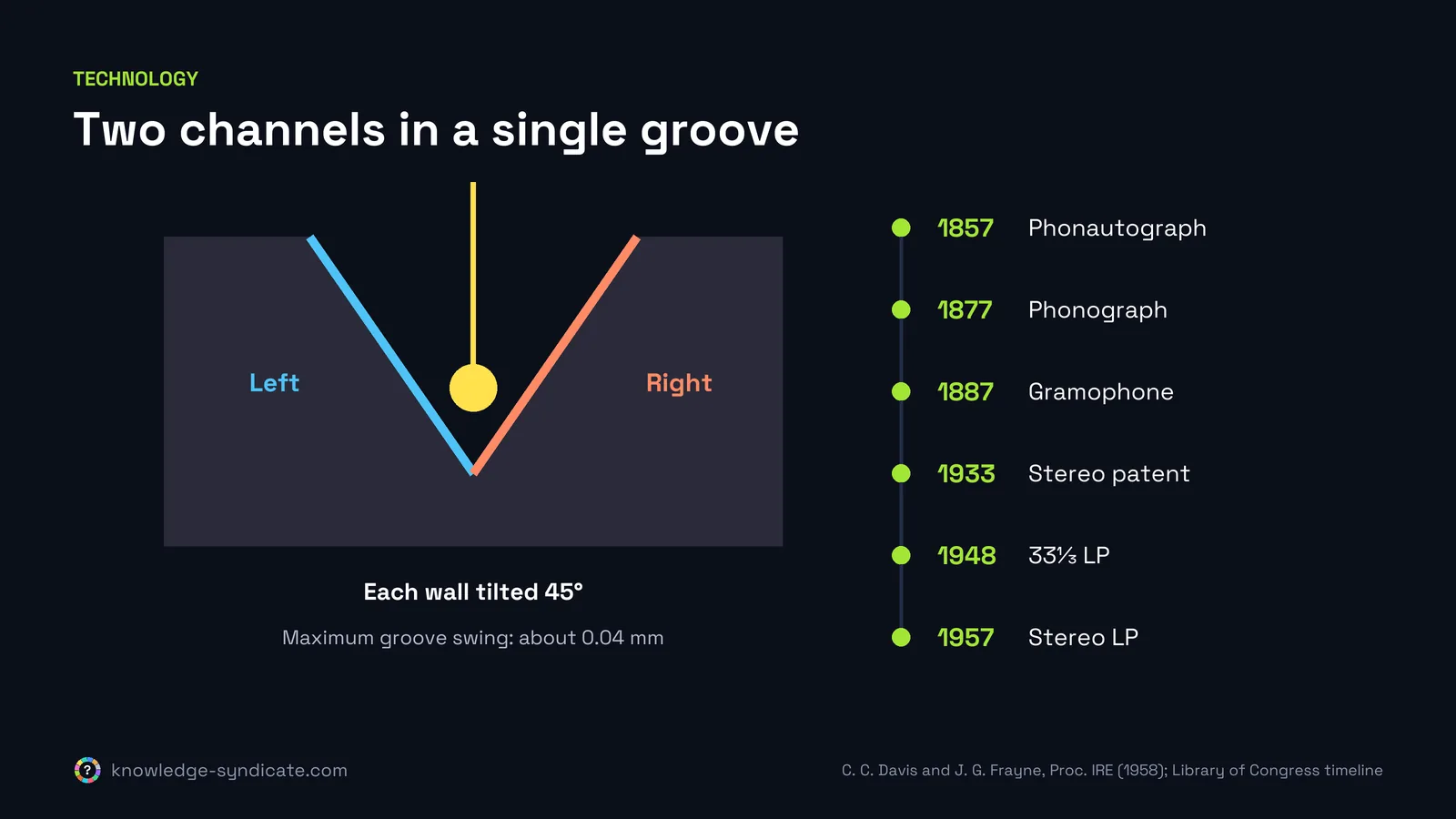
One groove and one stylus seem good for one channel. The stereo trick is to use the fact that the stylus can move in two directions at once. In 1958, two engineers, C. C. Davis and J. G. Frayne, described in Proceedings of the IRE the system that would win out. Their recorder put both stereo channels in a single groove with a single stylus. The two recording axes were at 90 degrees to each other, each tilted 45 degrees from the plane of the record.
Put simply: the groove is V-shaped, and each of its two walls carries one channel. Depending on the phase relationship between the channels, the groove moves side to side, up and down, or a mix of both. For any real piece of music, the result is a complex blend of the two motions, and the stylus splits it back into left and right.
The stereo that waited almost twenty-five years
Here’s the part almost nobody mentions. The paper itself admits the idea wasn’t new. According to Davis and Frayne, Blumlein was granted a British patent in 1933 for a two-channel stereophonic system. He proposed combining vertical and lateral motion and also pointed to the 45-45 system as an alternative. At a telephone laboratory, Keller and colleagues made stereophonic recordings as early as 1936 and were granted a US patent in 1938.
So why didn’t it reach the shops? The paper puts it down to two things: in the late 1930s that laboratory turned its effort to defense work, and the commercial recording companies showed apathy. The work was shelved. According to the Library of Congress timeline, the first commercial stereo LPs didn’t appear until November 1957.
The record that doesn’t sound like the recording
Another detail surprises people the first time they hear it. What gets carved into the groove isn’t a faithful copy of the sound. The Davis and Frayne paper describes a recorder able to cut with an even response from 30 to 15,000 cycles per second, but adds that in commercial practice this response is modified by inserting the RIAA pre-equalization characteristic, set by the US recording industry association, or an equivalent. And in the monitor amplifier, the one that lets engineers hear what’s being cut, the RIAA reproducing equalization is applied to undo it.
In other words, the record is cut with some frequencies boosted and others trimmed along an agreed curve, and the playback equipment applies the opposite curve to restore the balance. That’s why a turntable setup needs that correction for the sound to come out balanced.
The same paper gives a sense of how small everything is. In a very high-level recording, the maximum groove swing was 1.65 thousandths of an inch either way, about 0.04 millimeters. The authors doubted stereo recordings with normal equalization would reach that level. All the music on one side fits into movements of hundredths of a millimeter.
Thirty-three and a third
The format we now call vinyl was born in June 1948. According to a Library of Congress blog post, a record company then launched the first long-playing microgroove record, spinning at 33 1/3 revolutions per minute and holding about 23 minutes per side. Peter Goldmark’s team had perfected the microgroove in the summer of 1947, and engineer Bill Bachman was central to seeing it through.
The first LP, matrix number ML 4001, was Mendelssohn’s Violin Concerto, with the New York Philharmonic under Bruno Walter and Nathan Milstein as soloist. Its 1949 catalog boasted that the records were made of nonbreakable plastic and offered about six times as much music as conventional shellac records.
The competition answered fast. According to the Library of Congress, another record company introduced the 45 rpm disc the following year, and in 1949 a buyer had to choose between three formats: 78, 33 1/3 and 45. The 12-inch disc at 33 1/3 became the industry standard until the compact disc arrived in 1983.
A shape you can touch
Put it all together and a vinyl record is a very old idea pushed to the limit. Scott drew sound without being able to hear it. Edison carved it and gave it back. Berliner turned it on its side. A record company narrowed it so twenty-odd minutes would fit on a side. Two engineers put two channels in the same groove, using an idea that had been waiting almost a quarter of a century.
And what the stylus reads is still the same as in 1877: a shape. The music on a record is physically there, carved into the plastic, trembling at the scale of hundredths of a millimeter.