Who invented the barcode? From lines in the sand to the checkout
You slide a packet of biscuits across the checkout, it beeps, and the price appears by itself. It’s so routine that nobody stops to think those stripes have owners, a date and a fairly bumpy history. Who invented the barcode? Two students, to start with, then a patent ahead of its time, and finally a committee of supermarkets that had to agree on something. Along the way there’s a beach, a bull’s-eye and a pack of chewing gum.
An overheard conversation
According to the history of the Universal Product Code published by one of the companies that developed it, in 1948 Bernard Silver, a graduate student at the Drexel Institute of Technology, overheard a supermarket executive asking the dean to research an efficient way of encoding product data. Silver asked a fellow student, Woodland, who had worked on the Manhattan Project, for help.
The same page recalls a forerunner: in 1932 Wallace Flint, a Harvard business student whose father was a grocery wholesaler, wrote a thesis on how to automate the checkout queue. The idea used flow racks and punch cards. It was intriguing, but never practical.
Lines in the sand
According to that page, Woodland left Drexel and shut himself away in his grandfather’s flat in Miami to work on the problem full time. The idea came to him one day on the beach. He ran his fingers through the sand, left four parallel but uneven lines, and realised that wide and narrow lines could represent data, just like the dots and dashes of Morse code.
Who invented the barcode: the 1949 patent
US patent 2,612,994, Classifying Apparatus and Method, is signed by Norman J. Woodland of Ventnor, New Jersey, and Bernard Silver of Philadelphia. The application is dated 20 October 1949, with 11 claims, and the grant 7 October 1952. The company page gives a different date, 11 October 1952, and calls the inventor Joseph Woodland; here I follow the patent.
The aim, according to the text, was an automatic apparatus that would sort things by a photocell’s response to lines or colours attached to, printed on or associated with them. Another aim was to sort things without relying on their own characteristics, only on the label, and for the apparatus to act as a sensory organ for tabulating, computing and sorting machines. And there’s a sentence twenty years ahead of its time: one application of the invention is in the so-called supermarket field.
Ones and zeros as lines
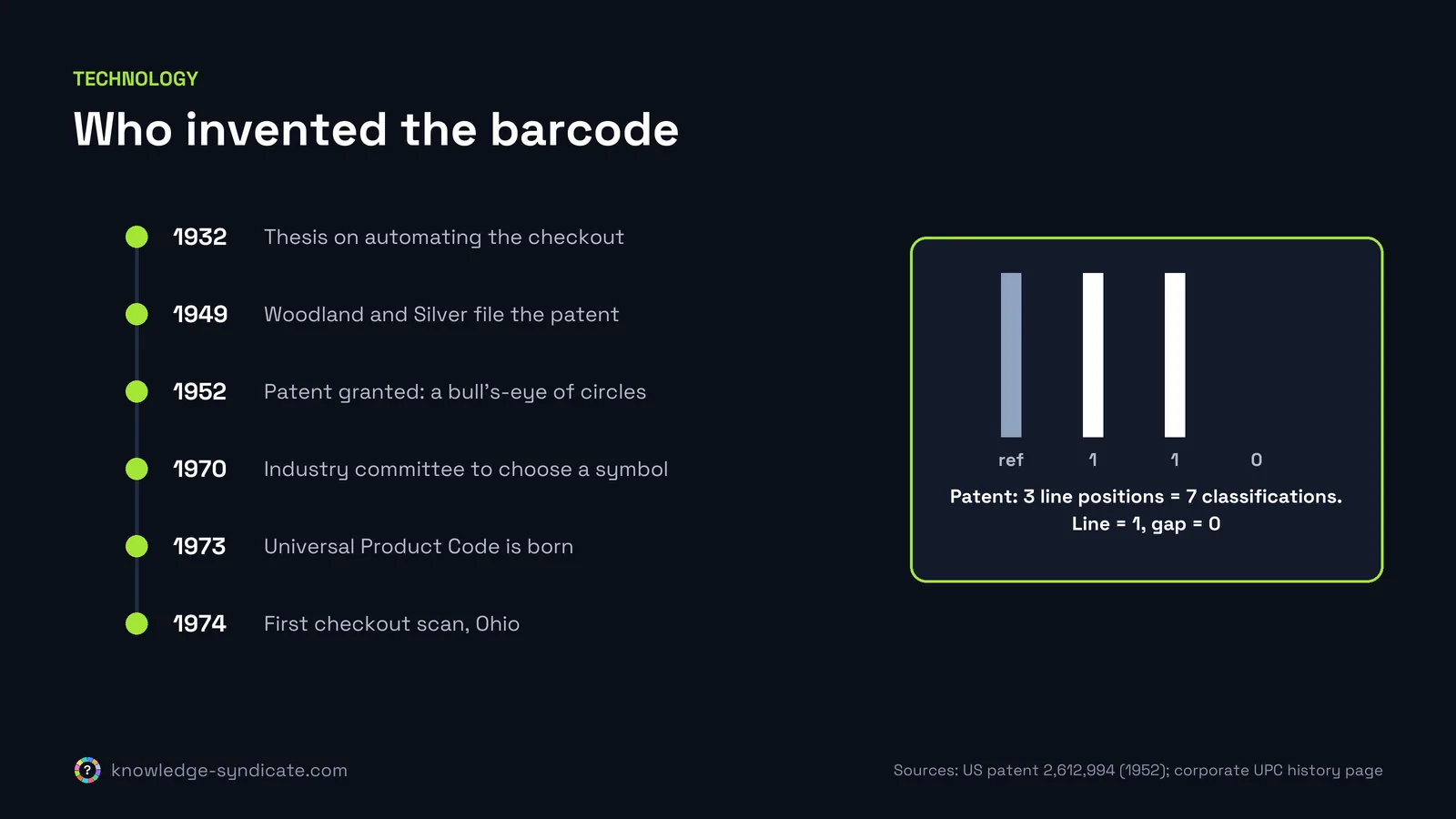
The patent’s first drawing is a pattern of white lines on a dark background. One line serves as a reference and the others have fixed places. If a place has a line, it counts as one; if not, zero. Each position has a weight, as in binary, so three positions allow seven different classifications.
The patent explains that by adding places for lines, the number of classifications grows very fast and can be made as large as you like. With ten positions, it gives the code 11111 11111 as an example. It also considers multicoloured patterns and fluorescent pigments lit with ultraviolet light, so that other colours nearby don’t confuse the reading.
A bull’s-eye so you don’t have to turn the packet
The straight-line drawing had a problem, and the patent says so: it only works if the pattern can be lined up with the apparatus. So it turns it into a circular pattern, a bull’s-eye of concentric circles, so that orientation stops mattering.
In the middle there’s a series of alternating black and white circles that let the apparatus recognise it’s looking at a label. Around them sit the lines carrying the information, which reflect less light than the white circles in the centre.
A see-through belt
The patent describes a specific system. Packets, cans included, carry the bull’s-eye on a sticker or stamped on, and are placed face down on a transparent conveyor belt. There they’re brightly lit, and a lens projects an image of the bottom of the packet onto a ground-glass screen.
A photocell, mounted on a carriage that shuttles back and forth across the belt, sweeps that image. That way the packet doesn’t have to be placed in an exact spot. The patent’s example is sorting packets into seven price categories, from 1 to 7 cents. If the apparatus recognises the label, a pusher shoves the packet onto an exit chute. If not, it carries on along the belt and is sent back. The chute, the patent explains, leads past a barrier to where the goods are wrapped to be taken off the premises.
The patent also sets out that the scanner and its electronic circuit have a double job: first to see and recognise the label, and only then to see and decode the classification instructions inside it. The light reaching the tube rises and falls as the aperture sweeps across the image, and those fluctuations are what the circuit turns into a number.
Ahead of its time
According to the company page, technical hurdles made the invention unworkable: it needed a 500-watt light and a special tube to turn the light into code. Woodland and Silver, hired by that company in 1951, sold the patent for 15,000 dollars.
My own reading, which is my reasoning: the underlying idea was good, but reading depended on a very strong light and a photo-emissive tube, like the one the patent itself describes. Without a cheap, reliable reader, there was no way to put it in thousands of checkouts.
The 1970 committee
According to the same page, by the late 1960s US supermarkets were selling more than 100 billion dollars a year, but the work was slow and full of errors: many of their 1.5 million employees spent their time sticking on price tags and keying in codes. In 1970 industry executives agreed they needed a scannable symbol and formed a committee to choose it.
George Laurer, the engineer who led the winning project, knew, according to the account, that the bull’s-eye had a flaw: it smeared when printed. He refused to stick with it even when his manager asked him to, and with help from his 15-year-old son he prepared a presentation of a linear design. His team also built a prototype scanner for the demonstration. The design had 30 black and 29 white lines that didn’t smudge, could be read by laser from any direction, and held the store and product information in 95 bits. Below the bars, numbers allowed it to be keyed in by hand when needed. Woodland’s support, the page says, helped win over the committee. According to the same page, Woodland had joined that company two decades earlier precisely because he believed it could develop a solution like this.
A pack of chewing gum
The Universal Product Code was officially born on 1 April 1973, with Laurer’s design and a few small tweaks. Soon afterwards a council was set up to manage the standards and assign numbers to the companies making packaged goods. According to the history page, the first scan at a checkout took place on 26 June 1974, at a supermarket in Troy, Ohio, and the item was a 67-cent pack of chewing gum.
There was resistance. Shoppers doubted its accuracy, unions feared machines would take jobs, and retailers weren’t sure about investing hundreds of thousands of dollars in a technology that, to break even, had to be printed on at least 75 per cent of products. Manufacturers, for their part, faced spending 200 million dollars a year on labels. Even so, the industry made suppliers use the code. According to the same source, checkout lines started moving 40 per cent faster.
What was left of the bull’s-eye
My own reading, which is reasoning from the patent and that history: the core of the 1949 invention survived. A label that carries a number instead of describing the object; a reader that doesn’t need to understand what it sees, only to tell light from dark; and a binary system that allows as many codes as you need. What changed was the shape, from circles to bars, and the technology to read it.
So who invented the barcode has two birthdays as an answer: the 1952 patent, with its bull’s-eye and its see-through belt, and that pack of chewing gum in 1974. Between them lay twenty-two years, a beach in Miami and a committee of supermarkets reaching agreement, which is no small thing.