Zeigarnik effect: why it’s so hard to leave a task half done
You close the laptop with an email half written and, over dinner, the email is still there, lurking somewhere in your mind. That’s the Zeigarnik effect, or so the story usually goes. The version that gets passed around says the mind keeps a tighter grip on whatever you left unfinished. It’s almost a hundred years old, it sounds great, and it has a problem: when psychologists have tried to repeat the experiment, they’ve had a very hard time getting it to work.
The curious part is that there was a second, less famous effect, born in the same circle. That one holds up. And it explains better why it’s hard to walk away from something half done.
Two studies from the 1920s
The story is laid out by Romain Ghibellini and Beat Meier of the University of Bern in a meta-analysis published in July 2025 in the journal Humanities and Social Sciences Communications. It all begins with two famous studies inspired by Kurt Lewin at the start of the twentieth century.
In the first, published in 1927, Zeigarnik gave participants lots of tasks, interrupted some of them and then asked them to recall all of them. According to her report, they remembered more of the interrupted tasks than the finished ones. That’s the Zeigarnik effect. In the second, from 1928, Ovsiankina used a similar method and observed that, given the chance, participants went back to the interrupted tasks on their own, without being asked. That’s the Ovsiankina effect.
The underlying theory was Lewin’s. He proposed that forming an intention creates an inner tension, a kind of temporary need, that lasts until the intention is fulfilled. If you’re interrupted, the tension doesn’t discharge. And that leftover tension would explain both why you remember the task better and why you want to go back to it.
The Zeigarnik effect, put to the test
Ghibellini and Meier set out to pool the available data. On 14 September 2023 they searched two major psychology databases for everything published under the terms Zeigarnik, Ovsiankina and interrupted or unfinished tasks. That turned up 1,455 publications, 1,349 once duplicates were removed. They kept the quantitative studies that compared interrupted and finished tasks and measured recall or resumption.
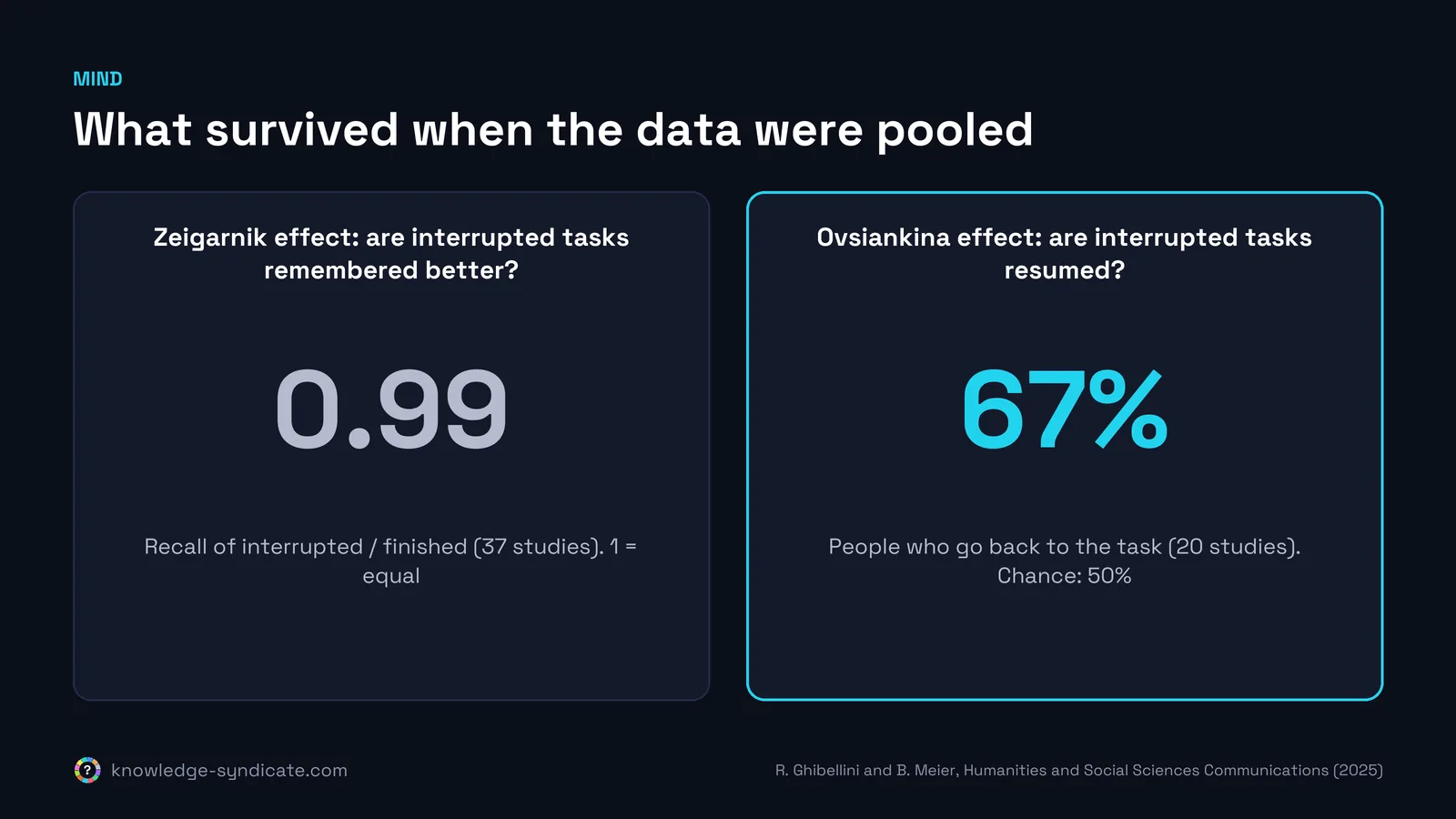
The most common measure of the Zeigarnik effect is a ratio: how many interrupted tasks people remember on average, divided by how many finished ones they remember. If memory favors unfinished business, that number should come out clearly above 1. Across 37 publications after the original study, the weighted average was 0.99. In other words, interrupted tasks were remembered about as well as finished ones. With another measure, the share of interrupted tasks among everything recalled, the figure was 49.16% across 13 publications: a hair below half. That second measure isn’t new either. Marrow introduced it in 1938 precisely to criticize Zeigarnik’s way of calculating, since dividing one number by another can distort the comparison depending on which way the advantage runs.
The authors don’t mince words. They call their analysis of the Zeigarnik effect sobering, say the values from the 1927 original look inflated and note that the effect is still freely cited, taken as a given and used to explain a host of findings, rarely with any question about whether it’s valid.
What does replicate: going back to the task
With the Ovsiankina effect it’s a different story. Its only measure is the percentage of people who resume an interrupted task when they get the chance. Including the original study, the weighted average was 67.00% across 21 publications. Without the original, 66.79% across 20. According to the authors, studies reliably show that interrupted tasks are resumed about 67% of the time, well above the 50% you’d expect by chance.
Their conclusion, in the paper’s abstract, is blunt: the Ovsiankina effect represents a general tendency, whereas the Zeigarnik effect lacks universal validity. In bar-stool terms, what you’ve got with that half-written email looks more like an itch to go back to it than a memory that’s especially good at holding on to unfinished things.
Why it worked in the 1920s
If the Zeigarnik effect doesn’t replicate, what happened in 1927? Ghibellini and Meier go through the conditions that, according to decades of research, swayed the result. One is the authority of the person running the experiment. Another is what the situation demands while you’re doing the task. Another is how involved the person is in it. According to the authors, those circumstances were more common in the past and are rarer now, which could explain why the effect is so hard to repeat.
There are striking examples of how much context matters. A researcher named Green noticed in 1963 that some studies used volunteers and others used students required to take part as part of their courses, and that volunteers showed a stronger effect, presumably because they were more involved. Other work found that dominant people showed the effect and submissive people showed the reverse. And several authors saw the effect flip in anxiety-inducing situations where self-esteem was on the line: the suggestion was that remembering the failure of not finishing felt threatening and was pushed out of mind.
So the Zeigarnik effect seems to depend on how you feel about the task and about whoever set it. With the right experimenter and a task you care about, it may show up. As a general law of memory, it doesn’t.
The money that kills the urge to finish
The Ovsiankina effect has its nuances too. One study covered by the meta-analysis, by McGraw and Fiala in 1982, wanted to know what happened if participants were motivated from outside, with money. One group was told in advance that they’d be paid for taking part. The other wasn’t told anything. The financial incentive noticeably lowered the share of people who went back to interrupted tasks.
The authors’ reading was that once payment entered the picture, finishing the task stopped being a goal of the participants’ own. It’s a detail with a lot in it: the urge to finish seems to work better when the task is yours than when you’re being paid to do it.
The pending task that barges into your head
Memory not favoring unfinished things doesn’t mean unfinished things leave you alone. In 2011, Masicampo and Baumeister published a series of experiments on unfulfilled goals in the Journal of Personality and Social Psychology. They activated a pending goal in participants and then measured what happened.
Unfinished goals caused intrusive thoughts while participants read an unrelated text. They made goal-related words more readily available in the mind. And they hurt performance on an unrelated anagram task. The pending business really did take up space.
The interesting part came next. When participants were allowed to write specific plans for their unfulfilled goals, those effects disappeared. And not just any plan would do: the reduction depended on how seriously people took it. Those who eventually carried out their plans were exactly the ones who stopped having intrusions. According to the authors, once a plan is made, the drive to reach the goal is put on hold and picks up again at the scheduled time.
Another detail runs against intuition: changes in goal-related emotions didn’t seem to be necessary for these effects. You didn’t have to feel anxious about the pending task for it to barge in, or stop feeling anxious for it to leave. As the authors put it, committing to a specific plan may help you reach the goal and, along the way, free up mental resources for other things.
What’s left of the myth
Put the two lines of work together and the picture looks quite different from the one going around. There’s no solid evidence that you remember what you left half done any better. There is evidence that you tend to go back to it, about two times in three when you get the chance. And that a pending task can occupy your mind until you give it a concrete plan.
Lewin’s theory, the tension that never discharges, may have been right at its core and wrong about the symptom that became famous. The tension seems to show up more in the urge to finish than in memory. A long time later, the effect with the famous name is the one that doesn’t hold up, and the one almost nobody cites is the one that does.