What causes déjà vu? The memory glitch almost everyone has had
You walk into a pub you’ve never been in, someone says something and, out of nowhere, you’re certain this has happened before. Exactly like this. The same chairs, the same light, the same sentence. It lasts a couple of seconds and then it’s gone. So what causes déjà vu, French for “already seen”? It’s one of those quirks of the mind that nearly everyone knows and hardly anyone can explain. Science has been at it for more than a century, and what it has found is far less mystical and far more interesting than any paranormal story.
What causes déjà vu: the definition first
A systematic review with meta-analysis published in 2024 by A. Hadzic and colleagues in Frontiers in Neurology uses a classic definition: any subjectively inappropriate impression of familiarity between the present experience and an undefined past. What matters is the word inappropriate. It isn’t enough for something to feel familiar. It has to feel familiar while you know it shouldn’t.
The review presents itself as the first of its kind on déjà vu. The authors searched four scientific databases up to 1 February 2023, found 1,677 records and kept 46 studies. According to the text, the earliest documentation of the phenomenon dates back to AD 400, although the name and formal definition came many centuries later. For a long time it was viewed through a mystical lens. Then came surveys, interviews, brain imaging and memory tests.
How many people get it?
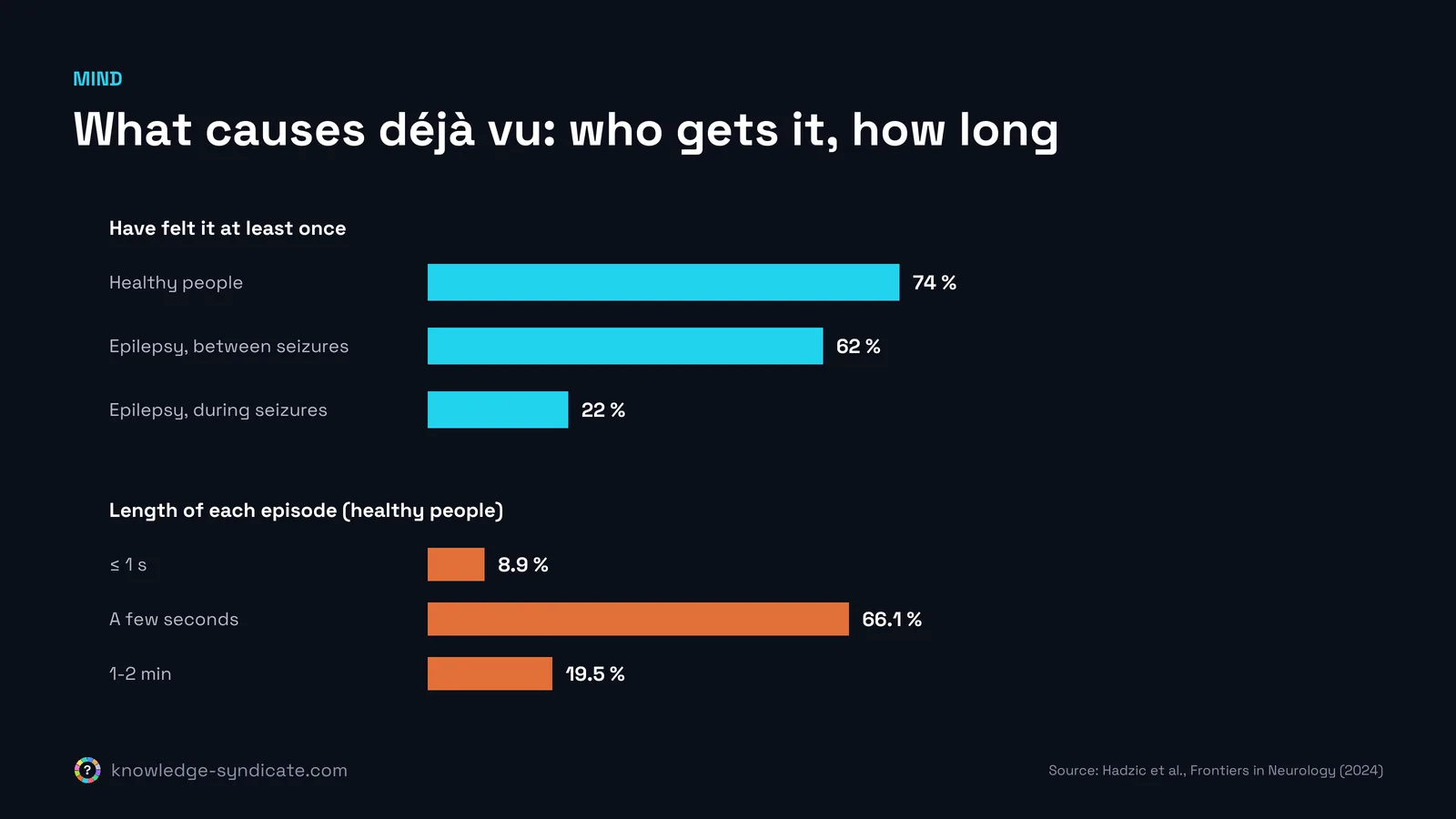
Nearly everyone. According to the meta-analysis, 74 per cent of healthy people have had déjà vu. Among people with epilepsy, 62 per cent have felt it between seizures and 22 per cent during the seizures themselves.
The review gives more detail from one of the included studies. Only 0.9 per cent notice it every week, 6.8 per cent a few times a month, 42.8 per cent a few times a year and 22.5 per cent less than once a year. As for length, two out of three episodes last a few seconds. 8.9 per cent last a second or less and almost 20 per cent between one and a couple of minutes. Episodes lasting hours are extremely rare.
According to the same review, déjà vu in healthy people becomes less frequent with age and is not linked to sex. And most people experience it as neutral or pleasant: reassuring, curious, surprising.
Travel brings more déjà vu
One finding has been repeated for decades. A 2013 study by A. R. O’Connor and C. J. A. Moulin in Frontiers in Psychology notes that how often people get déjà vu is associated with how much they travel. They cite a 1951 study in which only 11 per cent of those who didn’t travel said they had had it, against 32 per cent of those who travelled up to five times a year.
O’Connor and Moulin surveyed 206 university students and found the link with travel again. The authors leave the explanation open, and one possibility is simple: people who travel more are exposed to more new places, and déjà vu needs something new that nonetheless feels known.
My own reading, which is reasoning from that study: if you never leave your neighbourhood, your brain gets few chances to mistake a place it doesn’t know for one it does.
Two signals in memory
To understand déjà vu you have to separate two things that normally travel together. A 2012 paper by N. A. Illman and colleagues in Epilepsy Research and Treatment explains it with the dual-process model of recognition. According to that model, you recognise something as already seen by two routes. One is recollection, which brings back details of the original moment: where you were, what you thought, scattered images. The other is familiarity, a bare sense of having met it before, with no details.
According to Illman and colleagues, recollection depends on the hippocampus and a network of areas on the inner side of the temporal lobe, while familiarity depends on a more isolated region, the perirhinal cortex.
Their proposal for déjà vu is called the decoupled familiarity hypothesis. Déjà vu would be an erroneous feeling of familiarity that doesn’t match what the brain is processing at that moment. And they propose separating it from déjà vécu, “already lived”, which would be an error of recollection: there the scene feels familiar and on top of that you believe you’re reliving it in detail.
My own reading, which is reasoning from that paper: in déjà vu, the “this is familiar” alarm goes off by itself, and the part of memory that should fetch the file comes back empty-handed.
A century of seizures and electrodes
The scientific study of the phenomenon began in neurology. According to Illman and colleagues, in the 19th century Hughlings-Jackson described so-called dreamy states that appeared in certain epileptic seizures, and spoke of a kind of double consciousness. In one of the descriptions, quoted in the review, something occupying attention turns out to have been familiar, forgotten for a while, and recovered with a slight sense of satisfaction.
Then came studies using direct electrical stimulation of the brain, carried out while patients were assessed before possible epilepsy surgery. According to the same review, Penfield put these experiences down to the lateral temporal cortex. Later studies found that stimulating the inner side of the temporal lobe could indeed trigger déjà vu. A study by Bancaud and colleagues, with 16 patients, used the term déjà vécu for the first time in the scientific literature.
Brain imaging points the same way. Illman and colleagues cite a study in which people with temporal lobe epilepsy who had déjà vu showed lower metabolic activity in the entorhinal and perirhinal cortices, parahippocampal areas next to the hippocampus. Those without déjà vu only showed that drop in the hippocampus.
A 2018 study by J. Curot and colleagues in Brain Stimulation adds a curious variant. Some people, during stimulation, said the scene reminded them of a dream they had had. The authors called it déjà-rêvé, “already dreamed”, and concluded it is different from déjà vu. They found it in very few stimulations, and mostly on the inner side of the temporal lobe.
Not all déjà vu is the same
The Hadzic review concludes that déjà vu in healthy people, déjà vu between seizures and déjà vu during seizures are not the same experience. They differ in duration, frequency, emotional tone and the brain areas involved.
Illman and colleagues describe a study in which people with epilepsy didn’t usually feel surprised by seizure déjà vu, and it was more likely in a state of mental relaxation. In healthy people from the control group, by contrast, it appeared more with unfamiliar places or people, caused surprise and was more likely with mental fatigue. According to Illman and colleagues, there are physiological triggers for healthy déjà vu, such as stress or fatigue. And some people with epilepsy can tell the déjà vu of their seizures from the other kind.
According to the Hadzic review, the International League Against Epilepsy recognises déjà vu as a feature of epileptic seizures, but it doesn’t appear in the International Classification of Diseases, ICD-11. The authors propose including it.
Déjà vu made in the lab
If it’s a clash between familiarity and novelty, can it be triggered? A 2014 study by J. A. Urquhart and A. R. O’Connor in PeerJ tried. They started from a classic memory test: you’re shown words like rest, bed and blanket, all linked to one that never appears, sleep. At the end, many people think they saw sleep. That phantom word produces false familiarity.
The study’s trick was to add a second task. Participants had to watch the list for words starting with the first letters of the phantom word. Since none did, they ended up knowing that word was new. Familiarity on one side, certainty of novelty on the other. Exactly the definition of déjà vu.
With 30 participants, reported déjà vu was most frequent when the novelty was obvious, around 25 per cent, against a baseline of 10 per cent when it wasn’t. The strength of familiarity didn’t change the frequency much. The authors admit limits: the analogue captured part of the real experience, but it was narrower and could be swayed by what people thought was expected of them. Their conclusion is that knowing something is new is a central piece of déjà vu.
What doesn’t fit
Not everything adds up. The O’Connor and Moulin study looked for a link between how often people get déjà vu and their performance on standard memory tests, and found none. Neither recollection nor familiarity measured in the lab predicted who had more déjà vu. The authors suggest that déjà vu in healthy people reflects a mismatch between a memory signal that fires wrongly and the processes that monitor that signal, something ordinary tests don’t capture.
What’s left
My own reading, which is reasoning from the sources: déjà vu shows that memory works with several pieces that can come apart. One says “this is familiar”, another fetches the details and a third checks whether it all fits. When the first jumps the gun and the third catches it, you’re left with that odd feeling of having lived something you know is new. And then it passes, in a couple of seconds, as it nearly always does.