Stroop effect: why it’s hard to say what color a word is printed in
Try it in your head. In front of you is the word GREEN printed in purple ink, and you have to say “purple” out loud. Your mouth wants to say “green.” That little jam, that half-second scuffle inside your head, has a name: the Stroop effect. It’s an experiment you can repeat with a sheet of paper and some colored pencils. It began as a 1935 thesis with three experiments, a stopwatch and some three hundred college students.
A thesis at George Peabody College
The paper is titled “Studies of interference in serial verbal reactions.” It was written by J. Ridley Stroop of George Peabody College and published in 1935 in the Journal of Experimental Psychology, volume 18, pages 643 to 662. The journal received the manuscript on August 15, 1934. In a note, Stroop thanks those who helped him prepare “this thesis” and the roughly three hundred students who served as subjects.
The underlying question was old. It was already known that naming colors takes longer than reading color names. Stroop runs through the explanations on offer. Cattell, in 1886, and Lund, in 1927, put it down to practice. Woodworth and Wells, in 1911, suggested that the five color names, all “on the tip of the tongue,” got in each other’s way. Ligon, in 1932, had studied 638 schoolchildren from first to ninth grade and proposed a three-factor theory.
Interference itself had been studied for decades. Stroop recalls that Münsterberg, in 1892, looked at how changing daily habits tripped him up, such as opening the door of his room, dipping his pen in ink or taking his watch out of his pocket. Müller and Schumann, in 1894, laid down a law of associative inhibition: if “a” is already connected with “b,” it’s hard to connect it with “k,” because “b” gets in the way. And Culler, in 1912, trained people to respond with the right hand to red and the left hand to blue, then swapped the stimuli. In all those cases, a habit was built first and then the rules were changed.
What Stroop added was the idea of pitting the two stimuli against each other inside a single symbol. A word naming one color, printed in the ink of another. That way you could measure how much the ink gets in the way of reading, and how much the word gets in the way of naming the color.
Five colors and no yellow
The test sheet was carefully built. He started from the Woodworth-Wells color sheet but made two changes. He dropped black, because the control version of the words was going to be printed in black. And he dropped yellow, because it was hard to print words in yellow at an intensity close to the other colors. After consulting Dr. Peterson, he replaced them with brown and purple. The final colors were red, blue, green, brown and purple.
No word was printed in the color it named. Each one appeared an equal number of times in each of the other four colors. Each color showed up twice in every row and every column, and never twice in a row. The words were set in fourteen-point Franklin type. And each test was also printed in reverse order as a second form.
Experiment one: reading is easy
In the first experiment, 70 college students, 14 men and 56 women, read color names aloud. Sometimes they were printed in black, sometimes in inks that didn’t match the word. Each sheet had 100 words and each participant made 200 readings per test. Time was taken with a stopwatch, to a fifth of a second.
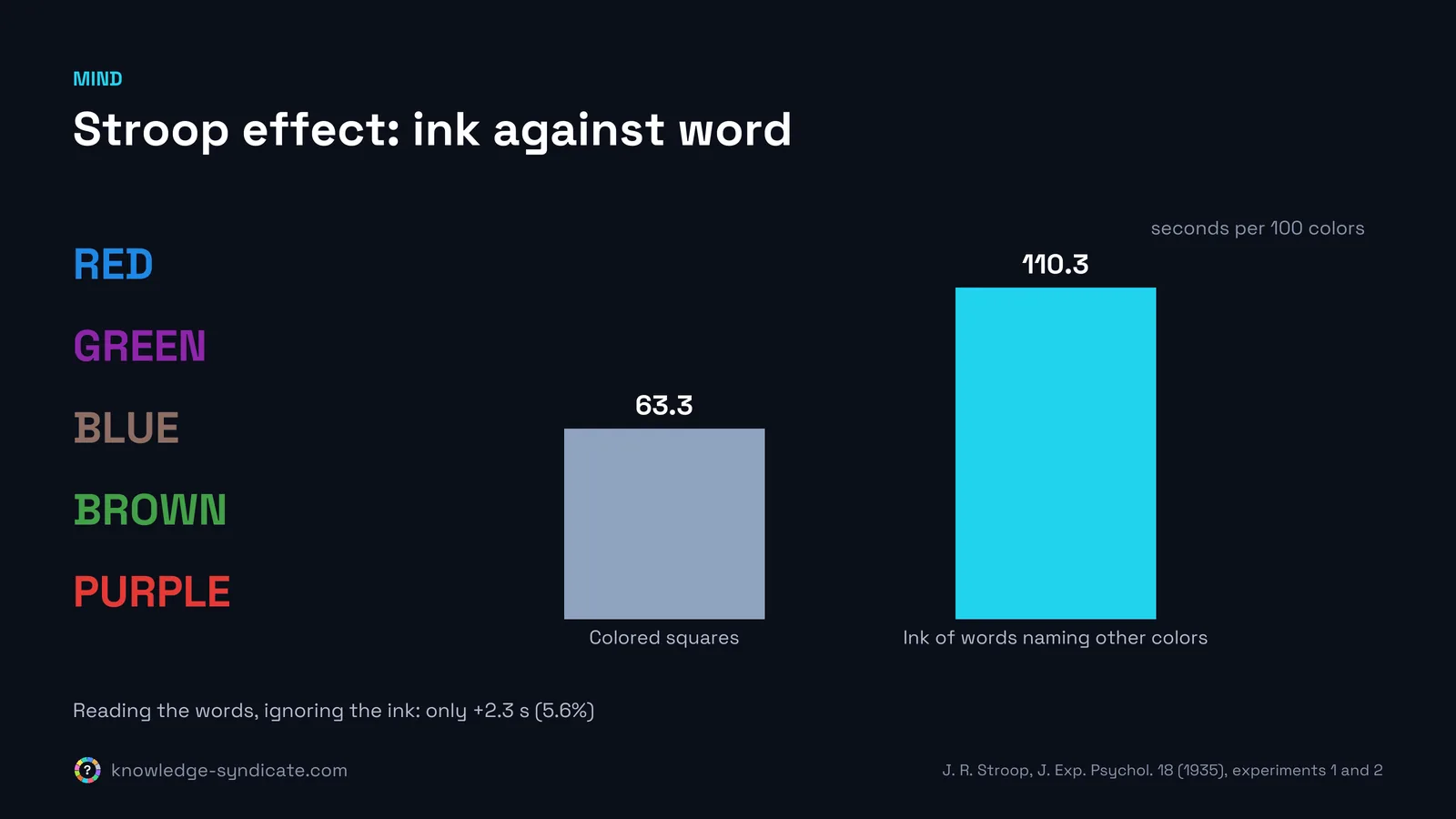
The result was almost nothing. Reading 100 color names printed in mismatched inks took an average of 2.3 seconds longer than reading them in black. Stroop works it out as 5.6% and declares it statistically unreliable, just as Peterson had predicted. The ink barely gets in the way of reading.
Experiment two: naming the color is hard
The second experiment flipped things around. A hundred students, 88 undergraduates, 29 men and 59 women, plus 12 graduate students, all women, had to say the color of the ink and ignore the word. If it said “red” in blue, the answer was “blue.” As a control, they named the same colors printed as squares.
Here the jam was huge. Naming 100 colors in squares took an average of 63.3 seconds. Naming the same 100 colors when they were the ink of words naming other colors took 110.3. A 74% increase. The medians were 61.9 and 110.4 seconds. The 47-second difference was 2.5 standard deviations, and Stroop calculates that 99% of the group took longer on the word test than the average on the square test.
They also made more mistakes. Fifty-nine percent of the group left an average of 2.6 errors uncorrected on the word test. On the square test, 32% left an average of 1.2.
A sex difference turned up along the way. Women were faster than men at naming colors in squares, by 8.2 seconds, a reliable difference. Stroop cites earlier studies that found the same and, in his conclusions, suggests the difference comes from the different training each sex gets.
Experiment three: practicing the fight
The third question was whether the jam goes away with practice. Stroop tested it with 32 students at the University of Arizona, 17 men and 15 women. Everyone took the Ishihara color vision test. One participant had red-green trouble and her data were discarded. Two others didn’t stick to the schedule and were dropped too.
For eight days they practiced naming the ink color of color words, 200 responses a day, always at the same time of day. The effects, according to Stroop himself, were five. Practice reduced the interference of words on color naming but didn’t eliminate it. It produced a learning curve like those in other experiments. It increased the group’s variability. It shortened the time to name colors in squares. And it increased the interference of colors on reading words.
That last point is odd. After eight days of training to focus on the ink, the ink started getting in the way of reading, something that barely happened before.
Stroop’s explanation
Stroop concludes that the associations between a written word and the response of reading it are stronger than those between a color and the response of naming it. Since both are formed through training, and the difference in strength roughly matches the difference in practice at each activity, he thinks it reasonable to explain the speed gap by practice.
And he caps it with a line you can follow without any statistics. The written word has been linked to one specific response: reading it. The color has been linked to many: admiring it, naming it, reaching for it, avoiding it. Reading is a straight road. Naming a color is a junction with lots of exits.
More than ninety years of the Stroop effect
The effect has been confirmed over and over. A 2014 paper in The Quarterly Journal of Experimental Psychology by L. Grégoire, P. Perruchet and B. Poulin-Charronnat sums it up as a well-documented result: incongruent color words slow color naming, but incongruent colors don’t slow color-word reading.
The same team went looking for a situation where the fight runs both ways. They showed musicians notes on a staff with a note name written inside. Sometimes they had to read the name while ignoring the position, and sometimes name the note by its position while ignoring the written name. Most showed interference in both tasks. The authors conclude that the pattern depends on the relative strength of the two competing pathways, and that how the associations were learned matters a lot.
There’s another twist. If the effect comes from reading automatically, you’d expect poor readers to suffer less interference. In 2007, A. Protopapas, A. Archonti and C. Skaloumbakas studied seventh graders, in a paper in Cognitive Psychology. They found the opposite: more interference in children with dyslexia than in other children, and more interference the weaker the reading skills across the general school population.
And one more. A team with M. Lifshitz first on the author list reviewed its work on suggestion in 2013, in the journal Cortex. According to them, in highly suggestible people, a suggestion can derail involuntary processes such as reading, and their results with the Stroop task point the same way.
Stroop effect: what a sheet of colors teaches
More than ninety years on, by my count from 1935, Stroop’s sheet keeps turning up in studies like the ones above. Its idea fits on one line: when two responses compete, the one you’ve practiced more wins, and the other has to fight its way through.
What the sheet doesn’t tell you is why that fight is so hard, and the debate goes on. Meanwhile, anyone can repeat the experiment. Write RED with a green marker, show it to someone, ask them to say the color of the ink and watch them hesitate.