Why do I get car sick when I read?
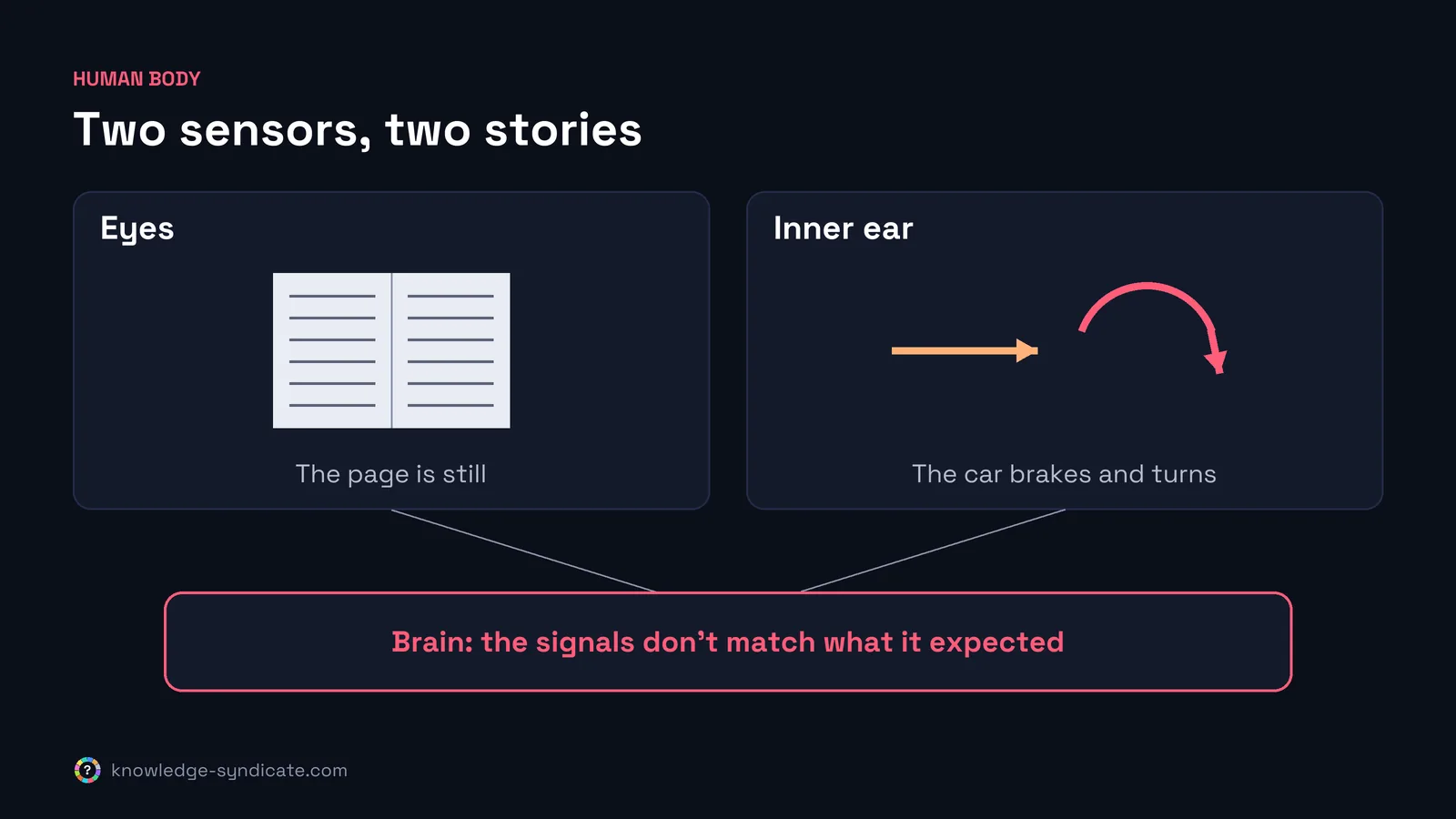
Your brain can’t stand being lied to, and the back seat of a car is a lie factory. You open a book on the highway, last three pages, and the cold sweat starts. So why do I get car sick when I read? The mechanism has a pretty solid answer. The reason behind it has a much more contested one. And there’s a strange fact along the way: people whose balance organs in the inner ear don’t work simply don’t get motion sick, in a car or anywhere else.
A problem more than 2,000 years old
Cars didn’t invent this. According to a 2016 review by Giovanni Bertolini and Dominik Straumann in Frontiers in Neurology, the first known thoughts on motion sickness go back more than 2,000 years to the Greek physician Hippocrates, who observed that sailing proves motion disorders the body. First came ships, then carriages, trains and cars. The problem is old; only the vehicle keeps changing.
Two sensors that disagree
To work out how you’re moving, your brain blends information from several sources. The two stars of this story are your eyes and the vestibular system, a set of sensors in the inner ear that detects acceleration, turns and the position of your head. It works like the accelerometer in a phone. It doesn’t need light or windows: it feels the shove even with your eyes shut.
For nearly your whole life, those two sensors tell the same story. You walk, the scenery moves, your inner ear feels the sway. Everything checks out. In a car with a book in front of you, it stops checking out. The vestibular system logs every brake and every curve. Your eyes, meanwhile, have been fixed for a while on a page that isn’t moving at all relative to you.
Why do I get car sick when I read but not when I look out the window
When you look at the road, your eyes see the scenery go by and confirm what the inner ear feels. Look down at a page and that confirmation vanishes. In 2015, Michael Sivak and Brandon Schoettle of the University of Michigan Transportation Research Institute summed up the three main factors behind motion sickness in a vehicle: conflict between balance and visual signals, not being able to anticipate the direction of motion, and having no control over that direction.
Reading in the passenger seat stacks all three. There’s conflict, because the page is still. You can’t anticipate, because you don’t see the curve coming. And you control nothing, because someone else has the wheel. The driver has two of those three factors on their side: they see the curve coming and they decide when to brake. According to the same work, activities like reading, texting, watching movies or playing games raise the likelihood and severity of motion sickness, while watching the road, talking on the phone or sleeping don’t necessarily cause it.
Conflict alone isn’t enough
Sensory conflict is the most accepted idea, and it comes with a twist that makes it more interesting. According to Bertolini and Straumann, a conflict between motion signals isn’t enough on its own to make you sick. What does it is a pattern that differs from what the brain expects based on past experience.
Put another way, the brain works like someone predicting the next move. Over the years it has learned how motion usually feels. When what arrives doesn’t match that prediction, the alarm goes off. That fits another observation in the same review: visual illusions of motion can also make people sick, even with the body sitting still. It’s the car situation flipped around: your eyes say you’re moving and your inner ear says you aren’t.
No inner ear, no motion sickness
Here’s the most striking fact. The 2016 review says it flat out: people without vestibular function in the labyrinth of the inner ear don’t get motion sick. That’s why researchers consider the vestibular system to be involved every time.
The observation is an old one. A review in the Journal of Vestibular Research notes that more than a century ago, deaf people with that kind of damage were already reported to seem immune. It has been seen in animals as well: according to that literature, work by Money and Cheung on dogs with the labyrinth removed on both sides suggests the loss changes how they respond to substances that trigger vomiting.
Which leads to the next question, the weirdest one of all. What’s a balance sensor doing in the vomiting business?
A poison detector making a mistake?
A brain spotting a contradiction explains the alarm. It doesn’t explain why the alarm ends in nausea. If the problem is bad information, the logical reaction would be, at most, to move carefully.
In 1977, Michel Treisman offered an answer in the journal Science, in a paper titled “Motion Sickness: An Evolutionary Hypothesis.” His reasoning starts from a coincidence: neurotoxins an animal swallows by accident produce symptoms very much like motion sickness. Many of them scramble perception and coordination. So over the course of evolution, a clash between the senses could have worked as a poisoning alert, and vomiting as the way to get the poison out.
On that view, the car is fooling a very old system. The consensus document from the Bárány Society, the international organization that specializes in these disorders, describes this hypothesis as treating motion sickness as an accidental, modern by-product of an ancient protective response to toxins. Vehicles have been around for a tiny slice of our species’ history, and the body has no plan for them.
The hypothesis has serious critics. One objection is about timing: once a toxin has reached the vestibular system, throwing up what’s left in the stomach doesn’t help much. Another is that it’s hard to test. A 2006 review by John Golding concluded that the balance of evidence favored the toxin-detector variant, but it’s still a hypothesis and should be treated as one.
The conflict theory has detractors too
The leading explanation isn’t closed either. A paper in the journal Ecological Psychology argues that the idea of conflict can’t reliably predict which situations make people sick and which don’t, and points somewhere else instead: to how we control posture and movement, in other words to the body’s instability. It’s a live argument among specialists, which is why this article talks about the most accepted explanation and not the final one.
Babies who can take it and kids who can’t
Motion sickness doesn’t hit every age the same way. A pediatric review in a Chilean otolaryngology journal says it frequently affects children, mainly between the ages of 2 and 12. The youngest seem to get a pass: a 2022 study of 81 children aged 2 to 17, published in the Journal of Neurology, notes that infants under about one or two are considered highly resistant, possibly because they don’t rely much on vision yet to perceive their own motion.
If that explanation is right, it fits everything above. Without that visual signal of motion, there’s little to contradict the inner ear. The study’s authors link kids’ susceptibility to how visual and balance signals get integrated, and they hypothesize that it arises from those conflicts between the senses.
The problem coming with driverless cars
If reading as a passenger makes you sick, self-driving cars have a design problem. In 2015, Sivak and Schoettle asked more than 3,200 adults in the U.S., India, China, Japan, Great Britain and Australia what they’d do instead of driving in a fully self-driving vehicle. More than a third of Americans said they’d do things that increase motion sickness, like reading, texting or watching movies. In India it was more than half, in China 40%, and in Japan, Great Britain and Australia between 26% and 30%. On the other side, more than 60% of Americans said they’d watch the road, talk on the phone or sleep, which wouldn’t necessarily make them sick.
From those numbers, they estimated that 6% to 12% of American adults riding in such vehicles would experience moderate or severe motion sickness at some point. Sivak explained it with the same three factors: in a self-driving vehicle, visual-balance conflict, the inability to anticipate and the lack of control all go up, because the former driver turns into one more passenger. That’s why the report suggests designing these cars with motion sickness in mind, for example with large, transparent windows that maximize the field of view, and with transparent video and work displays.