Why do we sneeze? The circuit from the nose to the brainstem
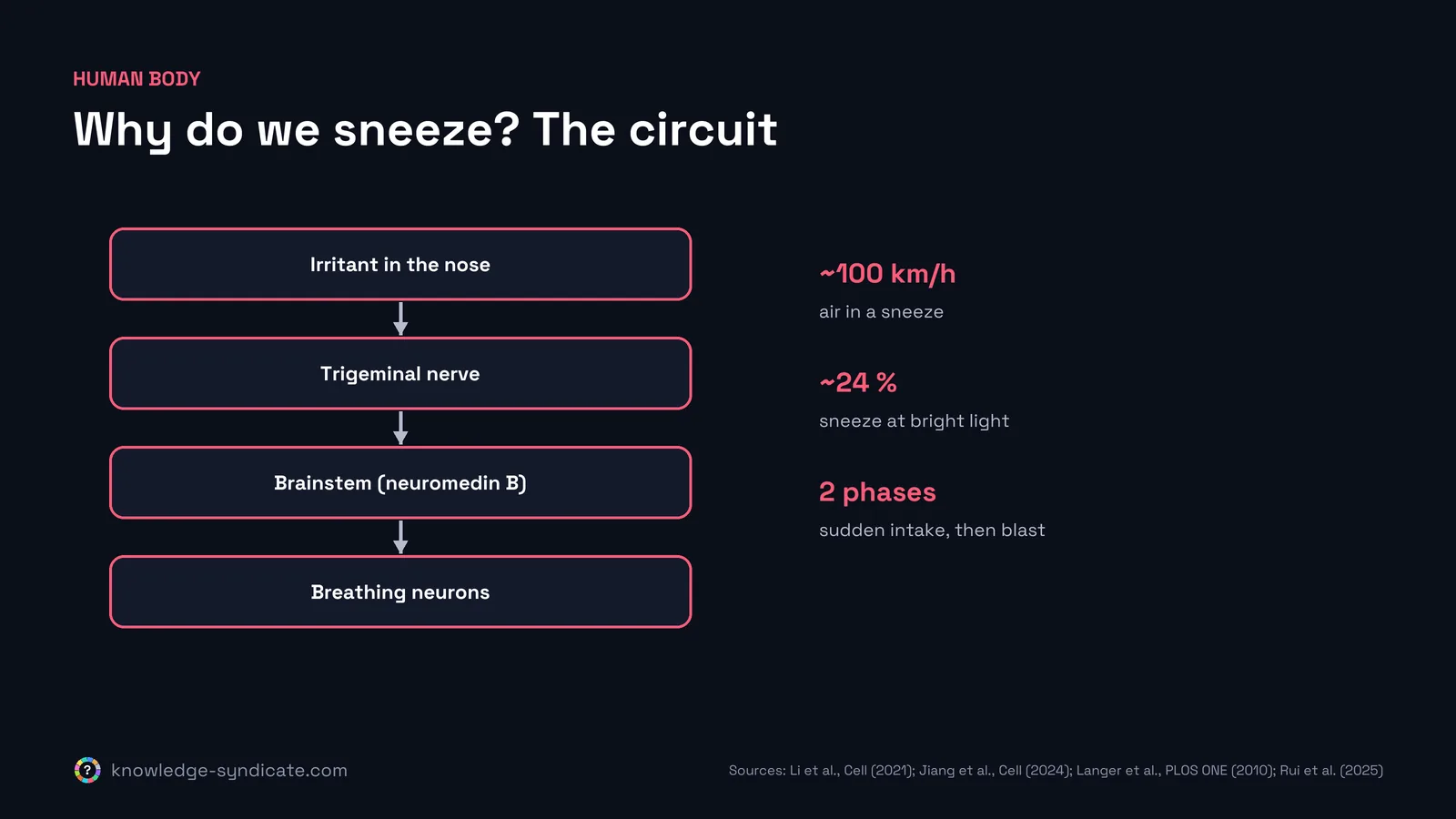
Everything is calm and suddenly something tickles your nose. You draw a breath without meaning to and, atchoo! You didn’t decide that. A sneeze is a reflex, and until a few years ago it wasn’t clear which wires connected it. So the question of why do we sneeze has two answers: what it’s for and how it works. In recent years, experiments with mice have started to map out the circuit piece by piece.
Why do we sneeze: a pressure wash
A 2025 review by Y. Rui and colleagues in Frontiers in Neuroscience describes it as a protective response of the body, designed to expel irritants or pathogens quickly from the airways. According to the review, it’s triggered mainly when receptors in the lining of the nose and throat are stimulated, receptors that detect things like pollen, smoke and other particles. In the nose, it says, these receptors start the sneeze through incoming C-type and cholinergic neurons.
The review quotes a striking figure: the air in a sneeze can reach nearly 100 kilometres per hour. That blast expels foreign particles and so keeps them from reaching the lower airways.
A 2010 paper by N. Langer and colleagues in PLOS ONE describes two phases. First, a sudden, spasmodic intake of breath. Then, an outward breath through the nose and mouth.
Forty thousand droplets
The sneeze also has a less pleasant side. The 2021 study by Li and colleagues, citing earlier work, notes that it is the most forceful and common mechanism for spreading infectious droplets in respiratory infections. According to that work, a single sneeze can create about 40,000 virus-laden droplets, which reach a radius of seven to eight metres and stay suspended in the air for up to ten minutes.
The comparison with coughing is striking. According to the same paper, a cough produces at most about 3,000 droplets, roughly the same as talking non-stop for five minutes.
My own calculation from those figures: in droplets, one sneeze is worth about thirteen coughs.
What sets off a sneeze
The triggers vary. According to Rui and colleagues, external ones include smells, dust, pollen and smoke. Irritant molecules such as capsaicin, the substance that makes chillies hot, or ammonia mainly stimulate the trigeminal nerve and produce stinging, cooling, burning or painful sensations that can end in a sneeze. Non-irritating smells act more through the olfactory nerve.
There are internal triggers too. Infections and inflammation can stimulate the receptors. In an allergy, according to the review, allergens such as dust mites or animal dander activate mast cells, which release substances like histamine, and that brings on inflammation and sneezing.
And there are odder triggers: a sudden blast of cold or hot air can stimulate receptors in the nose, and bright light can set off sneezes in some people.
The circuit, wire by wire
According to a 2021 study by F. Li and colleagues in Cell, the neural circuit of sneezing was still largely unknown. The team tackled the problem in mice.
First they had to make the mice sneeze in a measurable way. As they explain, capsaicin and histamine make humans sneeze, so they delivered them as droplets into the mice’s chambers with a nebuliser. Both compounds triggered sneeze-like episodes. The audio recordings showed peaks with both audible and ultrasonic components, and the breathing measurements showed forceful, convulsive outward breaths.
Then they looked for the messenger. According to the paper, a region of the brainstem that triggers sneezing was known in both cats and humans, and it matches the area where the nose’s sensory neurons end. They went through the neurotransmitters those neurons release and found that one peptide, neuromedin B, is indispensable for passing on the signal.
To make sure these were sneezes and not some other breathing reflex, they checked that they depended on the sensory fibres of the nasal lining rather than those of the trachea or lungs. The tests were decisive. If they destroyed the neurons in that region that respond to neuromedin B, or if the mice lacked the receptor for that molecule, the sneeze reflex disappeared. And those neurons in turn connect to a group of neurons that controls breathing. Activating them chemically was enough to make the mouse sneeze.
Sneezing and coughing aren’t the same
It used to be assumed that sneezing and coughing used the same receptors. A 2024 study by H. Jiang and colleagues, also in Cell, contradicts that in mice.
According to the authors, the nasal lining is supplied by several distinct populations of sensory neurons, but only one of them triggers sneezing in response to many irritants, allergens and viruses. That population also reaches the trachea, but it doesn’t trigger coughing. Coughing depends on a different population altogether. And at the circuit level, sneeze and cough signals travel along different pathways.
The 2025 review adds a detail: in mice in which those sneeze neurons are removed, the response to nebulised histamine, serotonin or capsaicin almost disappears. The review calls them, simply, “sneeze neurons”.
People who sneeze at the sun
Now the oddest case. Some people sneeze when they step suddenly into bright light. According to Langer and colleagues, it’s called the photic sneeze reflex, or ACHOO syndrome, an English acronym that sounds like a sneeze. They describe it as a sneeze that appears when someone adapted to the dark is suddenly exposed to intense light. It is usually set off by sunlight, though, as they note, it has been argued that artificial light, such as an ophthalmoscope, a camera flash or ultraviolet light, should also trigger it.
According to the paper, a Swedish study of blood donors found it in about 24 per cent of the people examined. It has also been seen in babies, which suggests some congenital factor. And since it’s more frequent when there is a family history, it was proposed to be inherited as a dominant trait. The authors warn, though, that this inheritance might be overstated, because people who know they have the reflex pay more attention to whether their relatives do too.
The paper also mentions, citing other authors, that the reflex has been considered potentially risky in certain jobs, such as baseball outfielders, high-wire acrobats and airplane pilots, and in everyday situations like driving out of a tunnel, which can triple the chance of a sneeze.
What happens in the brain
Langer and colleagues studied the phenomenon with electroencephalography, and describe their work as its first scientific examination. They compared people with the reflex and people without it while they looked at a checkerboard and at bright flashing lights.
They found that the visual cortex of photic sneezers was more excitable in response to visual stimuli. And the stronger tickle they felt in the nose was linked to activity in the insula and stronger activation in the secondary somatosensory cortex. Their conclusion is that the photic reflex wouldn’t be a classic reflex, the kind that stays in the brainstem or spinal cord, because it also involves specific areas of the cortex.
The paper also reviews two earlier ideas. One proposes a kind of crosstalk between the optic nerve and the trigeminal nerve. The other, that when one branch of the parasympathetic system is activated by light, neighbouring branches are activated too.
A disputed centre
There’s an interesting detail of timing. In 2010, Langer and colleagues wrote that a sneeze centre had been identified in the medulla of cats, but that it hadn’t yet been confirmed in humans. In 2021, Li and colleagues were already speaking of a region that triggers sneezing in both cats and humans.
My own reading, which is reasoning from the two sources: in a decade, the sneeze went from being a reflex with a doubtful centre in humans to a circuit with molecule names attached, at least in mice.
What’s left
My own reading, which is reasoning from the sources: a sneeze looks like a simple act, a burst of air and that’s it. But behind it are receptors in the nose, a nerve, a messenger molecule, a region of the brainstem and the neurons that move the lungs. And in one person in four, a short circuit with light as well. If you step into the sun and your nose tickles, it may be your visual cortex poking its nose in where it isn’t wanted.