Year without a summer: the 1815 volcano and the cold summer that gave us Frankenstein
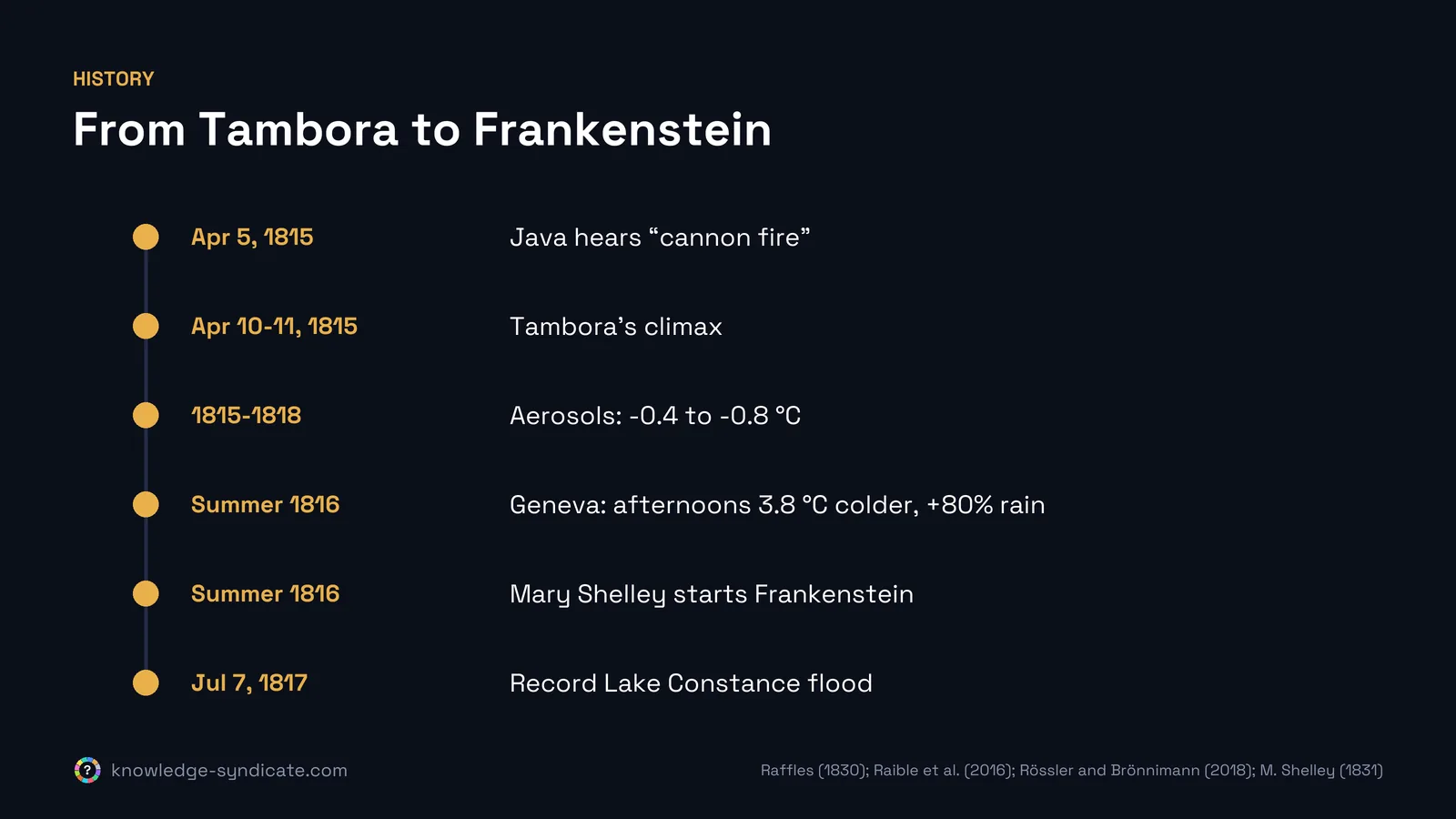
In the summer of 1816, Mary Shelley and her companions visited Switzerland and settled by Lake Geneva, as neighbors of Lord Byron. What they got was a wet, ungenial summer. The rain kept them indoors for days on end. To pass the time they read ghost stories and agreed to each write one. Out of that bet came Frankenstein. Their bad weather had started a year earlier and very far away, when a mountain in Indonesia blew itself apart. That’s the story of the year without a summer.
Cannon fire nobody had fired
The first warning was a noise. Thomas Stamford Raffles, then the British lieutenant-governor of Java, asked the officials in charge of each district on the island to write down what they had seen, and gathered their replies into an account that his widow published in 1830 in the memoir of his life.
According to that account, the first explosions were heard on Java on the evening of April 5, 1815. Almost everyone thought of distant cannon. A detachment of troops marched out of Djocjocarta, convinced a neighboring post was under attack. Along the coast, boats were sent out twice to look for a supposed ship in distress. In Macassar, the commander of the cruiser Benares took soldiers aboard to chase down pirates who didn’t exist. They came back on the 8th having found nothing.
The morning after the first blasts, a light fall of ash settled the question. It was a volcano. Even so, nobody could tell which one: in every district the noise sounded so close that people blamed the Marapi, the Gunung Kloot or the Gunung Bromo, volcanoes on Java itself. It was Tambora, on the island of Sumbawa, a good deal further east.
Breakfast by candlelight
The worst came on the night of April 10. The explosions grew louder and more frequent, and on the 11th they were shaking houses. One of the reports, written in Gresie, east on the island, tells the morning of the 12th almost minute by minute. The writer woke after what seemed a very long night, held his watch to the lamp and saw it was half past eight. At nine, no daylight at all. At eleven he breakfasted by candlelight, while the birds began to chirp as if dawn were breaking. At five in the afternoon he still couldn’t read or write without a candle.
In Banyuwangi the ash reached eight inches on the 12th and nine on the 15th. The report adds that it was extremely cold during those days. In Sumanap, the river suddenly rose four feet and fell back in about four minutes.
The commander of the Benares left the most harrowing description. At noon on the 12th, at sea, the darkness was so complete that you couldn’t see your hand held up in front of your eyes. The ash got into every part of the ship despite the awnings, and on deck it piled up a foot deep in places. When the ship neared Sumbawa on the 18th, the sea was covered in floating pumice, with burned and splintered logs. He mistook one of those rafts for a sandbank more than three miles long.
A Malay boat captain who passed Tambora at five miles said the lower part of the mountain was in flames. He went ashore for water and found the ground covered with three feet of ash and many of the inhabitants dead from famine. On Java, some people had their own explanation: the celebrated Nyai Loroh Kidul, a figure from their legends, had married off one of her children and was firing salutes from her supernatural artillery. They called the ash the dregs of her ammunition.
What science knows about Tambora
In 2016, an international team with C. C. Raible of the University of Bern as first author published a review in the journal WIREs Climate Change of what is known about Tambora. Its figures give scale to Raffles’ account.
According to the review, the climax of the eruption came on April 10 and 11, 1815, after almost a week of smaller blasts. The summit collapsed, leaving a caldera six by seven kilometers across and more than a kilometer deep. Recent estimates put the magma at 30 to 50 cubic kilometers, and the sulfur dioxide released at about 60 million tonnes. Before the big blast, the eruption columns were already more than 30 kilometers high.
The eruption killed thousands of people on Sumbawa immediately, and over the following months tens of thousands died of starvation and disease on Sumbawa and neighboring islands. It was the largest since Samalas in 1257. An earlier paper, published in Science in 1984 by R. B. Stothers, called it the world’s greatest ash eruption, so far as is definitely known, since the end of the last Ice Age.
What mattered for the climate was the gas. The plume rose into the stratosphere and formed sulfate aerosols that blocked part of the incoming sunlight for the next three years. According to the review, they cooled the annual average of the tropics and the extratropical Northern Hemisphere by 0.4 to 0.8 degrees compared with the previous thirty years. That sounds small. Spread across a whole year and half a planet, it isn’t.
The year without a summer, measured in Europe
The following year, 1816, got the nickname. The Bern review talks about failed harvests and famines across the Northern Hemisphere, including China, North America and Europe. And it brings in the thermometers of the time.
The summer of 1816 was one of the coldest measured across much of Western Europe, from central Scandinavia to the Mediterranean. The Central England Temperature series, which starts in 1659, ranks it as the third coldest summer in the whole record, behind only 1725 and 1695. Over the full year, 1816 averaged 7.9 degrees in that series, three below the 10.9 of 2014, the warmest year in the series when the review was written. Only one week of spring and summer, in late April, came in above normal.
Further east, in Russia and Ukraine, the few records point to a milder summer. The cold wasn’t the same everywhere. Air pressure that summer shows a weak Azores high and a strong Icelandic low, and data from about fifty stations point to more storms than usual in a band running from western France to Austria.
Geneva, the heart of the cold
And in the middle of that band sat Geneva. The review says the city lies in the region with Europe’s largest cold anomaly in 1816. Its twice-daily readings show afternoon temperatures shifted down by 3.8 degrees compared with the reference years, and sunrise temperatures by 1.8. Very cold mornings were no more common than usual. What vanished were the warm ones.
Summer rain in Geneva rose by 80%. Each downpour was as intense as usual, but it rained on many more days. The authors sum it up with a fine distinction: 1816 had extreme climate rather than extreme weather. Lots of gray days in a row, instead of a few terrible ones.
Across the Atlantic, in Boston, 1816 is also called the year without a summer. And according to recent reconstructions, over a large part of eastern North America temperatures were two degrees below the 1700 to 1890 average.
The snow that stayed
In Switzerland the cold left a legacy of water. A 2018 study by O. Rössler and S. Brönnimann of the University of Bern notes that snow was reported to have lasted through the summer of 1816. On July 7, 1817, Lake Constance reached the highest flood ever documented, and the Rhine flooded in Basel.
Their hydrological model adds nuance. Snow buildup in the springs of 1816 and 1817 was huge, comparable to the snowy winter of 1999. But according to their simulations, what fed the flood was the snow that fell in spring 1817, more than any snow surviving from 1815 and 1816. It also took a rainfall bigger than the worst recent flood, in 2005. They describe it as a bad combination of extreme weather inside an extreme climate.
A bet by the lake
Mary Shelley told the story in the introduction she wrote in 1831 for a new edition of Frankenstein. In the summer of 1816 they visited Switzerland and became Lord Byron’s neighbors. At first they spent their hours on the lake or walking its shores. But it proved a wet, ungenial summer, and incessant rain often confined them to the house for days.
Some volumes of ghost stories, translated from German into French, fell into their hands. Byron proposed they each write one. There were four of them. Byron started a tale and Percy Shelley another. Polidori had a terrible idea about a skull-headed lady punished for peeping through a keyhole, and then didn’t know what to do with her. The poets, bored with prose, soon gave up.
She kept going. She says that every morning they asked whether she had thought of a story, and every morning she had to say no. One night she listened to Byron and Percy Shelley discuss the principle of life: there was talk of experiments credited to Dr. Darwin and of galvanism, and of whether a corpse might be reanimated. In bed, unable to sleep, an image seized her: the pale student of unhallowed arts kneeling beside the thing he had put together. The next day she announced she had her story and began with the words “It was on a dreary night of November.” She had in mind a tale of a few pages. Percy Shelley urged her to make it longer.
The preface to the first edition, from 1818, puts it more plainly: the summer of 1816 around Geneva was cold and rainy, and in the evenings they crowded around a blazing wood fire. Then the weather suddenly cleared, the friends went off on a trip through the Alps and forgot their ghosts. Only one of those stories was ever finished.
Put the two stories together and you get the pieces of one. Geneva was the place in Europe where the cold of 1816 hit hardest, and that cold came from a volcano that on Java had sounded like cannon fire. Between the rain of that summer and one sleepless night came a monster people still read.