Great Fire of London: the four days of 1666 told by those who saw them
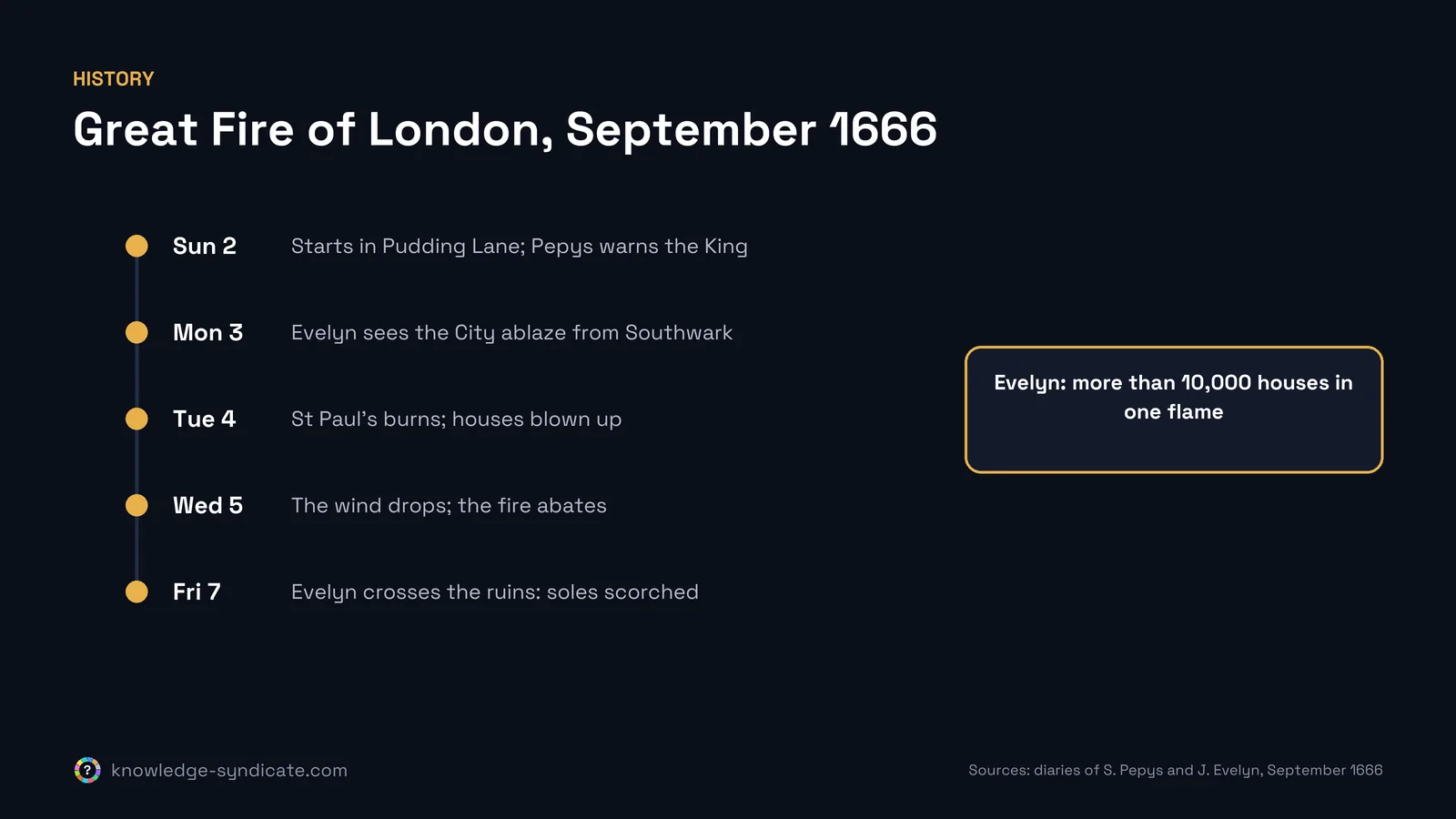
Some disasters we know through numbers. This one we know through two men who wrote down each night what they had seen that day. Samuel Pepys and John Evelyn weren’t historians, and that’s exactly why their diaries feel so close: the cheese buried in the garden, the pigeons that wouldn’t leave their houses, the shoes scorched on the ashes. The Great Fire of London in 1666 can be followed almost hour by hour through their eyes.
Three in the morning
Pepys tells it like this in his diary, in the Project Gutenberg edition. On the Saturday night some of the maids had stayed up preparing for the next day’s feast. At about three in the morning Jane, one of them, woke him to say a great fire could be seen in the City. Pepys got up in his nightgown, looked out of her window, reckoned it was at the back of Mark Lane at the farthest and, being unused to fires like the one that followed, went back to bed.
At seven he got up again. Jane told him she’d heard that more than 300 houses had burned down that night and that the fire was now burning all of Fish Street, by London Bridge. Pepys walked to the Tower, climbed to a high place and saw the houses at that end of the bridge all on fire. The Lieutenant of the Tower told him it had begun that morning in the King’s baker’s house in Pudding Lane, and had already burned St Magnus’s Church and most of Fish Street.
Great Fire of London: the view from the river
Pepys took a boat and went through the bridge. He saw people trying to save their goods, flinging them into the river or loading them into lighters. The poor stayed in their houses until the fire touched them, then ran to the boats. And he notes a detail that sticks: the pigeons were loath to leave their houses and hovered about the windows and balconies until their wings burned and they fell.
According to Pepys, nobody was trying to put the fire out; everyone was busy removing their goods. The wind was very high, driving it into the City, and after so long a drought everything burned, even the very stones of churches.
The King, the Lord Mayor and the hooks
Pepys went to Whitehall and told the King and the Duke of York what he had seen. He told them that unless the King commanded houses to be pulled down, nothing could stop the fire. The King sent him to tell the Lord Mayor to spare no houses and to pull down before the fire in every direction.
Pepys found the Lord Mayor in Cannon Street, worn out, with a handkerchief about his neck. According to the diary, on hearing the message the Lord Mayor cried that he was spent, that people would not obey him, and that he had been pulling down houses all night but the fire was overtaking them faster than they could do it. A note in the edition quotes a letter from the same day: the Duke of York feared a lack of workmen and tools, and in some churches there were great hooks for pulling down houses.
An arch of fire
In the afternoon Pepys went back on the river with his wife and some friends. He writes that on the Thames, with your face in the wind, you were almost burned by a shower of fire-drops, and that those drops and flakes set houses alight three, four, five or six houses away. They took refuge in an ale-house on Bankside, opposite the Three Cranes. As it grew dark they saw the fire as one entire arch from one side of the bridge to the other and up the hill, an arch of more than a mile. He writes that it made him weep to see it.
What Evelyn saw
John Evelyn lived it from another bank. In his diary, in the 1895 edition digitised on Archive.org, he records that on the 2nd that deplorable fire began near Fish Street. On the 3rd he drove with his wife and son to Bankside in Southwark and saw the whole City in flames along the waterside: all the houses from the bridge, all Thames Street and up towards Cheapside, down to the Three Cranes.
The next day he went back on foot. According to Evelyn, the night had been as light as day for ten miles around. The fire was driven by a fierce east wind in a very dry season, and it kindled back against the wind as well as forward. Evelyn agrees with Pepys on one thing: from the start people hardly stirred to quench it, and ran about like distracted creatures without even trying to save their goods.
Ten thousand houses in one flame
Evelyn writes that he saw more than 10,000 houses in one flame, that the sky looked like the top of a burning oven and that the light could be seen more than 40 miles away for many nights. By his reckoning the flames burned for nearly two miles in length and one in breadth, and the clouds of smoke stretched nearly 56 miles. The surrounding fields filled with furniture and tents to shelter people and whatever they had saved.
My own calculation, which is plain arithmetic: a mile is about 1.6 kilometres, so the fire front Evelyn describes was about 3 kilometres long and 1.6 wide.
St Paul’s and the molten lead
On 4 September, according to Evelyn, the fire reached the Inner Temple, and Fleet Street, the Old Bailey, Ludgate Hill and Newgate were burning. The stones of St Paul’s flew like grenades, molten lead ran down the streets, and the pavements glowed red, so that neither man nor horse could tread on them. That night Pepys records that St Paul’s had burned, along with all of Cheapside, and that he couldn’t send a letter to his father because the post house had burned down.
Cheese and wine underground
Pepys spent those days getting his things away. Early on the Monday he took his money and plate by cart to a friend’s house at Bethnal Green, still in his nightgown. On the Tuesday, with no way of moving everything, he dug a pit in the office garden with Sir W. Pen and put the wine in it. And he adds, quite calmly, that he also buried his Parmesan cheese.
Blowing up houses
What changed things was blowing up houses with gunpowder. Pepys says that on the Tuesday night the practice of blowing up houses began in Tower Street, near the Tower. At first it frightened people more than anything, but it stopped the fire, because it brought the houses down where they stood and then it was easy to put out what little was burning.
Evelyn saw it on Wednesday the 5th from Fetter Lane, where the King had ordered him to help. He writes that some seamen had proposed blowing up houses early on, which, he believed, would have saved nearly the whole City, but that some aldermen wouldn’t allow it because their houses would have been the first to go. That day the wind dropped and, around noon, the fury of the fire began to abate.
After the fire
On the Wednesday Pepys climbed Barking steeple and writes that he saw the saddest sight of desolation he ever saw. He crossed the City walking over hot coals, paid twopence for a penny loaf and picked up a piece of glass from the Mercers’ Chapel, melted and buckled like parchment. He saw a cat pulled out of a hole in a chimney with all its hair burned off, and still alive.
On the 7th Evelyn walked through the ruins. The soles of his shoes burned. Of St Paul’s only the inscription on the portico remained whole, and the lead on the roof, about 6 acres by his reckoning, had melted completely. The books the stationers had stored in St Faith’s below were burning for a week. Besides St Paul’s, Evelyn says, nearly a hundred other churches lay in ruins, along with the Mercers’ Chapel, the Exchange and the livery halls. According to Evelyn, some 200,000 people were scattered towards Islington and Highgate with what little they had saved.
Two diaries, one city
My own reading, which is reasoning from the two diaries: Pepys and Evelyn don’t agree on everything, and the details of timing don’t match exactly, but they describe the same fire. A city of tightly packed houses, with stores of oil, pitch and spirits by the river, after a dry summer, with an east wind. And a slow response. The Great Fire of London went out when people did what Pepys told the King on the first morning: open gaps the fire couldn’t jump.