How did Roman sewers work? Water, waste and a city that never turned off the tap
How did Roman sewers work? Well enough to earn their reputation as an engineering miracle. But if you could stroll through the Rome described by its own writers, cleanliness wouldn’t be your first impression. You’d hear water rushing under your feet, smell rancid oil from the jars, and, with a bit of bad luck, start scratching your head. The city had the best plumbing of its world and, at the same time, lice, worms and a black market in water. Both things are true.
Four hundred and forty-one years of river water
Our most direct source is a civil servant. Frontinus was appointed water commissioner of Rome by the emperor Nerva and wrote a treatise about the job, De aquis, which survives complete. He opens by explaining that the post concerns not only the convenience but also the health and even the safety of the city, and that he means to understand the business before running it.
His history starts with a fact that puts things in perspective: for 441 years after the city’s founding, Romans made do with water from the Tiber, from wells and from springs. The first aqueduct, the Appian, was brought in by the censor Appius Claudius, the same man who built the Appian Way, in 312 BC according to the Loeb edition. His colleague Plautius had found the springs.
By Frontinus’s day nine aqueducts ran into Rome, and he lists them one by one: Appian, Old Anio, Marcia, Tepula, Julia, Virgo, Alsietina, Claudia and New Anio. The arches of New Anio reached 109 feet in places. Frontinus was proud enough to land a jab: set against such works, compare if you will the idle Pyramids or the useless, though famous, works of the Greeks.
Why the water never stopped
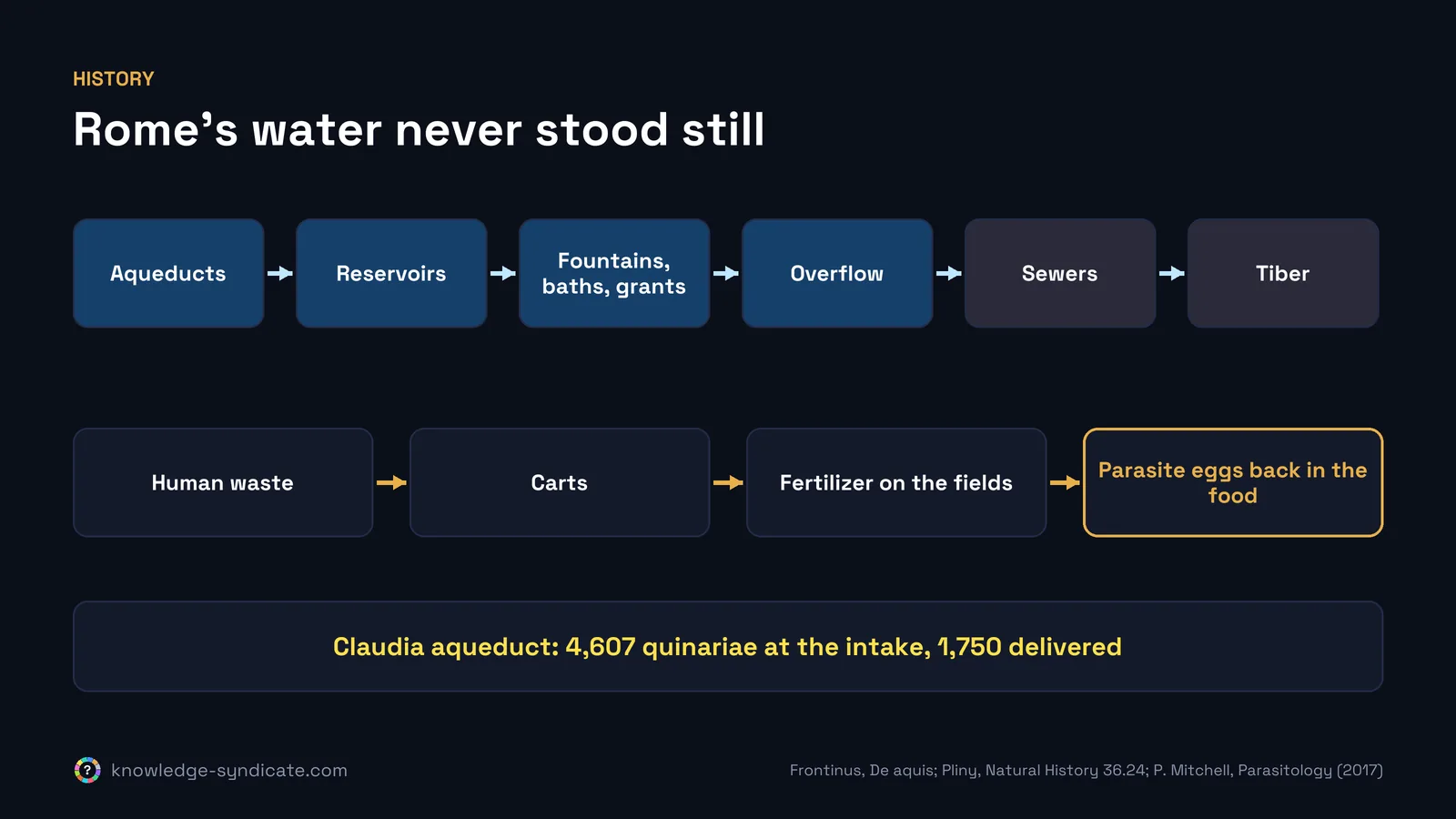
One difference from your home helps explain the system. In Frontinus’s Rome, the reservoirs had to overflow. Water came from the aqueducts into reservoirs, and from there it was shared out, following the plan of his own book, among public works, fountains, basins, the emperor and private holders of water grants. Whatever was left kept going.
The old law, Frontinus explains, let private citizens take only water that spilled from the basins onto the ground, the overflow, and only for baths or fulling works, for a fee. And that overflow had a destination set down in writing. Frontinus copies an imperial order forbidding anyone to take overflow water without permission, because the reservoirs must overflow, and that is proper not only for the health of the city but also for flushing the sewers. So Roman sewers didn’t run on rain and luck. They had a steady stream of clean aqueduct water pushing whatever was inside.
Frontinus boasts about the result. After his reforms, he writes, not even waste water is lost, the city looks clean and changed, the air is purer, and the causes of the unhealthy atmosphere that gave Rome’s air such a bad name among the ancients have been removed.
How did Roman sewers work underground? Ask Pliny
For the underground part, the best witness is Pliny the Elder. In his Natural History he calls the sewers the most stupendous work of all, since mountains had to be pierced to build them. He records that Marcus Agrippa, as aedile, actually sailed beneath Rome, and that seven rivers, brought in through artificial channels, ran under the city sweeping away all the filth.
His description reads almost like a damage report. Those torrents, swollen by rain, pound the floors and walls. Sometimes the Tiber floods and pushes back in, and river water and sewer water clash in the tunnels. Above them, houses collapse on their own or burn down, and now and then the ground shakes. And yet, he says, these works, built under King Tarquinius Priscus seven hundred years earlier, had survived almost unharmed. According to the story he passes on, Tarquinius made them wide enough for a wagon loaded with hay.
Pliny adds a story he says the great historians left out. The work was so hard and so long that many of the laborers put on it killed themselves. The king’s answer was brutal: he had the bodies of the suicides nailed to crosses, on display to their fellow citizens and to the birds. Shame, according to Pliny, stopped the suicides. Rome’s great sewer began, in his telling, with worn-out laborers and hanging corpses.
The black market in water
The best thing about Frontinus’s book is that it reads like an audit, and it exposes massive fraud. Water was measured in a unit called the quinaria. According to the official records, the Claudia aqueduct supplied 2,855 quinariae. Frontinus measured it at the intake and got 4,607. Yet only 1,750 reached the city. Along the way, water vanished on a grand scale.
The culprits had job titles. Frontinus describes water-men who, when a water grant changed hands, fitted a new nozzle to the reservoir and left the old one in place, drawing water from it to sell. And he describes the “puncturers.” In many parts of the city he found secret pipes running under the pavement, bored here and there to feed water through special branches to the businesses along the way. The upshot was that only a small amount was left for public use.
In other words, under the streets of Rome there was, as well as sewers, a pirate network of pipes. And the water commissioner put it in writing.
The waste that didn’t go down the drain
Not everything could be flushed. For human waste, as archaeologist Piers Mitchell of the University of Cambridge notes in a review in Parasitology, the Romans brought in laws requiring waste from towns and cities to be collected in carts and taken out to the countryside, where it was used as fertilizer.
And not every building was hooked up to a sewer that drained well. In Herculaneum, the town Vesuvius buried in AD 79, the Herculaneum Conservation Project excavated a branch of a sewer under an apartment block in 2007. On the ground floor there were shops, including a wine bar and a bakery, with two floors of rental apartments above. The sewer collected waste horizontally and had no outlet for solids, so it worked as a huge cesspit: more than a meter of material built up along 53 meters, sealed by the ash of the eruption.
For archaeologists it was a treasure. Rebecca Nicholson, Jennifer Robinson, Mark Robinson and Erica Rowan identified around 70 kinds of fish, 48 of marine mollusks and 3 of crustaceans. Most of the fish were small ones netted close to shore, cheap and nutritious food. In another study, Rowan counted 194 kinds of remains in all, including plants, fish, shellfish and birds. Ordinary people in Herculaneum ate a very varied diet, and we know because their sewer didn’t drain.
A mountain made of jars
Rome’s most famous trash is in plain sight. Monte Testaccio is an artificial hill about 150 feet tall and almost a mile around, made almost entirely of olive-oil amphorae from the province of Baetica, in what is now southern Spain.
José Remesal, co-director of the excavations for the University of Barcelona, estimated in a 2009 interview with Archaeology magazine something like 25 million complete jars, while warning that it’s hard to be exact. According to the same article, the dump was used from the reign of Augustus until the mid to late third century AD. These jars had thick walls and broke into large curved pieces, so recycling them didn’t pay, and throwing them away was probably cheaper.
What’s striking is how tidy the dumping was. Excavators found base-less jars filled with fragments acting as retaining walls, in terraces, each row set back a little to build the slope. And a thick layer of lime covered the debris, masking the smell of rancid oil. Remesal believes a dump this size must have had its own administration, though no one knows how it worked.
Sewers yes, health not so much
Here comes the twist that never makes the guided tour. Mitchell reviewed published parasite evidence from Roman-period sites in ten countries, from Britain to Egypt, including Rome, Pompeii and Parma. His summary opens with an impressive list: large multi-seat public latrines with washing facilities, sewer systems, sanitation laws, fountains and piped water from aqueducts. And yet whipworm, roundworm and the amoeba that causes dysentery were widespread.
His conclusion is that these public measures weren’t enough to protect people from parasites spread by fecal contamination. You’d expect them to fall with clean water, latrines and hand washing, he says, but that’s not what happened. One possible explanation is the fertilizer. Unless human waste is composted for many months before it goes on the fields, the parasite eggs reach the plants alive. The law that got the filth out of town sent it back in the food.
Lice tell a similar story. Mitchell lists fleas, head lice, body lice, pubic lice and bed bugs. Special combs for removing lice have been found, and delousing may have been a daily routine. In York, the concentration of lice and fleas in Roman layers was similar to that in Viking and medieval ones. The famous public baths don’t show up in the data.
And there’s one parasite the Romans seem to have spread across the map: fish tapeworm, more common in the Roman period than in the Bronze and Iron Ages. Mitchell points to fish sauce, garum, made from pieces of fish, salt and herbs, left to ferment in the sun without cooking, and traded across the whole empire.
What really kept the city running
Put Frontinus, Pliny and the archaeologists together and real Rome looks more like a modern city than you’d expect: magnificent infrastructure, barely kept up, with leaks, fraud and side effects nobody had planned for. Water poured in nonstop, flushed the sewers on the way out and went missing along the route in pirate pipes. Waste left in carts, in shiploads of jars that ended up on a hill, and in cesspits nobody emptied. And the people, well watered and well bathed, kept scratching their heads.
Frontinus wrote that his job concerned the health of the city. He was right, though probably not in the way he meant. The same system that made Rome’s air cleaner sent its leftovers to the fields that fed Rome.