Balmis Expedition: the vaccine carried around the world in children’s arms
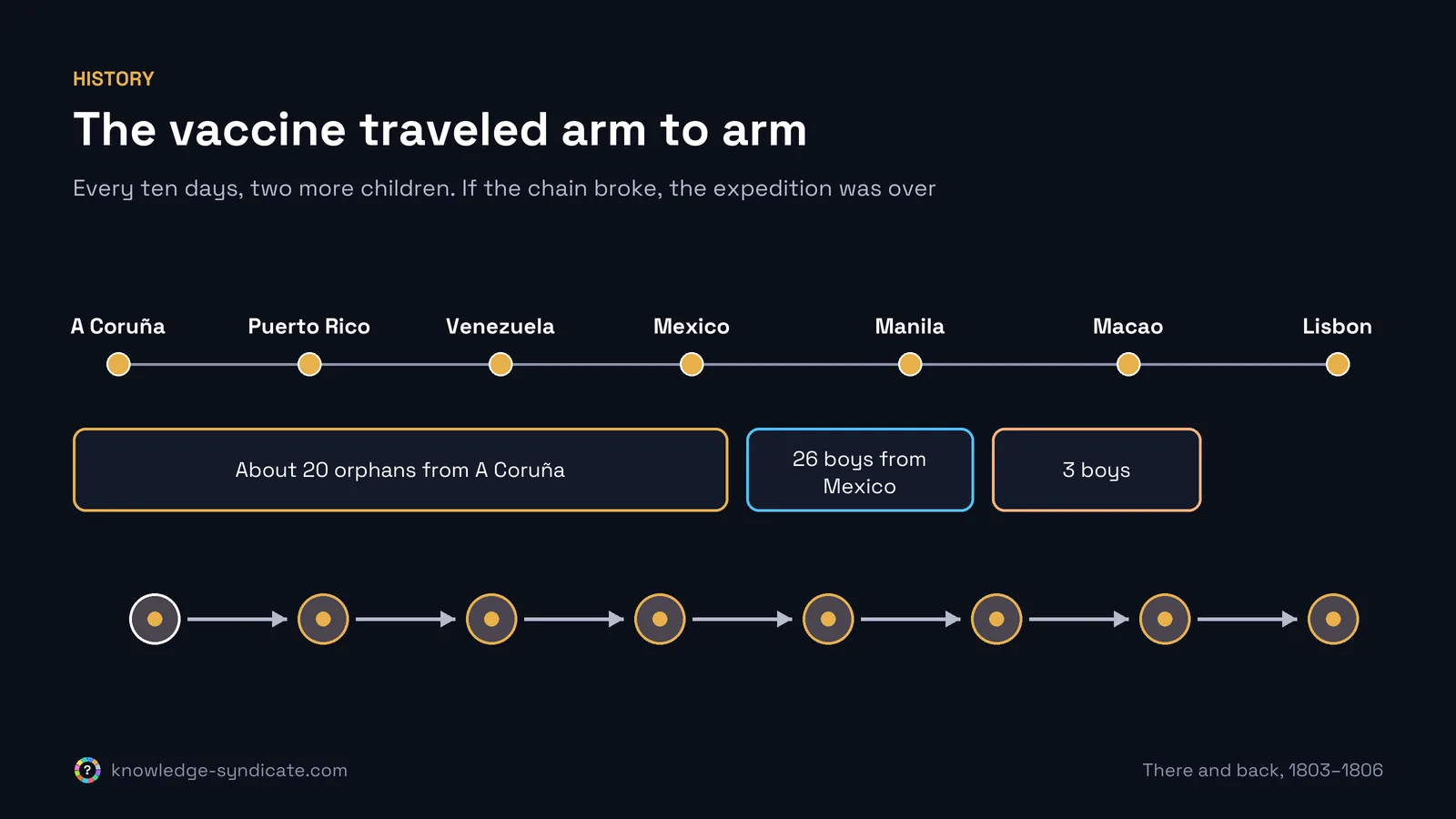
The Balmis Expedition had a logistics problem that’s hard to believe now. It needed to move a live biological product across an ocean, for weeks, with no refrigeration. The solution was to put it inside children. About twenty orphans from a foundling home in A Coruña went aboard, and during the crossing the virus passed from one arm to another, like a flame that has to be lit again before the last one dies. It’s one of the most brilliant feats in the history of medicine, and it gets less comfortable the closer you look.
A king with personal reasons
Smallpox had crossed the Atlantic with the conquistadors and had been ravaging the Americas for nearly three centuries. A 1972 article in the medical magazine MD gives some dizzying figures: an epidemic in Santo Domingo in 1515 with 200,000 dead and, in Mexico City alone in 1779, more than 44,000 cases and 8,820 deaths. Humboldt reckoned the waves came back every 17 or 18 years.
In 1796, Edward Jenner in England had vaccinated James Phipps, aged 8, with matter from cowpox, then showed the boy didn’t fall ill when exposed to real smallpox. He published in 1798. King Charles IV of Spain knew the disease up close: according to a chronology from East Carolina University, he’d had his children inoculated during the 1798 outbreak and received a copy of Jenner’s treatise in 1800. On March 14, 1803, he ordered an inquiry into how to bring the vaccine to his empire. Mass vaccination campaigns didn’t exist yet. This one, in the words of a paper by Catherine Mark and José Rigau-Pérez, would be the world’s first immunization campaign.
The problem: the vaccine died along the way
The vaccine back then wasn’t made in a lab. It was pus from a cowpox blister. You could keep it between two sheets of glass or soak it into silk threads and let it dry, but neither method was reliable on a long voyage. And infected cows weren’t exactly on hand everywhere.
There was one curious proposal, from the doctor José Flores, who had worked in Guatemala: send two light ships with infected cows and boys to be vaccinated arm to arm. In the end, the cow-free version from Francisco Javier de Balmis won out. Balmis was a 50-year-old from Alicante, son and grandson of surgeons, who had worked in Mexico during the 1779 epidemic and had translated a French treatise on the vaccine into Spanish. He’d also published a book defending a syphilis remedy based on Mexican roots, one of them a begonia that ended up bearing his name. The remedy didn’t make history. The logistics did.
Here’s how the method worked. Two children were vaccinated, and nine or ten days later, when the blister had ripened, fluid was taken from it to vaccinate two more. The chain couldn’t break. If at any point all the immunized children ran out of a fresh arm to pass the virus to, the expedition was over in mid-ocean. And it took a lot of children, because each one could only be used once: after that, they were immune.
What else went in the luggage
The children weren’t the only cargo. Balmis also took several thousand vaccine samples sealed between glass slides, as a backup he didn’t fully trust. He loaded barometers and thermometers for weather observations along the way, and 500 copies of his translation of the French treatise to hand out in colonial capitals. Those books had a double purpose: to teach local doctors the procedure and, it seems, to prop up his authority as the man in charge. The pay was spelled out in the royal order of August 4, 1803: 2,000 silver pesos a year for him, half that for his physician assistants, 600 for the surgeons and 500 for the nurses. There’s no line in the surviving summary for the children, whose payment was a promise of schooling.
And the risk was real, which is why the whole thing made sense. The older technique, variolation, deliberately infected people with pus from actual smallpox, and it could trigger a serious or even fatal case. Jenner’s method used a much milder disease. It was the difference between lighting a match near a powder keg and lighting one in the rain, and that’s why a king would pay for a ship full of boys to carry the safer one across the world.
Who the children were
It’s worth pausing here. The children came from a foundling home, and that’s no small detail. The royal order let Balmis use children from orphanages, with their parents’ permission when the parents were known, and in return the government would pay for their education. He first tried it with five orphans from Madrid on the trip to A Coruña, who were later sent home. The boys from the local foundling home boarded there.
Sources don’t agree on how many there were or how old. The 1972 article says 20 boys aged 8 to 10. The East Carolina chronology also says 20. Other sources say 22, aged 3 to 9. But nobody disputes the main point: they were small children, with no family in a position to refuse, and they traveled as living containers. A 2021 Guardian headline, about an exhibition devoted to them, flatly called them fridges.
Balmis, it has to be said, looked after them with unusual rigor. He demanded good food, proper clothing and a separate sleeping cubicle for each boy, because contact between them could spread the virus uncontrollably and use up the arms too soon. The motive was as practical as it was humane. According to the 1972 article, the whole trip around the world saw some seasickness and a single case of illness among the children. Other sources mention a death, and that detail isn’t settled.
Isabel Zendal, the only woman on board
The children’s carer was Isabel Zendal, director of the foundling home in A Coruña, whose surname appears in the documents in several spellings: Cendala, Sendales, Zendal. She boarded with her own small son. She was the only woman among a team of five doctors, two surgeons and three male nurses.
She did far more than her job required. When she was given the choice in Mexico of going home or carrying on across the Pacific, she carried on. According to a publication from the Galician Parliament and other sources, the World Health Organization regards her as the first nurse in history on an international mission. That recognition gets cited a lot, though no WHO document saying so has been tracked down.
The Balmis Expedition, port by port
The ship María Pita left A Coruña on November 30, 1803. It stopped in the Canary Islands and reached Puerto Rico on February 9, 1804. There came the first letdown: the vaccine had already arrived from elsewhere in the Caribbean. Balmis, by all accounts very touchy about his authority, didn’t take it well.
On March 20 they reached Puerto Cabello, in Venezuela, and the expedition split in two. José Salvany took the southern route into South America, on a journey of years through jungle and mountains: by 1809 he still hadn’t reached Buenos Aires. The 1972 article says one of Balmis’s assistants gave his life for the mission. Balmis went on to Cuba and Mexico, entering the capital on August 8, 1804. According to the chronology’s estimates, about 100,000 children were vaccinated in Mexico, around 2% of the population.
Here’s the part that rarely gets told. The orphans from A Coruña stayed in Mexico, in the viceroy’s care. Balmis instead organized the next stage with 26 Mexican boys, who left Acapulco on February 9, 1805, for the Philippines, five weeks across the Pacific. They reached Manila Bay on April 15. Then, with just 3 boys, Balmis went on to Macao and Canton, where he sought help from the British East India Company without success. After a later outbreak, that same company ended up paying for a vaccination clinic.
Saint Helena and the way home
On the way back he stopped at the British island of Saint Helena in the middle of the Atlantic, on February 18, 1806. The English vaccine hadn’t reached this English possession, and a Spanish doctor was the one who brought it. He reached Lisbon in mid-August, and on September 17 Charles IV received him at San Ildefonso.
He’d gone around the world. And he left behind something longer lasting than the jabs: in each major territory he set up vaccination boards and public rooms, a system to keep the chain going once he’d left. He returned to Mexico between 1809 and 1811 to check on it, and found mixed results. Jenner is credited with saying history could hardly offer a nobler example of philanthropy.
Two hundred years later
Smallpox was declared eradicated in 1980, the only human disease ever wiped out. Balmis’s name came back into the papers in 2020, when the Spanish army called its pandemic deployment Operation Balmis. And Madrid named an emergency hospital after Isabel Zendal.
We know far less about the children. The royal order promised to educate them at state expense, and on paper they ended up in the viceroy’s charge in Mexico. Some twenty kids with no families carried in their arms some of the best news the Americas had received in three hundred years, and history held on to the names of the doctor and the ship before theirs.