Green Sahara: when the desert had lakes and herders
The Sahara is the word we use for desert. It covers around 9 million square kilometers, and a 2025 paper in Nature describes it as one of the most arid regions on the planet. Yet about 7,000 years ago, in a mountain range in southwestern Libya, herders were burying their dead under a rock overhang, surrounded by a terrain with water. The Green Sahara isn’t documentary folklore: it’s recorded in fossil lakes, pollen, archaeological sites and, above all, on the seafloor. And the most surprising part is that it has been green more than two hundred times.
The last Green Sahara
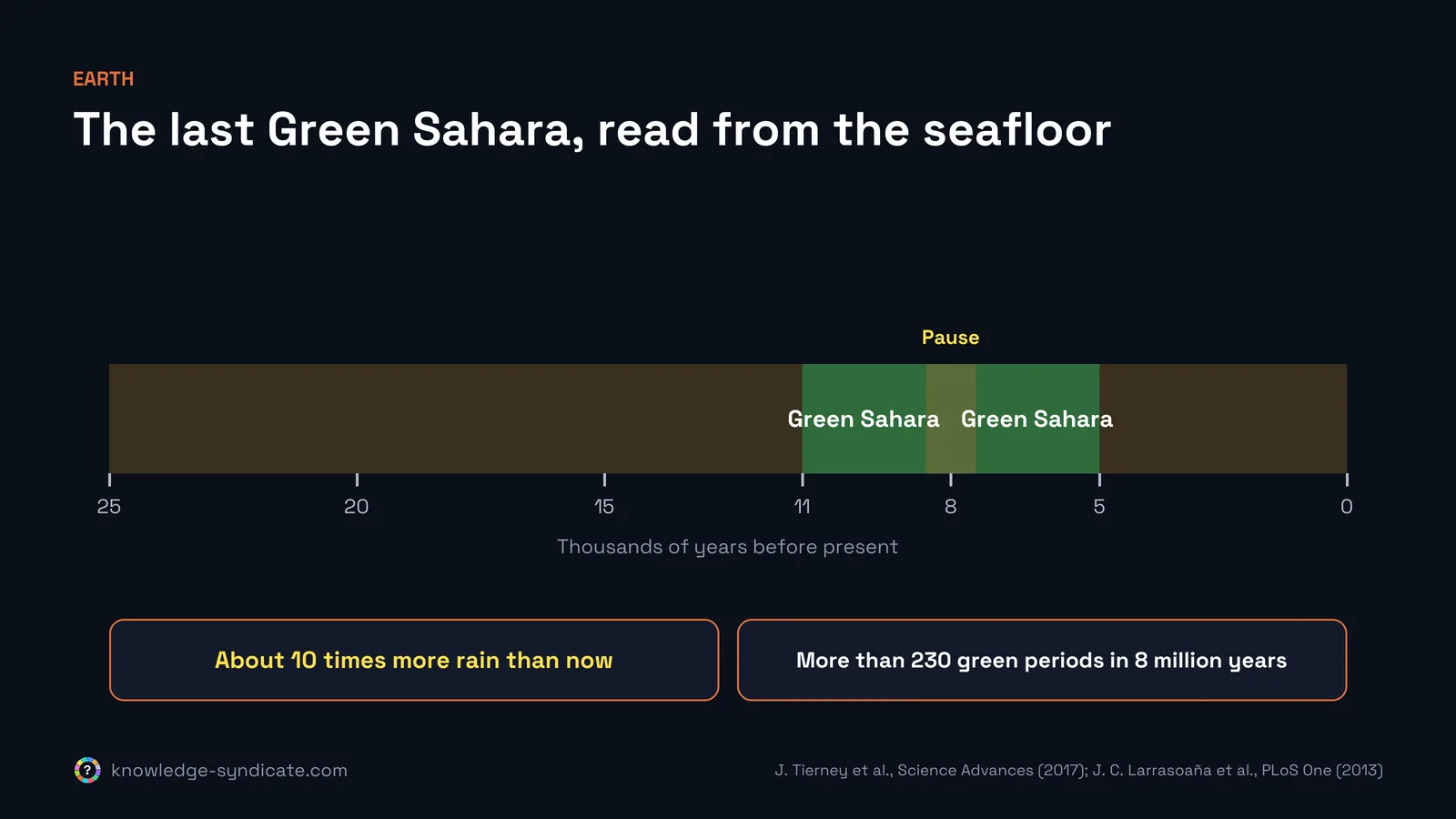
A 2017 paper in Science Advances by Jessica Tierney, Francesco Pausata and Peter deMenocal sums up the most recent episode. During the early Holocene, between 11,000 and 5,000 years ago, the hyperarid Sahara turned into a terrain of widespread grasslands, varying tree cover, large permanent lakes and river networks. The evidence comes from old lake deposits, pollen and archaeological remains showing that people lived, hunted and gathered in the heart of the present-day desert.
Other work stretches the calendar a little. The Takarkori genetic study, which comes up later, puts the African Humid Period between 14,500 and 5,000 years ago. Exact dates vary by region and type of record, but the ending, around 5,000 years ago, shows up in both.
What researchers lacked was a continuous measure of how much rain fell. Tierney’s team found one in an unlikely place: the bottom of the ocean, off the west coast of Africa.
Leaf wax on the seafloor
Plants coat their leaves in a protective wax. Wind and rivers carry its remains out to sea, where they pile up in the sediment layer by layer. The makeup of that wax, specifically the ratio of certain forms of carbon and hydrogen, holds a fingerprint of the rain the plants received.
Using a set of sediment cores taken off West Africa, from 19 to 32 degrees north, the team rebuilt western Saharan rainfall over the last 25,000 years. Their findings: during the Green Sahara it rained about ten times more than in the present-day desert Sahara. The green reached as far as 31 degrees north, off the coast of Morocco. That northernmost core lies off Cape Ghir, a region that now gets its rain in a Mediterranean-style season from December to March, yet the authors judge that most of the extra rain back then was monsoon rain. And the ending was probably abrupt.
The tenfold figure fits other estimates gathered in the same paper from ancient lakes: rainfall increases of 300 to 900 millimeters a year, or 500 millimeters or more across the Sahara and Sahel, with tropical plants reaching as far north as 24 degrees.
The pause 8,000 years ago
The marine record held a surprise. About 8,000 years ago, the Green Sahara took a long pause, lasting roughly a millennium. According to the authors, that matches the archaeological record remarkably well: around then, Neolithic people temporarily abandoned places they had lived in, with shifts in population and lifestyle.
The authors speculate about a cause: a cooling in the Northern Hemisphere about 8,200 years ago may have started the pause, and the land surface itself, with less vegetation, may have dragged it out. It’s a hypothesis, presented as one. What it shows clearly is that the Green Sahara wasn’t a stable garden for six thousand years either.
What switched the Green Sahara on
The root cause lies beyond Earth. Our planet’s axis traces a slow wobble, precession, which changes the time of year when we’re closest to the Sun. According to the 2017 paper, when that cycle brings the closest approach to the Sun into the northern summer, North Africa gets more solar radiation. The land heats up far more than the sea, that contrast strengthens the African monsoon, and rain pushes deep into the Sahara.
But orbit alone can’t explain that much water. The most interesting finding in the study is that climate models driven only by the orbital change fail to reproduce the Green Sahara: they give far less rain than the leaf waxes indicate and don’t carry it as far north. The authors conclude that two strong amplifiers are needed. One is vegetation. The other is dust. Without those mechanisms, they write, the models fail systematically.
That has a practical consequence the authors point out themselves. To simulate the future of the Sahara and the Sahel properly, models will need to represent those vegetation and dust effects better.
More than 230 Green Saharas
Now for the part almost nobody mentions. The last Green Sahara was only the most recent in a long series. In 2013, Larrasoaña, Roberts and Rohling published a compilation in PLoS One of land and marine records from in and around North Africa. It allowed them to identify more than 230 Green Sahara periods in the last 8 million years, during which savannah spread across most of the desert.
They had a rhythm. By the authors’ estimate, each period took 2,000 to 3,000 years to develop, peaked for 4,000 to 8,000 years and ended within another 2,000 to 3,000, which fragmented habitats quickly. And they came grouped in longer cycles of roughly 400,000 and 100,000 years, reflecting how another feature of Earth’s orbit, its eccentricity, modulates precession.
The authors add a nuance: from about 900,000 years ago, after large polar ice caps formed, green periods seem somewhat less frequent. And they note that their dates match those of archaeological and fossil hominin sites in the Sahara. Their argument is that this succession of green windows may have shaped human migration and evolution, something they say had been left out of the story because so little was known about these periods.
The women of Takarkori
So who lived in that Green Sahara? In 2025, a team led by Salem published in Nature the first analysis of ancient genomes from the central Sahara. They came from two women buried in the Takarkori rock shelter, in the Tadrart Acacus mountains of southwestern Libya. Both were naturally mummified and belonged to the Middle Pastoral period: one was between 7,158 and 6,796 years old, the other between 6,555 and 6,281, according to radiocarbon dating.
DNA barely survives in that region, so the find is rare. And the result was unexpected. Most of their ancestry comes from a previously unknown North African lineage that split from sub-Saharan African lineages at roughly the same time as the humans who left Africa, and that stayed isolated for most of its history. Their closest genetic relatives were 15,000-year-old hunter-gatherers from Taforalt Cave in Morocco. The genomes hold other details. Strontium isotopes in the remains at the site, mostly from women of childbearing age, children and juveniles, pointed to a local origin. And the Neanderthal traces are telling: the Takarkori women carry ten times less Neanderthal ancestry than early farmers from the Levant, but clearly more than contemporary sub-Saharan genomes, along with small traces of ancestry from the Levant.
A Green Sahara that wasn’t a corridor
That isolation says something about the Green Sahara itself. If the desert turned into savannah with lakes, you’d expect it to fill with people moving between northern and southern Africa. The Takarkori genomes suggest the opposite: there was little gene flow from sub-Saharan Africa to the north during the humid period.
The authors offer an explanation. A Sahara of about 9 million square kilometers, with grasslands, wetlands, woodlands, lakes, mountains and savannahs, probably had fragmented habitats that held back contact, on top of social and cultural barriers. And one more finding: herding reached the Green Sahara but, according to the study, spread through cultural diffusion, taken up by people who were already there, rather than through a large influx of newcomers.
The desert that comes back
Put the pieces together and the Sahara looks less like an eternal desert than a terrain that switches on and off. It does so to the slow beat of Earth’s orbit, with vegetation and dust amplifying each change. And when it switches off, it can be fast: according to the 2017 paper, some records suggest the last Green Sahara ended within centuries, about 5,000 years ago.
The authors themselves frame it as a lesson for a warming planet: a gradual push from outside can trigger rapid, abrupt responses in dry regions. The Green Sahara of the fossil lakes was one of the normal phases of a system that has been swinging back and forth for millions of years.