Krakatoa eruption: the bang heard nearly 5,000 kilometres away
On the island of Rodriguez, out in the Indian Ocean, distant booms were heard during the night, like heavy guns, coming from the east. The chief of police told the story. They came from a volcano nearly 5,000 kilometres away. The Krakatoa eruption wasn’t the one that threw out most material, and yet it left a huge trail of data: barographs recording in many observatories, tide gauges and accounts by people who wrote down what they heard and saw. Let’s look at what they recorded.
The Krakatoa eruption report
In 1888 the Krakatoa Committee of the Royal Society published a report of nearly 500 pages called The Eruption of Krakatoa and Subsequent Phenomena. It brought together chapters by several authors: one on the volcanic phenomena by Judd, another on the sounds by Strachey, and others on the air waves, the sea waves and the effects in the sky.
According to Judd, the water of the strait played the leading role. As the eruption emptied the crater, the sea forced its way towards the volcanic focus. Those inrushes of cold water first damped the activity down and then, at the end, set off tremendous explosions of abnormal violence.
Four explosions in one morning
According to the report, the first waves reached the coasts of Java and Sumatra between six and seven in the evening of 26 August. During the night there were small oscillations of the sea. But the highest and most destructive waves were the ones that followed four great explosions on the morning of the 27th, at 5.30, 6.44, 10.02 and 10.52.
A 2022 study by P. Lynett and colleagues in Nature puts it in similar terms: on 27 August 1883 Krakatoa produced four explosive eruptions over five hours, which generated a series of tsunamis.
On 29 August a ship sailed round the island and found that its whole northern part had gone. According to Judd, a cavity more than 300 metres deep had opened where the crater used to be.
Thirty-six thousand dead
According to the report, the waves that rushed onto the land stranded vessels near the shore, swept away towns and villages along the coast, carried off two lighthouses and killed 36,380 people, 37 of them of European origin.
Modern studies give similar figures. A 2019 paper by T. R. Walter and colleagues in Nature Communications speaks of more than 36,000 dead, and Lynett’s paper of at least 36,000. A 2020 paper by L. Ye and H. Kanamori in Science Advances gives more than 35,000 casualties in the coastal towns around the strait, and adds that the exact mechanism behind the tsunami is still debated.
The most distant noise
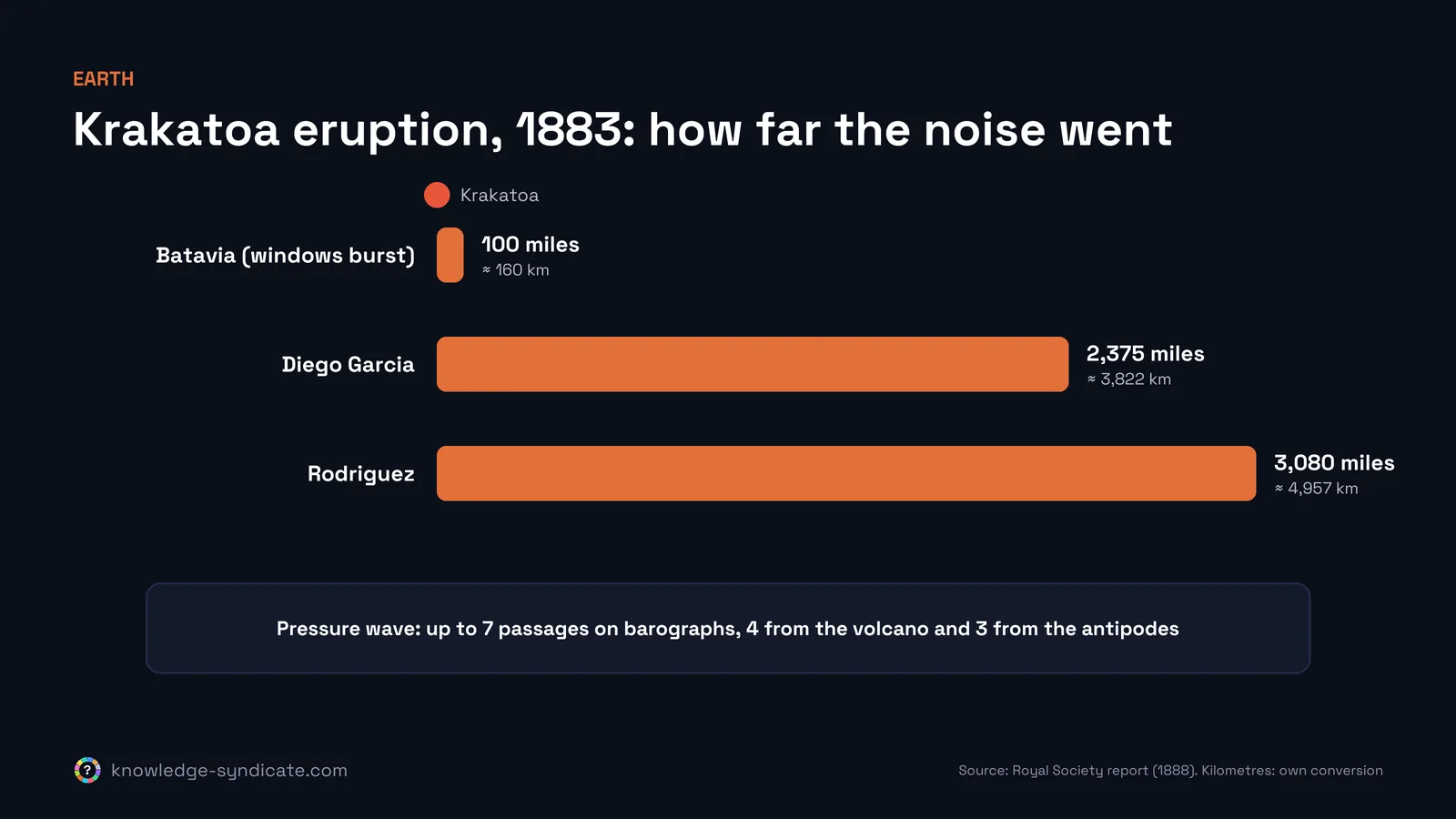
Strachey’s chapter on the sounds is something else. According to the report, the most remote place where the explosions were heard was Rodriguez, very nearly 3,000 English miles from the volcano. And it adds that this was the only instance on record of sounds being heard at anything like such a distance.
My own calculation from that figure: 3,000 miles is about 4,800 kilometres. Elsewhere the report gives a more exact figure for Rodriguez: 3,080 miles, close to 5,000 kilometres.
The report quotes the account of James Wallis, Chief Officer of Police on the island. Sunday the 26th was stormy, with heavy rain and squalls. Several times during the night, reports were heard coming from the east, like the distant roar of heavy guns, and they carried on at intervals until three in the afternoon of the 27th.
At Diego Garcia, more than 2,250 miles away, the sounds were heard very distinctly and were taken for guns fired by a ship in distress, a belief shared at Port Blair in the Andaman Islands. According to Strachey, the area over which the explosions were heard came to a bit less than one thirteenth of the whole surface of the globe.
The report lists more places. In Ceylon and in Australia the sounds were heard at many spots far apart from each other. At Dorey, in New Guinea, they were heard clearly and noted down at the time, long before anyone knew where they came from. And why did they carry so far west and not so far east? According to the report, the most likely help was the westward drift of the lower layers of air in the trade-wind belt, which is where Rodriguez sits.
Strachey was careful, too. The chapter mentions a report of sounds supposedly heard in the Cayman Islands, south of Cuba, which had been put down to Krakatoa. But the evidence was judged so vague that it was left out of the table.
Smashed windows and a jumping gasometer
According to the report, the air waves from the explosions came in three kinds. The fastest were heard as sound. Others, bigger, burst windows in and even cracked walls 100 miles away, at Batavia and Buitenzorg. Lamps fell over, gas jets went out and a gasometer, pushed by one of those waves, leaped out of its well and let the gas escape. According to the report, every account put the damage down to vibrations of the air and not to earthquakes.
Dark at midday
Close to the volcano, what people noticed most was the darkness. According to the report, at Buitenzorg the dust fall began at eleven in the morning, darkness came at noon and lifted when the dust stopped falling, at two in the afternoon. To the east, the darkness reached Tjandjer, about 130 English miles away, and Bandong, nearly 150 miles from the volcano. The report’s index also records that some material was shot straight up to a height of about 31 miles.
Seven laps on the barometers
The longest waves went round the planet. According to the report, the barographs of many observatories recorded the great oscillation from the last explosion, and in many cases up to seven passages could be told apart.
The explanation is lovely. The wave left Krakatoa and spread out in a widening circle until it became a great circle 180 degrees away, on the far side of the Earth. Then it kept going and closed in to a point, at the volcano’s antipodes. From there it bounced back towards Krakatoa, and from Krakatoa it set off again. According to the report, it was observed no fewer than seven times at many stations: four passages of the wave heading out from the volcano and three of the one coming back from the antipodes.
Lynett’s study adds a modern detail: the sea-level changes observed far away were caused by the coupling between the sea surface and those air-pressure pulses, and the tsunami was picked up on tide gauges as far away as the Gulf of Aden, 11,000 kilometres off.
A blue sun
Dust was a whole other chapter. The report gathers sightings of a blue sun and of hazes in the sky that moved westward round the planet. By its reckoning, the phenomenon travelled at about 70 miles an hour on its first lap of the Earth and about 76 on the second.
My own calculation from those figures: 76 miles an hour is about 120 kilometres an hour. The report backs up the scale: within the tropics, the smoke stream went round the world in about thirteen days.
Not the biggest
A curious point Judd stresses: in the amount of material thrown out, or in the extent and length of the darkness, the Krakatoa eruption fell well short of other historical ones. Judd cites Tambora, on Sumbawa, in 1815, among others that ejected far more material. What made it unique, according to Judd, was the violence of the final explosions, which produced waves in the sea and in the air with no parallel in the records.
Walter and colleagues give a modern figure: about 12 cubic kilometres of rock erupted, and a collapsed caldera seven kilometres wide. On the rim of that caldera, according to Ye and Kanamori, a new volcano rose out of the sea in 1929, Anak Krakatau, “son of Krakatau”. On 22 December 2018 a collapse of its flank set off another tsunami that killed at least 437 people.
What’s left
My own reading, which is reasoning from the sources: Krakatoa was a terrible disaster and, at the same time, the first great accidental global experiment. Barometers across half the world, tide gauges, sharp ears and tinted skies made it possible to follow a single explosion round the Earth. The Royal Society pulled all that data into one report. And the son of the volcano is still there, a reminder that the Sunda Strait isn’t finished.