Where does the solar system end? It depends which border you pick
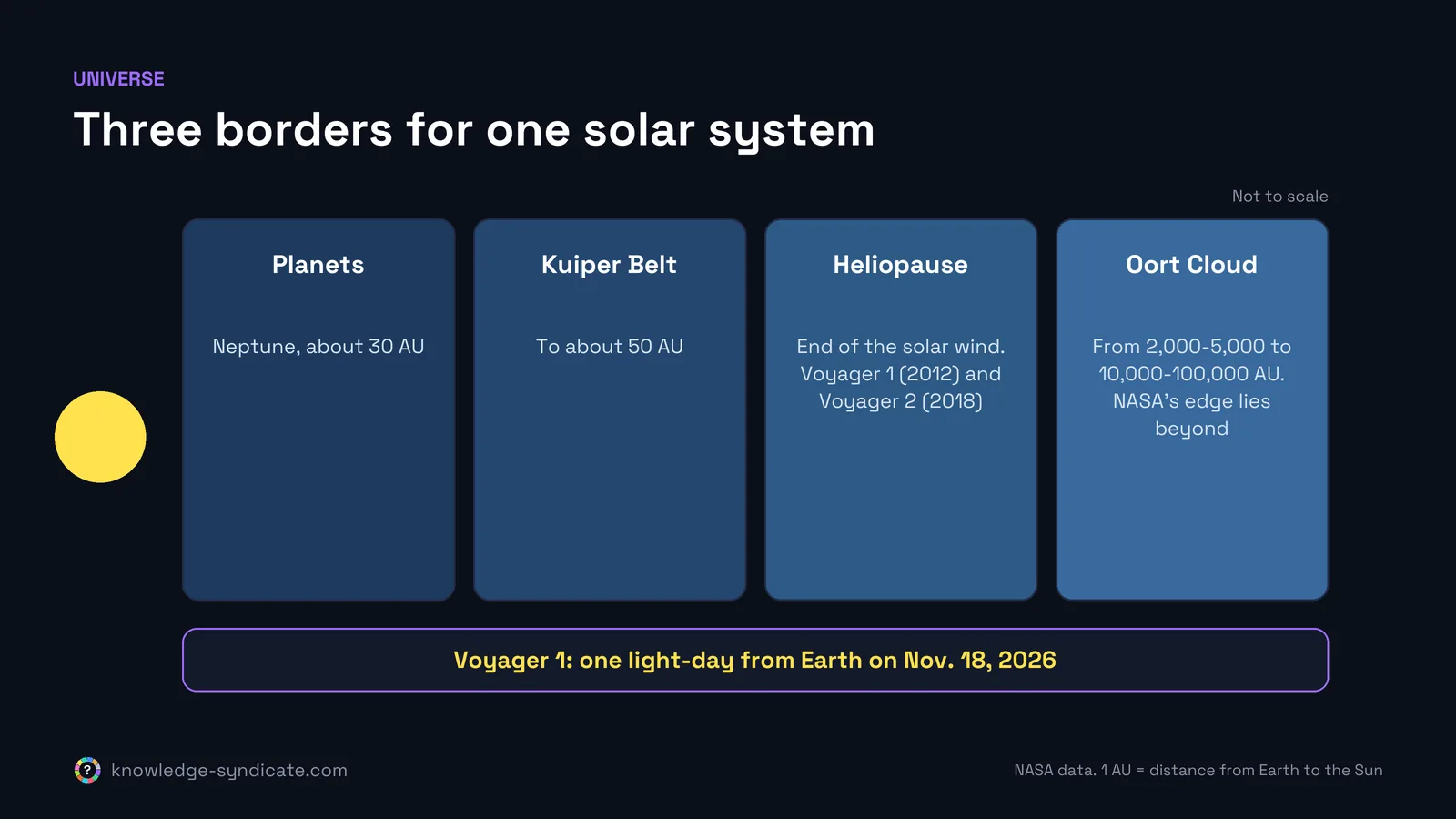
For years you’ve seen headlines saying a probe has left the solar system. NASA, the agency that launched it, says otherwise. Both can be true at once, and the trouble lies in a question that sounds simple: where does the solar system end? It depends on what you’re measuring. Planets, wind and gravity give three different answers, and the farthest one is thousands of years of travel away.
The planetary border
The school answer is Neptune. According to NASA, its orbit lies about 30 astronomical units from the Sun, and one astronomical unit is the distance from Earth to the Sun. Neptune is roughly thirty times farther out than we are.
But that’s exactly where another region begins. The Kuiper Belt starts at Neptune’s orbit, and its main part ends around 50 astronomical units. It’s a ring of icy bodies, and Pluto lives there, circling the Sun twice for every three orbits of Neptune. NASA also puts it in light-travel terms: just under three hours after passing Neptune’s orbit, sunlight goes past the outer edge of the Kuiper Belt.
If the solar system were just a list of planets, we’d be done here. It isn’t, as two probes launched in 1977 showed.
The bubble of the solar wind
Besides shining, the Sun blows. It throws out a constant stream of charged particles, the solar wind, which according to NASA creates a bubble enveloping the planets: the heliosphere. That bubble moves through the space between the stars, which has its own gas, much colder and denser. The border between the two is the heliopause, where the thin, hot solar wind meets the interstellar medium.
Voyager 1 crossed that border in August 2012. The team settled on the 25th, from abrupt changes recorded by its particle and magnetic field instruments. When NASA announced it, in September 2013, the probe was about 12 billion miles (19 billion kilometers) from the Sun.
Proving it took some ingenuity. Voyager 1’s plasma sensor, which would have measured the gas directly, no longer worked. So the team waited for help from the Sun itself. A solar eruption from March 2012 reached the probe in April 2013 and set the plasma around it vibrating. The plasma wave instrument picked up those vibrations on April 9, and their pitch gave away the density of the gas: more than 40 times that of the outer layer of the heliosphere. They then found fainter vibrations from October and November 2012 that told the same story. “Clearly we had passed through the heliopause,” said Don Gurnett of the University of Iowa in NASA’s September 2013 release.
A border with holes in it
Voyager 2 crossed on November 5, 2018, when it was about 11 billion miles (18 billion kilometers) from Earth. Its plasma sensor still worked, and it saw the speed of the solar wind particles plunge that day. Three other instruments backed it up.
With two crossings there was something to compare, and the result wasn’t a clean line. In 2019, NASA summarized five papers in Nature Astronomy. The two probes crossed at different distances from the Sun: Voyager 1 left through the front of the bubble, Voyager 2 through a flank that seems more porous. Particles from inside are leaking out, so the hull has leaks. Plasma is compressed on both sides of the boundary, for reasons scientists don’t yet understand. And Voyager 2 confirmed something its twin had seen: just beyond the heliopause, the magnetic field runs in the same direction as the field inside the bubble. Without Voyager 2, project scientist Ed Stone said, “we wouldn’t know if what we were seeing with Voyager 1 was characteristic of the entire heliosphere.” By then, in November 2019, Voyager 1 was more than 13.6 billion miles (22 billion kilometers) from the Sun, and Voyager 2 about 11.3 billion miles (18.2 billion kilometers).
Neither probe has reached calm interstellar space yet. NASA describes Voyager 1 as being in a transitional region just outside the bubble, and Voyager 2 in a perturbed zone still touched by the Sun. The wind’s border looks more like a choppy coastline than a fence.
Where does the solar system end, according to NASA?
Here’s the part almost no headline tells you. In its December 2018 release on Voyager 2, NASA spelled it out: Voyager 1 and Voyager 2 have not yet left the solar system, and won’t anytime soon. For the agency, the edge of the solar system lies beyond the outer edge of the Oort Cloud.
The Oort Cloud is, in NASA’s words, a theorized group of icy objects. No one has observed it directly, and according to NASA many comets come from it. Its inner edge would be 2,000 to 5,000 astronomical units from the Sun, and its outer edge somewhere between 10,000 and 100,000. Next to that, Neptune is on the doorstep.
And the timetable is on another scale. NASA estimates Voyager 2 will need about 300 years to reach the inner edge of the Oort Cloud and possibly 30,000 years to fly beyond it. NASA’s page on the cloud gives the same figures for Voyager 1: about 300 years to get in and maybe 30,000 to get out the other side. Our most distant spacecraft are, by that border, still in the hallway.
Why the headlines aren’t entirely wrong
So who’s right? Both, each with their own definition. When NASA announced in 2013 that Voyager 1 had reached interstellar space, it meant the border of the solar wind. Ed Stone, the project scientist, called it mankind’s historic leap into interstellar space. Outside the heliosphere, the gas around the probe no longer comes from the Sun.
The heliopause marks where the Sun’s wind gives out. The Oort Cloud lies far, far beyond it, and NASA counts it as part of the solar system. A headline saying a probe has left the solar system is mixing up two borders: it has left the bubble and is still inside the territory.
One light-day, on November 18, 2026
Meanwhile, Voyager 1 has crossed another mark, one with no physical meaning but plenty of poetry. According to NASA, on Wednesday, November 18, 2026, at 2:16:07 a.m. Pacific time, 5:16:07 a.m. Eastern, it reached 16.094 billion miles (25.902 billion kilometers) from Earth. That’s how far light travels in a day. According to NASA, it’s the first human-made object to get that far.
Past that point, what changes is the conversation: a command sent from Earth will take 24 hours to arrive, and the reply another 24. Ask Voyager 1 a question and you’ll wait two days for the answer.
The probe reaches that milestone showing its age. It runs on the decay of plutonium, which is fading, and both Voyagers lose about 4 watts of power a year. It launched in 1977 with ten science instruments. Some were switched off after the planetary flybys, and in recent years the shrinking power supply has forced the team to turn off two more. In September 2026, engineers swapped three devices that keep the spacecraft warm for lower-power alternatives, a maneuver the team nicknamed the Big Bang. Without that swap, according to NASA, another Voyager 1 instrument would have had to go as early as summer 2027.
And October brought a scare. On the 18th and 19th, the Deep Space Network failed to detect the probe’s signal in two scheduled attempts. The signal came back on the 20th. The team found that one group of thrusters had gone offline and the backups had turned on, which is what the automatic fault protection does to put the spacecraft in a safe configuration. At the end of October, the cause was still being investigated.
The three answers, one line each
If someone at the bar asks you where the solar system ends, pick whichever answer you like. Counting planets, at Neptune, about 30 astronomical units out. Counting the Sun’s wind, at the heliopause, which Voyager 2 crossed about 11 billion miles from Earth. Counting everything that circles the Sun, beyond the Oort Cloud, at a distance that may reach 100,000 times Earth’s distance from the Sun.
Voyager 1 has been flying for almost half a century and is one light-day from home. To leave the last of those borders behind, NASA says, it needs about another 30,000 years. None of us will see it happen.