Discovery of Neptune: the planet that was calculated first and seen second
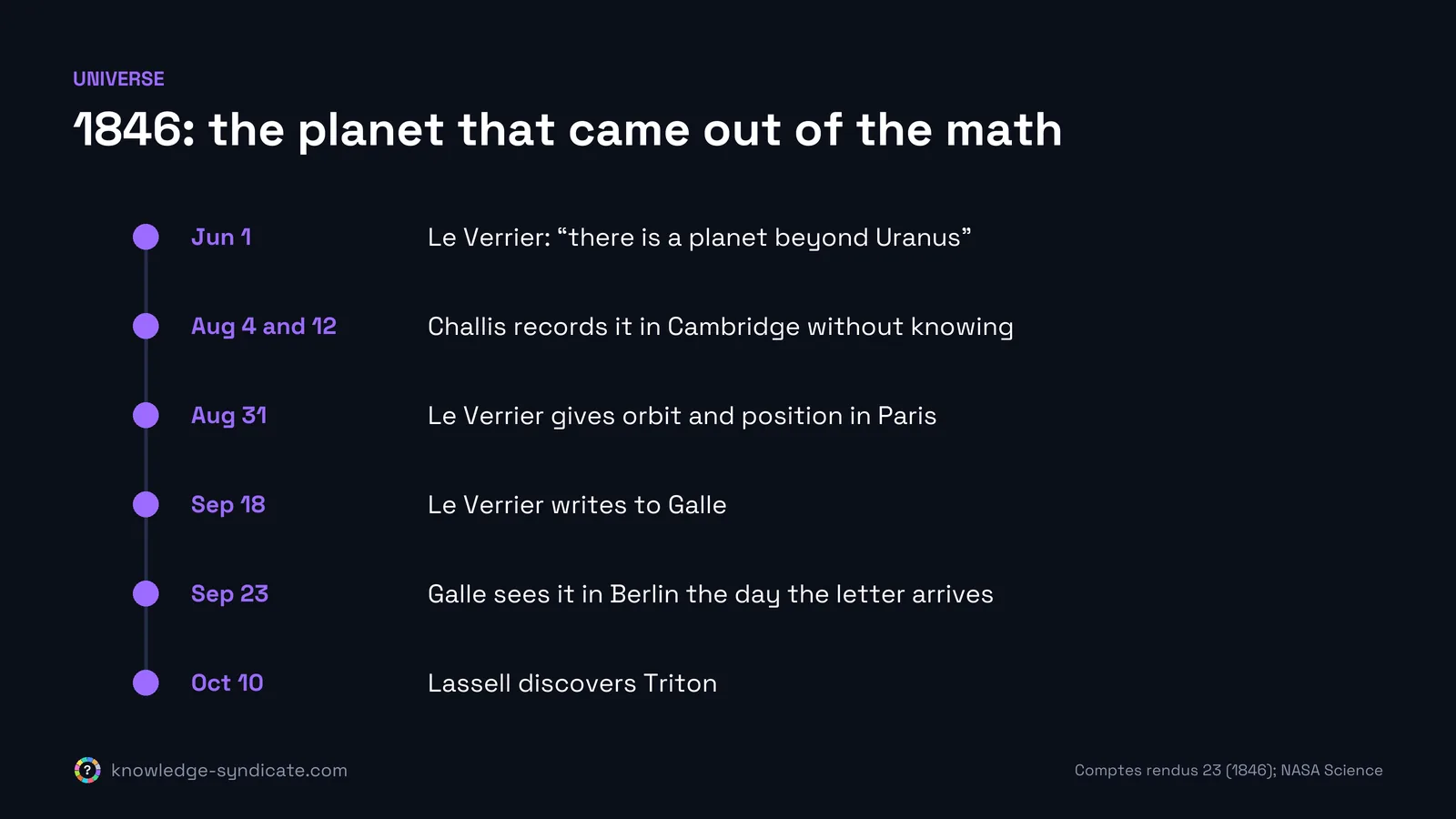
Some discoveries come from a lucky break at the telescope. The discovery of Neptune ran the other way. First someone did months of calculations. Then someone else, in Berlin, opened a letter, pointed the telescope where it said and found a new planet that same night. NASA sums it up like this: Neptune was the first planet located through mathematical predictions rather than through regular observations of the sky.
A planet behaving badly
Uranus was causing headaches. Its position in the sky didn’t match what theory predicted. Le Verrier laid out the problem before the Academy of Sciences in Paris at its session of June 1, 1846, as he himself recalls in the note he published three months later in the Academy’s proceedings, the Comptes rendus.
What he had shown was blunt: the observations of Uranus could not be reproduced, within universal gravitation, by assuming that only the Sun and the known planets were acting on it. All the anomalies, on the other hand, were explained down to the smallest detail by a new planet lying beyond Uranus and following a particular orbit. As early as June he had dared to give it a position: 325 degrees of heliocentric longitude, that is, measured from the Sun, for January 1, 1847.
Important things were still missing, such as the planet’s mass, which would decide whether it could be seen, and how long it took to go around. Le Verrier promised to sharpen the numbers. And he warned he would do it fast, with the telescope search in mind.
The note of August 31
The note reached the Academy on August 31, 1846. Le Verrier explains that the work had taken longer than expected, and that the planet’s opposition, the most favorable moment to look for it, had caught up with him. Even so, there were three months of possible searching left that year.
This time, to make the results more precise, he had used all the old observations of Uranus, nineteen in all. And he gave the full list of orbital elements for the planet he was hunting: a semi-major axis of 36.154 times the Earth-Sun distance, one full orbit every 217.387 years and an eccentricity of 0.10761. For January 1, 1847, he calculated a heliocentric longitude of 326 degrees 39 minutes, at 33.06 times the Earth-Sun distance. Very close to June’s 325 degrees. He placed it about five degrees east of a star in the constellation Capricornus.
He noted that opposition had fallen on August 19 and that the timing was very favorable. Then he set out to work out whether the planet would look like a point or a disk. Uranus, at 19 times the Earth-Sun distance, shows an apparent diameter of 4 arcseconds. The new planet, by his figures, would have about two and a half times the mass of Uranus. Assuming the same density, which he considered the least favorable assumption for seeing it, he got 3.3 arcseconds. Enough to tell it apart from a star in a good telescope.
Le Verrier explained why that mattered. If the planet looked like a star, every small star in the region would have to be measured and watched to see which one moved, a long and painful job. If it showed a disk, simply looking at what each point looked like would be enough.
A letter to Berlin
On October 5, 1846, in another note to the Academy, Le Verrier added a postscript. With his article already written, he had received from Galle, an astronomer at the Berlin Observatory, the news that he had seen the planet, close to the place indicated. Le Verrier had written to him on September 18 asking for help. Galle saw the planet on the very day he received the letter.
The Berlin observation is dated September 23. Le Verrier published the position alongside the one he had calculated from the disturbances of Uranus, so anyone could compare them. NASA tells it with a line that sums up the feat: Galle found Neptune on his first night of searching.
What had happened in Cambridge
The story had a second act, and it arrived as letters. On October 12, Arago read to the Academy a letter from Challis, director of the Cambridge Observatory, dated October 5.
Challis said that on July 29 he had begun charting the stars in the area where theory placed the planet. On September 29 he read Le Verrier’s latest results in the journal L’Institut and kept strictly to his directions. He used the observatory’s big telescope, the Northumberland refractor, at a magnification of 170. Of more than 300 stars whose positions he noted, only one caught his eye. He asked his assistant to write down: it seems to have a disk. It was the planet. He couldn’t check the next night, and then news of Galle’s discovery reached him.
On October 19, Arago came back with a review of the criticisms and priority disputes the discovery had stirred up. He called it “planet Le Verrier.” And he read out several documents that had come from England.
The young mathematician who didn’t publish
One of the texts said that a young mathematician from Cambridge, Adams, had independently reached a position almost identical to Le Verrier’s, without knowing the Frenchman’s results.
Another was an extract from a letter by Airy, director of the Greenwich Observatory, to Le Verrier, dated October 14. Airy told him that parallel research in England had led to the same result, but said that he must without doubt be regarded as the person who had really predicted the planet’s position. And he added that the English investigations were not, he believed, quite as extensive as his.
The third was a letter from Challis to the Athenaeum, dated October 15, written with Adams’ permission after Sir John Herschel had alluded to his research in that same journal. According to Challis, Adams had decided to explain the anomalies of Uranus with a more distant planet before he graduated. In February 1844 he asked, through Challis, for the earliest Greenwich observations, which were then being reduced. In September 1845 he gave Challis the longitude, eccentricity, perihelion and mass of his planet, and in October sent them, slightly corrected, to Airy. When Le Verrier published an almost identical longitude in June 1846, the coincidence inspired confidence, and Airy suggested a systematic search with the Cambridge telescope.
Challis started on July 29, 1846. And here’s the painful part. On August 4 and 12 he recorded the planet’s position. On the 12th he came across an eighth-magnitude star that had not been in that same zone on July 30. Comparing those two nights would have revealed the planet. He didn’t do it until after the Berlin announcement, he said, because he felt a longer search was needed and because he was busy with other work. From the August positions, Adams worked out a distance from the Sun of 30.05 times the Earth’s, a little less than theory had given. And Challis proposed a name: Oceanus.
Arago was merciless. He pointed out that none of those documents mentioned any publication of Adams’ work. For him, the only fair way to write the history of science was to rely on publications with a definite date. Adams had not printed a single line, nor communicated his work to any learned society, and so, Arago concluded, he had no valid claim to a place in the history of the discovery.
Discovery of Neptune: what the calculation got right
The figures let you set the prediction against reality, with my own comparisons. Le Verrier gave the planet a mean distance of 36.154 times the Earth-Sun distance and a period of 217.387 years. NASA says Neptune is more than 30 times as far from the Sun as Earth, and that in 2011 it completed its first orbit since 1846, a 165-year trip. So the calculated orbit was quite a bit bigger and slower than the real one.
The position, though, did the job it needed to. Galle found the planet, in Le Verrier’s words, close to the place he had indicated, and in Cambridge Adams had reached an almost identical longitude on his own. To find it that autumn, all you needed was to know where to look.
NASA adds a detail that makes the story even stranger. Galileo had recorded Neptune as a fixed star during his observations of 1612 and 1613 with his small telescope. He had it in view more than two centuries earlier and logged it as a star. Neptune is also the only planet in the solar system that can’t be seen with the naked eye.
The story had a quick epilogue. According to NASA, on October 10, 1846, seventeen days after Galle’s discovery, William Lassell discovered Triton, Neptune’s largest moon. By then the planet already had a rough orbit, a moon and a priority fight between two countries. All in less than a month. And it had all started with a planet that wasn’t where it should have been.