How does water get to the top of a tree?
A tree pulls off something every day that no suction pump can manage: it lifts water hundreds of feet without a motor, without a sound and without paying a dime. How does water get to the top of a tree? It sounds like a grade-school question, but it had botanists arguing in the late 1800s, it was cracked with the help of trees that kept drinking after their trunks had been killed, and it still has surprises in store. Trees make noises we can’t hear, they suffer something a lot like a blood clot, and they have a height limit you can calculate.
Why sucking doesn’t cut it
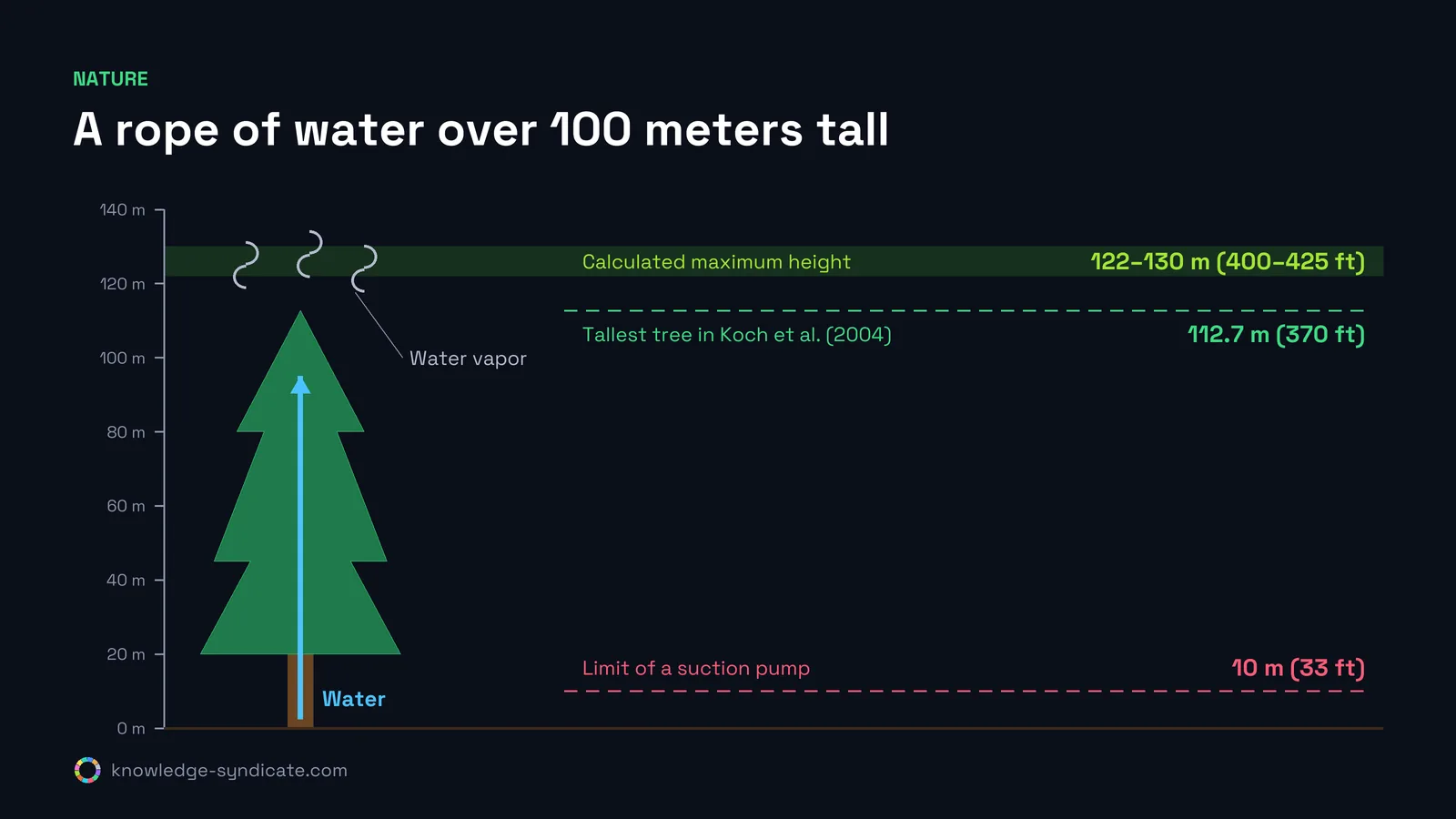
The first thing anyone thinks of is that the tree sucks water up the way you drink through a straw. The trouble is that sucking has a limit. According to the botany department at Trinity College Dublin, a mechanical suction pump can only lift water about 10 meters, roughly 33 feet. Above that, no matter how hard you pull, the water won’t rise any further.
That limit is exactly what made 19th-century physiologists skeptical. If a pump tops out at 33 feet, how could a leaf drag water up from 150, 250 or 300 feet below? The favored explanation back then was something else entirely: living cells in the wood pushed the water upward by spending energy, like a chain of tiny pumps along the trunk.
The dead tree that kept drinking
That living-pump theory had a problem, and it came from experiments by a botanist named Strasburger. According to Trinity College, in 1892 two Dublin scientists, Henry Dixon and John Joly, saw those experiments for themselves, and they showed something baffling: trees kept drawing up water even after their trunks had been killed.
If the cells in the trunk were dead and the water still rose, they couldn’t be the ones doing the pushing. There had to be another explanation, one that worked with nothing alive in the middle. Dixon and Joly went looking for it.
How does water get to the top of a tree? A rope made of water
The answer they proposed in 1895, in a paper called On the Ascent of Sap published by Britain’s Royal Society, flips the whole picture around. Nothing pushes the water from below. Evaporation drags it from above.
Here’s how it works. Leaves have pores that let water vapor escape into the air, especially in sun and heat. Each water molecule that evaporates leaves a gap that has to be filled by another one, and that one pulls on the next, and so on all the way down to the roots. Trinity College describes it as suction passed down through continuous columns of water inside the xylem, the ultra-thin pipes in the wood.
What makes the trick possible is a property of water you can’t see with the naked eye: its molecules are strongly attracted to each other. That’s cohesion. Thanks to it, a column of water behaves like a rope: pull one end and the whole thing comes up. And it’s a surprisingly tough rope. According to Trinity College, those columns hold together under suction of more than 300 atmospheres, as long as they’re inside narrow tubes like the xylem. In a wide tube they’d snap.
That’s why it’s called the cohesion-tension theory: cohesion because the water holds together, and tension because the column is stretched, pulled from above. A suction pump hits its 33-foot ceiling; a tree, on the other hand, hauls on a rope of water that doesn’t break.
The theory was greeted with plenty of skepticism in 1895. Dixon and Joly ran a series of experiments to answer the critics, Dixon defended it in a 1914 book, and over time it won out. Trinity College notes that standard botany textbooks still call it the “Dixon and Joly cohesion theory.”
The part almost everyone skips
The rope explanation leaves one question hanging: if the rope snaps the moment a bubble gets in, how did the pipes fill with water in the first place? You can’t pull on a rope that doesn’t exist yet.
The physicist and philosopher of science Harvey Brown went back over the history of the theory in 2013, in the journal Physics in Perspective, and pointed to exactly this. Since the theory was born, plant scientists have known that other processes are needed to “prime” the tree, and the main one is so obvious to them that it often gets left out of the story: growth itself. A tree never has to lift water up an empty 300-foot pipe. Its pipes form and fill as the tree grows, inch by inch. The rope gets woven while it’s being pulled. Brown adds that other factors depend heavily on the type of tree.
An oak that sweats 40,000 gallons a year
The most striking thing is how much water this system moves. Almost all the water that climbs a tree doesn’t stay in it: it evaporates through the leaves. According to the U.S. Geological Survey’s Water Science School, a large oak tree can transpire about 40,000 gallons of water a year. Spread across the calendar, that works out to more than a hundred gallons a day on average, though in practice nearly all of it happens in the months when the tree has leaves. Natural Resources Wales uses the same figure, converted to 151,000 liters, in its teaching materials.
Crops are no slouches either. The same USGS source says an acre of corn gives off roughly 3,000 to 4,000 gallons of water a day.
All of that flow runs through ultra-thin tubes without a single moving part. And the sun drives it: its heat evaporates water from the leaves and gets the pull going.
Bubbles that snap the rope
A stretched rope has a weak spot, and in a tree it’s called cavitation. If the tension gets too strong, for example during a drought, a gas bubble can form in the water column. The column breaks, the pipe empties out, and it stops carrying water.
The tree physics and physiology lab of INRAE, France’s national research institute for agriculture, food and the environment, in Clermont-Ferrand, compares it to something that happens to us: that gas embolism blocks a tree’s plumbing the same way a blood clot can block a person’s circulation. And it gets worse with drought. The same team developed a machine that spins samples in a centrifuge and recreates the effect of a drought on the pipes in a matter of minutes. With it, they’ve found that resistance to cavitation varies enormously from one species to another.
Here’s the detail that sounds like science fiction. When a pipe cavitates, it makes a sound. A 2015 study co-authored by Hervé Cochard of INRAE examines the ultrasonic acoustic emissions woody plants give off and how they relate to cavitation during freeze-thaw cycles. They’re clicks the human ear can’t pick up, but sensors can.
Why there are no 650-foot trees
If the rope of water is so good, why don’t trees keep growing forever? In 2004, researcher George Koch of Northern Arizona University and his colleagues published a study in Nature on the coast redwoods of Northern California’s wet temperate forests, home of the tallest tree known at the time: 112.7 meters, about 370 feet.
They looked at how the leaves change with height. Down low, leaves are broad and well spaced; up top, they’re small and tightly packed. Both the length of the leaves and the angle between each leaf and its twig shrink as you go up. At the very top, gravity and the length of the trip make it harder for water to arrive, so leaves suffer more water stress and photosynthesize less. Extrapolating those changes, the team calculated a maximum height of 122 to 130 meters, roughly 400 to 425 feet, barring mechanical damage first. The authors point out that the figure lines up with the tallest trees on record from the past. Above that ceiling, the rope of water can’t keep worthwhile leaves supplied.
The note Nature ran about the study added another detail: those redwoods are around 2,000 years old, so past droughts or lightning strikes may have cut their growth short.
The glass chamber that blew up
Measuring the tension of water inside a branch isn’t easy, and it gave Dixon a scare. According to Trinity College, in 1922 he was testing a glass pressure chamber and keeping an eye on it through a mirror. In the reflection he saw the walls start to bulge, and the device exploded. The idea was sound; the material wasn’t. In 1965, Scholander and his colleagues built the same kind of instrument out of metal.