Why is glass transparent?
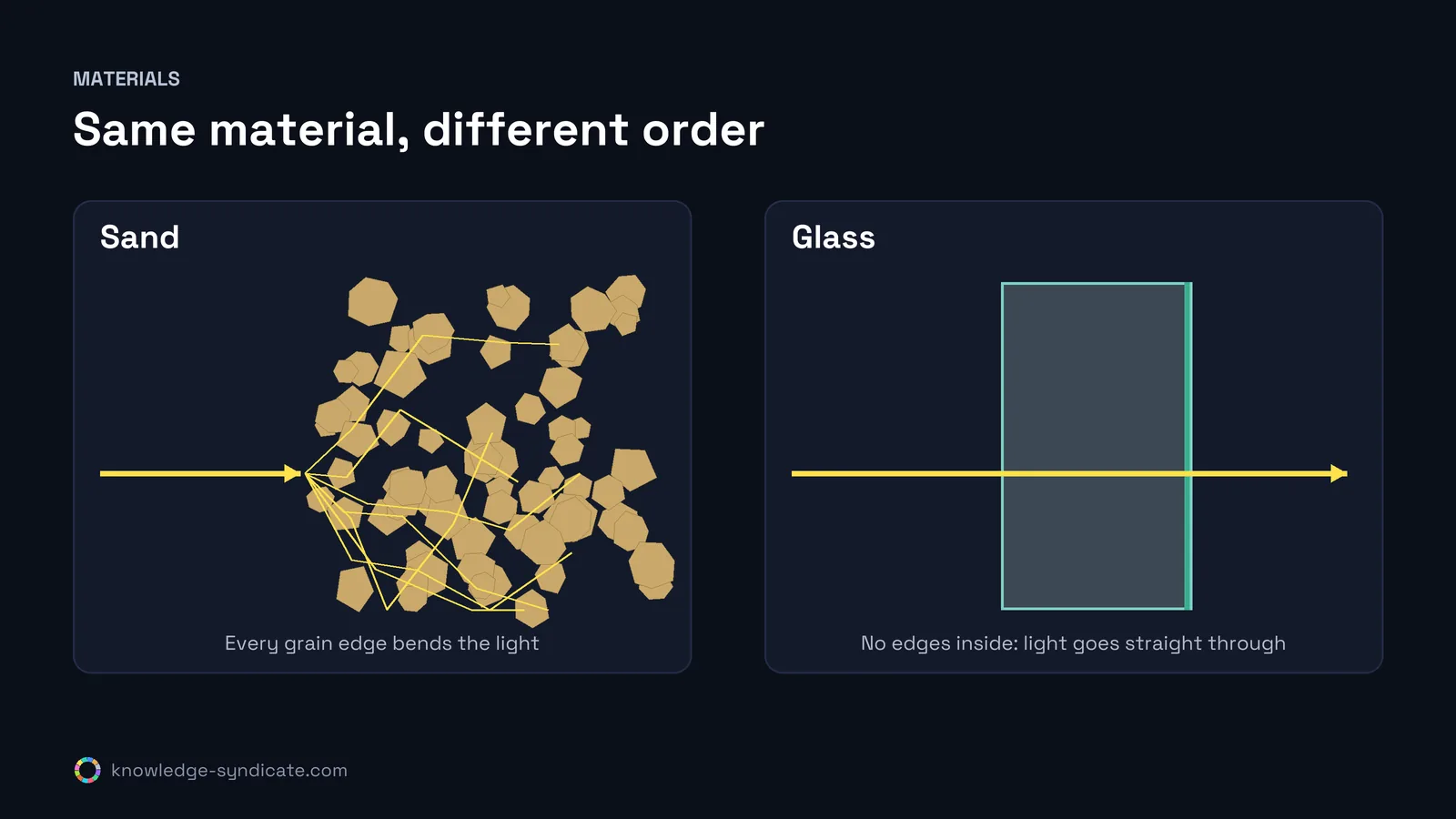
Glass is sand that quit hiding. Its main ingredient is quartz, the same mineral that makes up much of the sand on a beach, yet a handful of sand blocks everything and a window lets you see everything. So why is glass transparent when sand isn’t? There are two answers that work together: one is about electrons that won’t accept small tips, and the other is about order and disorder. Along the way you’ll run into a myth that made it into a serious encyclopedia, a sheet of wood you can see through, and car windows that let in more sun than you’d think.
Electrons that won’t take small tips
Light travels in little packets of energy called photons. When a photon hits a material, one of two things happens: an electron in the material takes it, or nobody wants it and the photon keeps going.
For an electron to take a photon, the photon has to hand over exactly the energy the electron needs to climb to a higher level. Electrons don’t accept just any amount. Either you give them precisely what it takes to reach the next step, or there’s no deal. Penn State’s introductory materials course explains it with rows: the electrons in an atom can only sit in certain rows, and moving up to the next one takes a push of exactly the right size.
In glass, those rows are so far apart that a photon of visible light can’t make any electron jump. The photon arrives, no electron can take it, and it keeps going. Multiply that by the ridiculous number of photons pouring through a window and you get a material that lets light through almost untouched.
That’s the first requirement for being transparent: visible light can’t be absorbed. It isn’t enough on its own, though. Sand doesn’t absorb that much light either, and you still can’t see through it.
Why is glass transparent when sand is not
This is where the second ingredient comes in: order. The quartz in sand is crystalline. Its atoms sit in a regular lattice, and every grain has faces, edges and flaws. According to the same Penn State course, those crystal edges and defects reflect and scatter light. Every time a ray crosses from one grain to another, or from a grain into air, it changes direction. After thousands of bounces, the light comes out any which way and the image is gone. That’s why a pile of sand looks white or golden, but you can’t see through it.
Glass is made of nearly the same stuff, with one difference: its atoms don’t form crystals. They stay jumbled up like a liquid, but frozen in place. Scientists call that an amorphous material. That amorphous structure, Penn State explains, breaks up the band structure that crystalline quartz would have, so there are no levels left that an electron could jump to by absorbing visible light. And with no grains or edges inside, the material is uniform at a microscopic scale, and light has nothing to bounce off.
Bottom line: glass is transparent because its electrons can’t take visible light and because it has no internal borders to throw that light off course. Sand half-passes the first test and flunks the second.
Wood you can see through
If the trick is not absorbing and not scattering, then any material that pulls off both should turn transparent. In 2016, a team at the KTH Royal Institute of Technology in Stockholm, led by Lars Berglund, proved it with wood.
The Swedish team chemically stripped lignin, one of the components of plant cell walls, out of a thin wood veneer. The veneer turned white and full of pores, still opaque. Then they filled the pores with a transparent polymer and tuned the optical properties of the two materials at the nanoscale, so light wouldn’t notice the switch from one to the other.
The result, published in the journal Biomacromolecules, was wood you can look through. No magic involved: they removed what was coloring it and plugged the gaps where light was getting lost. Glass does the same thing without being asked.
Ultraviolet doesn’t make it through
If visible light gets through because it’s short on energy, light with more energy should get trapped. And it does. Ultraviolet photons arrive with just the right amount of energy for the electrons in glass to take them, Penn State explains, which is why glass blocks the sun’s tanning rays.
There’s fine print. According to an online glass-processing course hosted by Lehigh University and taught by Professor James E. Shelby, the ultraviolet cutoff in commercial glass sits around 310 nanometers, and it’s caused less by the glass itself than by the iron it contains as an impurity. Above that cutoff, some of the longer-wave ultraviolet, UVA, slips through.
You can see this in cars. In 2016, a study published in JAMA Ophthalmology measured how much UVA the glass blocked in 29 cars from 15 manufacturers, checked at Los Angeles dealerships. Windshields blocked an average of 96%. Side windows averaged only 71%, with some as low as 44%. The difference comes down to construction: windshields are laminated glass, while side windows are usually tempered glass. The authors also found that tinted windows, which let in less visible light, didn’t reliably block more UVA.
The green you see on the edge
Look at a window head-on and it seems colorless. Look at it edge-on and you’ll see bottle green. That green comes from iron too.
Shelby’s course spells it out: iron is the most common impurity in the sands used to make glass and the most common colorant in commercial glass. It gives flat glass various shades of green and bottles their greens and ambers. At the thickness of a normal window, the color barely shows. But when you look through the edge, light travels through inches of glass instead of a fraction of an inch, and the green builds up until it jumps out at you.
Getting rid of it isn’t easy. To make what the industry calls “water white” glass, the clearest kind, most of the iron oxide has to go. Sometimes it’s kept on purpose: car glass contains more iron, because one form of iron helps block the ultraviolet that damages plastics and another helps control the heat coming in with the sun.
Cathedral windows aren’t dripping
Now the myth. You’ve probably heard it at a bar: glass is really a super-slow liquid, and the proof is that medieval cathedral windows are thicker at the bottom because the glass has been sagging for centuries.
In 1998, materials engineer Edgar Dutra Zanotto of the Federal University of São Carlos in Brazil, after students and colleagues had asked him about it several times, sat down to do the math. In his paper in the American Journal of Physics, he writes that he first assumed it was a Brazilian myth, until he learned a colleague had heard it in Argentina, and a reviewer for the journal confirmed it was widespread in the United States. It even showed up in a materials science textbook and in the Encyclopaedia Britannica itself.
He didn’t just use modern window glass. His paper includes the composition of a yellow medieval glass from the Saint-Gatien Cathedral in Tours, France, and a table showing how much medieval recipes varied: silica, the main ingredient, ranged from 45% to 75% of the mix. His numbers were brutal. To see noticeable flow in 800 years, you’d have to heat typical medieval glass to about 414°C, roughly 777°F. At room temperature, window glass would only flow over spans of time far beyond human history. He also points to evidence anyone can check: museums are full of glass vases thousands of years old that still haven’t sagged.
So why are some cathedral panes thicker at the bottom? Zanotto offers a factory explanation. Old window glass was blown into cylinders, which were then split and flattened by hand. The pieces came out uneven, so some lower parts could end up thicker than the upper ones, just as others could be thinner.
The story got a second round in 2018. Penn State researcher John Mauro redid the calculation using the actual composition of the 13th-century glass in the windows of Westminster Abbey. He found that earlier estimates were off by 16 orders of magnitude: that glass flows far faster than anyone thought. Even so, it would take billions of years to produce nanometer-sized changes in its shape. The myth is still dead, just with a more accurate death certificate. Mauro sums it up by calling glass a hybrid: a liquid-like structure that behaves mechanically like a solid.
Murano and the banished furnaces
Glass furnaces have one drawback: they set things on fire. In 1291, according to Italy’s official tourism portal, the Republic of Venice ordered the city’s glassworks moved to the island of Murano to limit the fires the workshop furnaces kept causing. What started as a fire-safety rule put all of Venice’s glassmakers on one island, and the same portal calls Murano the homeland of blown glass.