Roman concrete: the white lumps that keep it going
Roman harbor walls have been sitting in the sea for about two thousand years. The reputation of Roman concrete as indestructible raises an annoying question for any engineer: what did they know that we don’t? The answer comes in two layers. The Romans wrote the first one down themselves. The second was hiding in white lumps that experts had been looking at for decades without paying them much attention.
A sand that turns to stone under water
The architect Vitruvius left the best-known recipe in ancient building in De architectura. Lime, he explains, comes from burning white stone, is slaked with water to make mortar, and is mixed with sand at three parts pit sand to one of lime, or two parts river or sea sand to one. Add a third part of crushed, sieved pottery to river sand and the mortar comes out better.
Then he describes something that strikes him as almost magical. Around Baiae and in the country near Mount Vesuvius there’s a kind of sand that, mixed with lime and rubble, hardens as well under water as in an ordinary building. He puts it down to the heat beneath those mountains, with their hot springs and inner fire, which leave the earth dry and light. When moisture arrives, he says, everything binds and hardens so fast that neither waves nor the force of the water can pull it apart. And he adds a detail that makes a modern reader smile: it was said that in former times there had been fire in abundance under Vesuvius.
Pliny the Elder, in his Natural History, marvels at the same thing. The dust of the hills around Puteoli forms a barrier against the waves of the sea, turns into stone the moment it’s immersed, and grows harder by the day, especially when mixed with the cement of Cumae. That volcanic ash, and materials that play the same role, are known as pozzolana.
Roman concrete in the sea: minerals that grow with time
The first layer of the modern explanation backs Pliny up. Geologist Marie Jackson of the University of Utah and her team studied cores of Roman harbor concrete drilled by the ROMACONS project between 2002 and 2009, including one from Portus Cosanus in Tuscany. Their results came out in 2017 in American Mineralogist.
As the university’s summary puts it, when seawater seeped through the concrete in breakwaters and piers, it dissolved components of the volcanic ash. That fluid allowed new minerals to grow inside pumice particles and pores: an aluminous tobermorite and a zeolite called phillipsite. In other words, the sea was building fresh crystals inside the structure itself.
The University of Utah sums it up with two bold lines: that 2,000-year-old Roman piers and breakwaters still stand and are stronger than when they were built, and that modern marine concrete structures crumble within decades. That comparison comes from the institutional release and should be read as such, but the underlying mechanism is in the paper: reactions between water and rock at ambient temperature, long after the concrete had set.
The lumps everyone could see
The second layer is more recent and has a touch of the detective story. Look closely at a piece of Roman concrete and you’ll see small white lumps scattered through it. They’re bits of lime, and they turn up in almost every Roman mortar, on land and at sea.
In 2023, Linda Seymour, Admir Masic and colleagues at the Massachusetts Institute of Technology published a paper on these lumps in Science Advances. They point out that they had traditionally been explained as defects: lime that was under- or over-burned, lime that had carbonated before use, lime that didn’t fully dissolve, or careless mixing. A building blunder repeated for centuries across an entire empire, then, which is odd for people who, according to Vitruvius and Pliny, insisted on pure white limestone for making lime.
The team analyzed samples from the city wall of Privernum, in Italy, about two thousand years old, using electron microscopy, X-ray diffraction and Raman spectroscopy. Their conclusion is that the Romans used what’s called hot mixing: they worked with quicklime, the calcium oxide that comes out of the kiln, alongside or instead of slaked lime. Quicklime gives off a lot of heat when it meets water, and those conditions leave high-surface-area lumps of lime inside the mortar.
Cracks that close by themselves
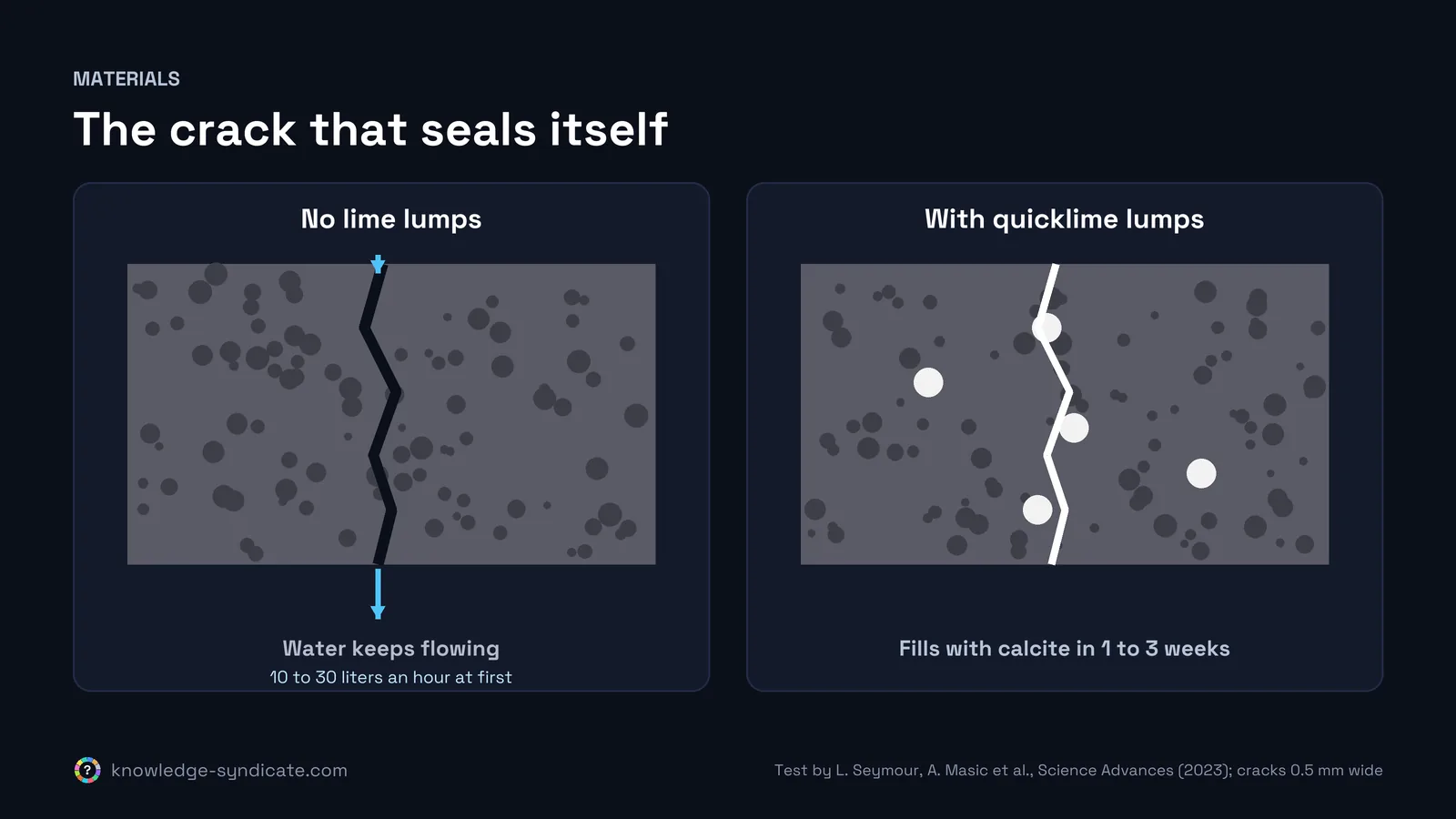
The MIT proposal is that the lumps act as a calcium reserve. When a crack opens, it tends to run through the lumps, and if water gets in, the calcium dissolves and recrystallizes as calcium carbonate, filling the gap.
They tested it with modern concrete made by imitating the method. They broke the samples, put the halves back together with a crack half a millimeter wide, and ran water through them continuously. At first, 10 to 30 liters an hour flowed through the cracks. In the samples with lime lumps, the flow dropped to almost zero within one to three weeks: the crack had filled with new calcite. In the controls without lumps, the water kept flowing.
The interest goes beyond archaeology. The same paper notes that making Portland cement releases up to a metric ton of CO₂ equivalent per ton produced, and that cement accounts for up to 8% of global greenhouse gas emissions. Concrete that repairs itself lasts longer and needs less repair work.
Faster, and without shrinking
Hot mixing has other practical advantages. According to the 2023 paper, modern reproductions of ancient mortars made this way set faster than those made with slaked lime putty or powder. For anyone building in a hurry, that’s no small detail.
The team also checked shrinkage, the way concrete contracts as it dries, in an industrial-type mix containing quicklime. Early on, the quicklime, which expands as it hydrates, offset part of that shrinkage. After 365 days, the two mixes, with and without quicklime, had shrunk by practically the same amount, less than 1% apart. Adding quicklime didn’t spoil the concrete’s long-term behavior.
And the paper reminds us why all the effort is worth it. Roman mortars and concretes have held up in different climates, in earthquake zones and in direct contact with seawater. That toughness let Romans put up larger, more complex structures than before, including buildings in the sea. The Privernum samples, in fact, came from a city wall in the open air, exposed to the weather for two thousand years.
The half-built site at Pompeii
What was missing was proof from a place where the material was actually being made. It came in December 2025, in Nature Communications, from a team led by Ellie Vaserman and Admir Masic, with Gabriel Zuchtriegel of the Pompeii Archaeological Park among the authors.
Excavations in Pompeii’s Regio IX had uncovered something unusual: a building site in full swing at the moment Vesuvius erupted in AD 79. There were finished walls, walls halfway up, piles of dry raw materials ready alongside, and tools. Pompeii was in the middle of rebuilding, because an earthquake in AD 62 had caused damage across the city.
Analysis of those piles left little room for doubt. According to the paper’s abstract, it shows unequivocally that quicklime was premixed dry with pozzolan before water was added. Hot mixing, just as the 2023 study proposed. The authors note, citing earlier work, that the reaction can exceed 200 °C in local hot spots within the mix.
Vitruvius told a different story
And here’s the part that hardly ever gets told. The same 2025 paper summarizes what Vitruvius says: quicklime was mixed with water to make slaked lime, and that slaked lime was the main binder, later combined with pozzolan. That’s the recipe that has been read for centuries as the official manual of Roman building. There’s even an inscription from Puteoli from 105 BC that mentions calx restincta, interpreted as slaked lime.
The Pompeii site, by contrast, had quicklime mixed in dry. The authors explain that there were amphorae with slaked-lime residue, but in quantities far too small to have been the calcium source for the big walls, and that this lime is generally thought to have been used for decorative work or floors. In short, slaked lime existed, but the concrete walls were made another way.
It’s curious that the most famous text on the subject left out, or didn’t explain well, the step that probably gives the material much of its ability to heal. Vitruvius himself mentions the heat common to lime and volcanic ash when he explains why the mix hardens. Perhaps he was describing the effect of quicklime without realizing it.
What can be copied, and what can’t
The two mechanisms work together. In harbors, seawater makes new minerals grow in the volcanic ash. In any wall, lumps of quicklime store calcium to seal cracks when water gets in. Both depend on how the mix is made, which ash goes into it, and time.
The hardest thing to copy is the time scale. According to the Utah study, the minerals that strengthen the breakwaters form at ambient temperature long after setting. The MIT and Pompeii teams present their results as inspiration for longer-lasting concrete and for restoration materials.
So those little white dots in a Roman wall may be the first-aid kit that has kept it standing.