Charles Goodyear: a hot stove, some sulphur and the rubber that stopped melting
A raincoat that sticks to the chair in August and cracks like cardboard in January. That was rubber before 1840. Charles Goodyear is the man usually credited with fixing it, and his story has debtors’ prison, rotting mail bags, an Irishman who dipped his trousers in a barrel of sap, and a stove. Most of it comes from Goodyear himself, in a book he published in 1853 to stake his claim. Read it knowing that. Still, what he says fits with what his great English rival wrote, separately, a few years later.
An impossible material
Goodyear devoted the first volume of Gum-Elastic and its Varieties, published in New Haven in 1853, to what was wrong with rubber before his invention. The trouble came twice a year. Manufacturers had to wait for warm weather and cold weather to come round, at least twelve months and often longer, before they knew whether their goods would decompose. Goods made in large quantities over the winter rotted when the warm weather returned and were a total loss.
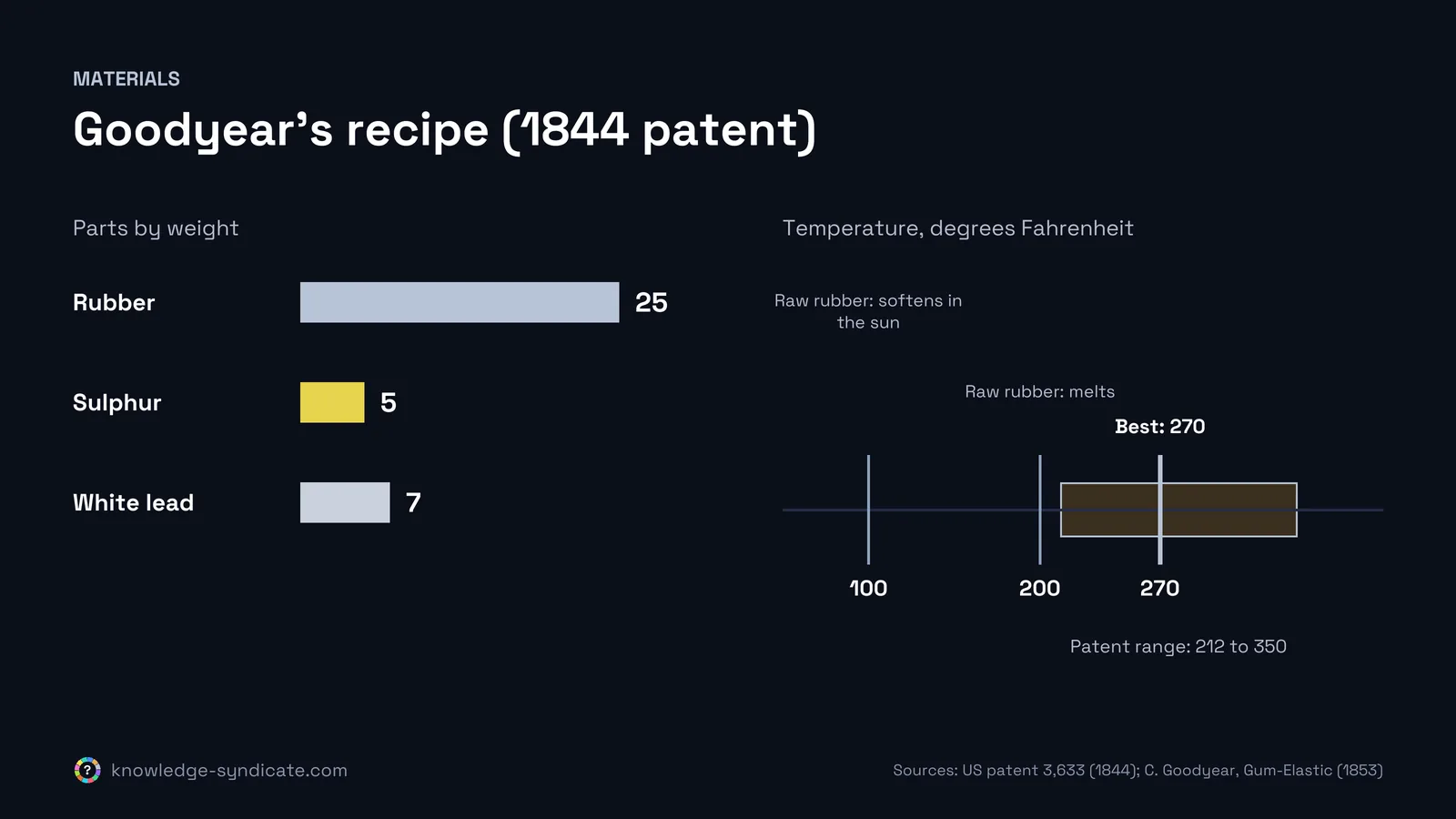
His temperature figures are blunt. It was well established, he writes, that rubber melted at about 200 degrees Fahrenheit and softened in the sun at 100 or less. Manufacturers were careful never to go above 100 degrees. And for rubber waterproofs, the circulars warned customers not to get too close to the fire.
The American companies that had piled into the business, he says, failed with the total loss of their capital, and their shares were spread so widely that the failure was a public calamity. Nobody wanted to hear about rubber.
A hardware man in jail
Goodyear was no chemist, and he says so. He came from hardware. His father, Amasa Goodyear, made buttons, spoons, scythes and spring steel hay forks that the son ranks among the great farming improvements of his country. In 1826 Charles moved to Philadelphia and set up what he describes as the first shop in the United States selling home-made hardware. It went well until 1830, when the firm had to suspend payments.
He tells what came next without decoration. Over ten years, under the laws of the time, he was repeatedly imprisoned for debt. He spends a paragraph on what you learn about human nature from behind a prison door with not a dollar in your pocket.
His interest in rubber, he says, went back to boyhood, when a thin scale peeled off a bottle or a shoe stuck together into a solid lump from the warmth of his hand. He thought it would make a useful fabric if it could be made evenly thin and kept from sticking.
A life-preserver valve
The first contact was by chance. He was walking past the New York store of a rubber maker and stopped in to ask about a life-preserver, meaning to buy one. Looking at the tubes used to inflate them, he thought he could improve them. Some months later he brought the company’s agent an improved tube.
The agent liked it, but gave him better advice: work on the rubber itself. He promised that the company would pay very well anyone who beat the two big problems of the trade, the stickiness and the later decomposition of the goods. Goodyear, he writes, was blessed with ignorance of the obstacles ahead.
Rolling pin, marble slab and a barrel of sap
He started in a small house, mixing the rubber by hand and spreading it with a rolling pin on a marble slab. He tried everything. One early idea was mixing magnesia into the rubber, from half a pound to a pound per pound of gum, because it gave a white compound. He bound a book with it in 1834. The cover softened and fermented at the time. By 1853, he says, it was as hard as a shell.
In New Haven he found forty or fifty barrels of rubber sap on the market, some of it still liquid. If the solvents were the problem, he reasoned, liquid sap would solve it. An Irish workman he calls Jerry had the same idea and got there first. He opened a barrel at night, and in the morning turned up wearing trousers he’d dipped in the sap, telling his employer that a Yankee wasn’t as quick at inventing as an Irishman. The job looked so good that at first everyone thought the problem was solved.
Hayward’s sulphur
In the summer of 1838 Goodyear met Nathaniel Hayward of Woburn, Massachusetts, who had been foreman at a rubber factory. Hayward used sulphur by mixing it into the solvent. Through him, Goodyear writes, he first learned that sulphur could dry rubber. He bought Hayward’s claim to combining sulphur with rubber, and a patent for it was issued on 24 February 1839. Goodyear stresses that it covered the use of sulphur. The heating process came later.
Sulphur had a bad name, though. The smell, he says, kept the goods off the market. Another manufacturer had tried it and noticed nothing of interest.
The mail bags
By then Goodyear had a process using nitric acid gas that improved the surface of rubber. He sold licences, made a little money, and landed a government order for a large number of mail bags. Everyone saw it as the test. If the bags held up, the invention had arrived.
They were finished in the warm season and left on show at his factory, which drew plenty of curious visitors. While he was away for a few weeks, they decomposed and fell off their handles. The culprit, he says, was the colouring he’d used to give them a leathery look: chromes, white lead, vermilion. Several thousand life-preservers went the same way. The public verdict was complete failure. Everything he owned went under the hammer, and the pawnbroker became his main resource.
The Woburn stove
Here is the moment everyone retells, and it’s worth reading in his own words. On his trips to the Woburn factory to wind up the business, he ran some experiments on how heat affected the same compound that had rotted in the mail bags. He was surprised to find that the specimen, carelessly brought into contact with a hot stove, charred like leather.
He tried to get his brother and some others who knew the trade to look at it, because nothing like it had been seen: rubber always melted under strong heat. They didn’t think it worth noticing. They took it as one more of his appeals on behalf of some new experiment.
He reasoned that if the charring could be stopped at the right point, the rubber might lose its stickiness right through. He found that rubber wouldn’t melt in boiling sulphur at any heat; it always charred. He heated a piece in front of an open fire and it charred again, but at the edge of the burnt part there was a line, a border, left uncharred and perfectly cured. By Goodyear’s own account, this happened at Woburn in the winter of 1838 to 1839.
He rejects the word accident. He admits it didn’t come from chemical research, but says it came from the closest application and observation, and compares it to the falling of an apple: it only suggests something to a mind already prepared. Even so, it took him two more years to convince anyone he had found something valuable.
The 1844 recipe
US patent number 3,633, dated 15 June 1844, sets out the process. Goodyear combines rubber with sulphur and white lead and heats the compound at a regulated temperature. The proportion that worked best for him: twenty-five parts rubber, five of sulphur and seven of white lead.
The temperature has some slack, from 212 to 350 degrees Fahrenheit, but the best effect comes as close as possible to 270. The result, the patent says, is rubber that is no longer softened by the sun or by any heat below what it received in preparation, isn’t harmed by cold, and resists the oils and turpentine that normally dissolve it.
Samples that smelled of sulphur
Across the Atlantic, Thomas Hancock, of a firm in the trade, had been working rubber for more than twenty years. In his personal narrative, published in London in 1857, he says that in the early autumn of 1842 his friend W. Brockedon showed him some small bits of rubber brought from America by a man who said he was the inventor’s agent. They didn’t stiffen in the cold and were barely affected by solvents, heat or oils. The method was a secret.
Hancock got two tiny pieces. One smelled faintly of sulphur and had a little powder on it, which he suspected had been rubbed on to mislead. He confirmed they didn’t harden in the cold. He made no analysis of them, he says, and asked no one else to. They were enough to show it could be done.
Ice from a passing cart
He shut himself in his laboratory at Stoke Newington, lighting his own fires, often working until midnight. He tried thousands of tiny mixtures. In winter, the outdoor cold was enough to test them. In spring and summer he bought ice from a cart that went past his gate every morning, and examined the scraps buried in it.
He found that temperature and exposure time both mattered: the same compound at the same heat could come out good or bad depending on the hours, anything from one to six or seven. His patent passed the great seal on 21 November 1843. And he writes something that holds for both men: although he in England and others in America had mixed sulphur with rubber long before, none of them had ever dreamt of its true value.
Brockedon supplied the name. Hancock had simply called the process “the change.” Talking it over with friends, Brockedon suggested “vulcanization,” after Vulcan, the mythological figure at home with sulphur and heat. Hancock adopted it, and the word stuck in Europe and America.
Charles Goodyear and the chemistry he couldn’t see
Neither Goodyear nor Hancock could explain the change. Goodyear admits in 1853 that the results had not yet been satisfactorily accounted for. Modern chemistry can. According to a 2020 review in the journal Materials, in vulcanization, as invented by Goodyear, sulphur forms bonds between polymer chains, and the result is a three-dimensional cross-linked network. That’s why vulcanized rubber can’t be melted down again, which makes it hard to recycle.
My own reading of this, which is my reasoning: the chains in raw rubber can slide past one another, and heat makes them slide more. Tied together by sulphur bridges, they no longer flow. The rubber stops being sticky and keeps its stretch. That fits what both inventors saw: a material that no longer melted in the sun or hardened in the ice.
The same review puts the number of tyres thrown away each year at about 40 million tonnes, and one of their main components is vulcanized rubber. It all started with a cured strip at the edge of a sample burnt on a stove, and a debt-ridden merchant who paid attention to it when nobody else did.