Why do onions make you cry?
A whole onion doesn’t make anyone cry. You can hold one up to your face and stare at it for an hour. So why do onions make you cry the moment a knife goes in? Because the weapon doesn’t exist until you cut. It’s a kit of separate parts that assembles itself at the moment of attack, and you’re the attacker. The best part is that for decades the textbook chemistry had a piece wrong, and the people who found it worked at a Japanese food company and won an Ig Nobel for it.
A weapon that assembles when you cut
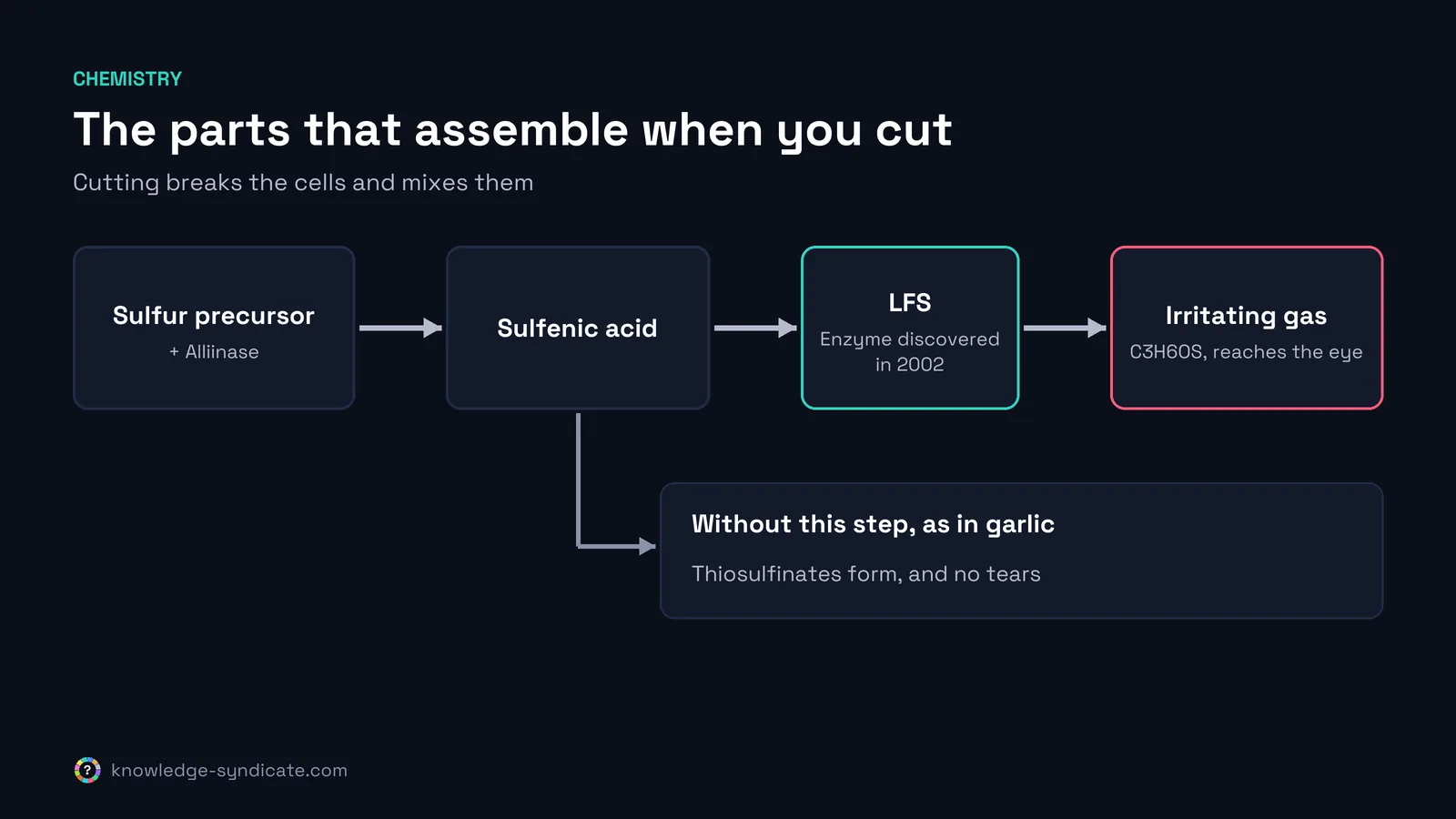
Inside an intact onion are two things that never touch. One is a sulfur molecule, trans-S-1-propenyl-L-cysteine sulfoxide, which chemists shorten to PRENCSO and which we’ll just call the precursor. The other is an enzyme called alliinase. Cutting the cells breaks that separation and the two meet.
Alliinase splits the precursor and produces a sulfenic acid, 1-propenyl sulfenic acid, an unstable molecule. Then the culprit forms: syn-propanethial S-oxide, a small molecule with the formula C₃H₆OS. It’s fairly volatile, so it rises off the cutting board and drifts up to your face. Specialists call it the lachrymatory factor, from the Latin lacrima, tear, and they aren’t joking.
Eric Block, a chemist at the University at Albany in New York, has worked on onion chemistry since the 1970s. He worked out the structure of that molecule in 1979. He also noticed something that sounds obvious once it’s said: if the lachrymatory factor shows up only after the tissue is broken, then cutting must set off a reaction.
Why do onions make you cry when garlic doesn’t?
For years the textbook said this: alliinase acts, and the irritating molecule forms by itself, spontaneously, from the sulfenic acid. It fit, and nobody saw a reason to look closer.
Except for a detail sitting in every kitchen. Garlic has alliinase too. And no matter how much garlic you chop, nobody cries. If alliinase were enough to produce tears, garlic would do the same.
In 2002, Shinsuke Imai and his team at a Japanese food company published a note in Nature with a lovely title: “An onion enzyme that makes the eyes water.” They ran the direct test. They added garlic alliinase to the onion’s precursor and no lachrymatory factor formed, not a trace. The yield of other molecules, thiosulfinates, went up instead. So a piece was missing. They isolated it and named it lachrymatory-factor synthase, or LFS. That enzyme converts the sulfenic acid into the molecule that stings.
Imai has described the strange part in an interview: LFS is one of the abundant proteins in onion extract, and purifying it wasn’t hard. It had been in plain sight for decades. For this work the team received the 2013 Ig Nobel Prize in Chemistry, the award that makes you laugh and then think. The enzyme’s structure wasn’t solved until 2017, using X-ray crystallography, in a paper in ACS Chemical Biology. “It’s one small but critical piece of a puzzle,” Block said.
What happens when it reaches your eye
The cornea is packed with nerve endings whose job is to report anything that shouldn’t be there. When the gas arrives, it irritates those nerves, it stings, and the tear glands respond by reflex to dilute it and wash it out. That’s why you cry even when your emotional life has nothing to do with the stir-fry.
Many sources add that some of the gas reacts with the water in your eye to form small amounts of sulfuric acid. Block says so in a popular-science interview, and so does a teaching page from the University of Bristol’s chemistry school. Other summaries flag this explanation as loose, and none of the sources consulted gives a measured amount. What’s certain is the outcome: corneal nerves detect the molecule and the eye defends itself.
What the onion gets out of it
Block believes these irritating compounds probably help the plant defend itself against whatever’s eating it. That makes sense: an onion is a bulb full of stored food sitting in the ground, with no legs to run away on. A chemical trap that fires only when something bites has the advantage of costing almost nothing until then. Still, it’s a reasonable hypothesis, and the sources consulted don’t offer direct proof that it works this way against any given animal.
The irony runs the other way. That same defense system gives us much of the flavor that makes humans grow onions by the ton. A 2024 review in Food Reviews International notes that the lachrymatory factor also contributes to the onion’s distinctive flavor. The repellent is what draws us in.
How the droplets fly, caught in slow motion
In 2025 a study appeared that nobody had done before: filming what happens during the cut. Zixuan Wu, Sunghwan Jung and colleagues at Cornell University recorded it with high-speed cameras and published in PNAS. “No one had visualized or quantified this process,” Jung told Physics World.
What you see is violent. Each layer’s outer skin is tough and holds out against the blade while the tissue inside gets compressed. When it finally gives, the spray comes out in two stages: first a fast mist-like burst, then threads of liquid that break up into droplets. The fastest reach about 40 meters per second, or roughly 90 mph. Hundreds to thousands of droplets can fly out within 20 thousandths of a second, and Physics World reports they reach up to 60 cm, about 2 feet, in height.
Here’s the surprise for anyone who has argued about this in a kitchen. When the cutting speed went from 0.44 to 2.03 meters per second, the number of droplets went up fourfold. Going from a blade with a tip radius of 0.91 microns to one of 13.3 raised it up to fortyfold, and the droplets flew out with more energy as well. A blunt knife is an onion-spraying machine. The authors say this backs up the old belief about sharp knives.
The fridge trap
The fridge tip has a loyal following. The Bristol page, for example, suggests cooling the onion to reduce evaporation. It sounds right, since cold slows evaporation.
The Cornell team kept onions at 1°C, about 34°F, for 12 hours. Droplet speeds didn’t change significantly and the fracture looked almost identical. But the chilled onion released a noticeably larger volume of droplets. So droplet physics doesn’t back the fridge as cheerfully as people claim, and the authors themselves call for more experiments.
There’s also a piece nobody has measured. The Cornell paper counts droplets, not irritating molecules. It doesn’t measure how much lachrymatory factor travels in each one. A cold onion could release more droplets and less gas at the same time. Until someone measures both together, that kitchen argument stays open. Nobody, so far, has counted the tears.
And the frying pan disarms it
Part of this your nose already knows. A softened, cooked onion doesn’t sting the eyes of whoever’s sitting at the table. The Bristol page gives the chemical reason: heat denatures the enzymes that form the irritant, so production stops. It does warn that opinion on these kitchen methods is mixed. And the reaction that already happened during chopping is another matter, because the gas that escaped has escaped.
The onion that doesn’t make you cry
If LFS is the piece that makes the molecule, you can just remove it. Imai’s team suggested as much in 2002. In 2008, Colin Eady of New Zealand’s Crop & Food Research, with Japanese colleagues, published the result of doing so in Plant Physiology. Using RNA interference gene silencing, they cut LFS activity by as much as 1,544-fold. Eady said they had been unable to induce tearing even by crushing their test onions.
The interesting bit is where the sulfur went. With no route to the lachrymatory factor, the sulfenic acid took the other path, the same one seen with garlic alliinase: more thiosulfinates and, from there, more volatile sulfur compounds, including one called zwiebelane, after the German word for onion. So a modified onion doesn’t smell of less. It smells different. In that 2008 announcement, Eady hoped tearless onions could become the norm for households and industry within a decade. That decade has been and gone.
Which leaves the fact underneath all this. The thing on your cutting board isn’t trying to make you cry. It’s trying to make you stop biting, using an enzyme science overlooked until 2002, and it fires harder the blunter your knife is.