Maillard reaction: why bread and meat turn brown when you cook them
A slice of toast is a chemistry experiment nobody writes down in a lab notebook. White bread goes in, brown bread comes out, and it smells different. In between, things happen that took a chemist years to sort out. The Maillard reaction carries that chemist’s name, Louis-Camille Maillard, and the funny part is that he wasn’t thinking about breakfast. He was trying to work out how living things build proteins. What he got was a brown liquid.
A tube, a little water and glucose
The note appeared in the proceedings of the French Academy of Sciences, the Comptes rendus, volume 154, pages 66 and 67, in the session of January 8, 1912. It’s signed “L.-C. Maillard” and presented by Armand Gautier. The title is a whole program: the action of amino acids on sugars, and the formation of melanoidins by a methodical route.
Maillard explains where he was coming from. He was studying the role of alcohols in the natural synthesis of protein-like substances, and that led him to put amino acids together with a “complex alcohol” found in every living thing, d-glucose. But, he says, in that mixture the aldehyde part of glucose matters more than its alcohol parts, at least when there’s glucose to spare.
The recipe is almost a kitchen one. In a tube you put one part glycocoll, an amino acid, with four parts glucose and three or four parts water. You set it in a water bath to help it dissolve. After ten minutes at most, the liquid takes on a very recognizable yellow tint. The color deepens faster and faster and fairly soon reaches dark brown. Later on, the liquid foams: it’s giving off carbon dioxide, which Maillard identifies by bubbling it through baryta water.
So browning began in a tube of water. That already tells you something: to get it going, all it takes is sugar, amino acid, heat and time.
Where the gas came from
The carbon dioxide puzzled Maillard. It could come from two places: from the amino acid itself, or from something being oxidized by oxygen taken from the air or from the glucose. To find out, he set up two experiments.
In the first, he put half a gram of glycocoll, two grams of glucose and two cubic centimeters of water in a bell jar over mercury, with 14.6 cubic centimeters of oxygen. After six hours at 100 degrees, 12.6 cubic centimeters of oxygen were left. Very little had gone. Meanwhile, 22.9 cubic centimeters of carbon dioxide had formed. Conclusion: the gas wasn’t getting its oxygen from the air.
In the second, he trapped the gases in absorbers and weighed them. With just under a gram of glycocoll and about two grams of glucose he got, in seven hours, a little over a tenth of a gram of carbon dioxide. Analyzing the residue showed him the gas’s oxygen didn’t come from the glucose either.
That left one source. The gas came from the acid group of the amino acid, which was splitting off. Maillard proposed that this split went hand in hand with the amino acid’s nitrogen latching onto the aldehyde carbon of the sugar. And that at least two glucose molecules went into the new substance, losing water along the way and forming double bonds and perhaps rings. The blackish substances that resulted could be, in his words, polycyclic molecules with one nitrogen atom.
Some sugars sprint and some don’t budge
Maillard didn’t stop at one pair. He tried glucose with seven amino acids: glycocoll, sarcosine, alanine, valine, leucine, tyrosine and glutamic acid. The most active, he notes, was alanine.
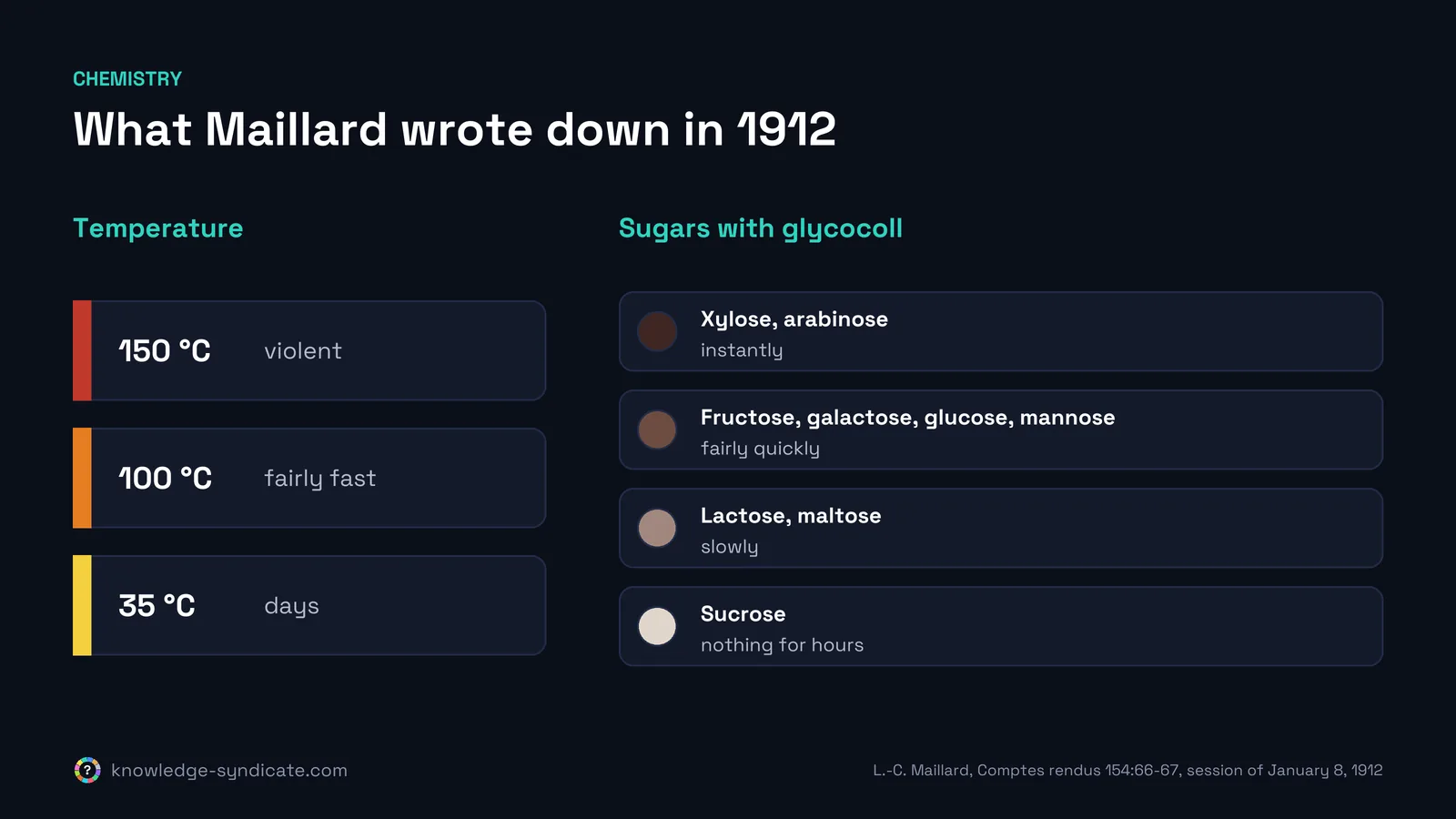
Then he swapped the sugar and kept glycocoll fixed. Here the note reads like a race. Xylose and arabinose reacted instantly. Fructose, galactose, glucose and mannose, fairly quickly. Lactose and maltose, slowly. And sucrose, not at all for several hours. After that a slow reaction set in, which Maillard puts down to the sucrose having split first.
That detail fits the modern definition. The historical review published in 2014 by M. Hellwig and T. Henle, of the Technical University of Dresden, describes the reaction as that of reducing carbohydrates with amino compounds. And the 2002 paper by D. S. Mottram and colleagues in Nature talks about the Maillard reaction between amino acids and reducing sugars. Both definitions call specifically for reducing sugars, and in Maillard’s tube each sugar kept its own pace.
The thermometer is in charge
The most useful line in the whole note, for anyone who has ever burned toast, is short. The reaction is violent at 150 degrees, fairly fast at 100, and can be seen after a few days at 35 degrees, and even below.
That’s nearly the whole mystery of browning. The chemistry at 35 degrees is the same as at 150. What changes is the speed. At body temperature it takes days of patience. At 100 degrees, Maillard’s tube needed ten minutes to turn yellow and a good while longer to reach brown. At 150, things turned violent. From those speeds it follows that strong heat browns fast and gentle heat barely shows.
A measurement from 2002 shows the same thing from another angle. A team at Stockholm University, with E. Tareke as first author, was trying to find out where a substance called acrylamide came from, since they kept finding it bound to the hemoglobin of people with no known exposure. They suspected cooking at high temperatures, because earlier studies of rats fed fried feed had pointed that way. Heating foods in the lab, they found that acrylamide formation depended on temperature. And in unheated or boiled foods they couldn’t detect it, below 5 micrograms per kilo.
The acrylamide trail
That acrylamide story ended up leading back to Maillard. The Swedish work, published in August 2002 in the Journal of Agricultural and Food Chemistry, measured moderate levels, 5 to 50 micrograms per kilo, in heated protein-rich foods. And much higher levels, 150 to 4,000 micrograms per kilo, in carbohydrate-rich foods such as potato, beetroot, some commercial potato products and crispbread.
What was missing was how it formed. Seven weeks later, on October 3, 2002, Nature ran two notes back to back in the same issue. One, from a University of Reading team with D. S. Mottram as first author, had a blunt title: acrylamide is formed in the Maillard reaction. It showed that acrylamide can be generated from food components during heating, through the reaction between amino acids and reducing sugars. And that asparagine, a major amino acid in potatoes and cereals, is a decisive player in that pathway. Mottram notes that acrylamide is classified as probably carcinogenic in humans.
The other note, from a food-industry research center in Lausanne with R. H. Stadler as first author, reached the same place independently. Acrylamide can be released by heating certain amino acids, asparagine for example, particularly together with reducing sugars, and also from early products of the Maillard reaction. The authors sum it up this way: the same reaction that gives flavor and color to heat-processed foods can, under particular conditions, be linked to the formation of acrylamide.
In other words, the color, the aroma and that substance come out of the same family of reactions. Which is why the Swedish finding on boiled foods lines up with Maillard’s thermometer from ninety years earlier.
The Maillard reaction beyond the kitchen
The list of consequences Maillard wrote in 1912 is the most surprising part of the note. He found them as numerous as they were interesting across several fields: human physiology and pathology, plant physiology, agronomy, with the ripening of manure and humus, various industries, and geology, with mineral fuels. Listing them all, he says, would take too long. Cooking, where the reaction shows up every single day, isn’t mentioned by name.
He develops only one consequence, and it’s a lab one. When you analyze materials that contain both sugars and amino acids, for example when breaking down proteins or tissues, you only recover as amino acids the part that escaped the action of the sugars. That’s why such analyses produced melanoidins, substances of unknown makeup that turned up by chance. Maillard was proud he could now make them on purpose, from a specific amino acid and a specific sugar, and hoped that way to work out their structure.
The human physiology part took a while to be confirmed, but it came. According to Hellwig and Henle, the discovery that these non-enzymatic conversions also happen inside organisms led to intensive study of their role in diabetes and ageing. Dietary Maillard products are discussed as “glycotoxins,” and increasingly also for possible positive effects in the human body. The authors close with the idea that, more than a hundred years on, this complex reaction is still a live topic across several disciplines.
What happens, step by step, in a crust
Putting the 1912 note together with the later work, you can tell the story of browning without formulas. There are reducing sugars, and there are amino acids or compounds with amino groups. With heat, the amino acid’s nitrogen joins the sugar’s carbon. What comes out loses water, gives off carbon dioxide and links up into bigger and darker molecules, the melanoidins. Along the way, aromas and flavors appear. The Dresden review puts it in three words: aroma, taste and appearance of heat-processed food.
More heat, more speed. At 35 degrees it’s days. At 100, minutes for the first yellow. At 150, chemical violence. And each sugar goes at its own pace: some react instantly, others slowly, and one needs to break apart first.
Maillard closed his note with a very chemist’s hope: that his method would shed light on the structure of melanoidins, just as building peptides on purpose had helped people understand proteins. More than a century later, every slice of toast repeats his experiment with no tube and no mercury bell jar. And it smells better.