How does soap work? The molecule with a foot in each camp
If you wash an oily pan with just water, the oil stays put, because water wants nothing to do with it. How does soap work? It’s a piece of molecular diplomacy: a substance with a foot in each camp that forces two enemies to leave down the drain together. The curious thing is that we’ve been using it for thousands of years, and for nearly all of that time without knowing why it worked. What’s more, a good deal of what gets told about its history is little more than undocumented legend. Even the most repeated origin stories turn out, on inspection, to have no source at all.
The problem: water and oil ignore each other
Water molecules are polar: they have one zone with a bit of positive charge and another with a bit of negative charge, and they attract each other strongly. Grease, on the other hand, is made of long chains of carbon and hydrogen with no significant charge. Pour oil into water and the water prefers to stick to itself and pushes the oil away, up to the surface. There’s no way for one to dissolve the other, however hard you scrub.
So washing with water alone carries off dust and loose dirt, but the greasy film stays. And much of what clings to your skin or clothes comes wrapped in grease.
How does soap work, molecule by molecule?
Chemically, a soap is a salt of a fatty acid. According to Norton’s organic chemistry textbook, it’s written RCO₂⁻ Na⁺ or K⁺, where R is a long chain of 12 to 18 carbon atoms. When it dissolves in water, it splits into a metal ion and a carboxylate ion, and the carboxylate does the work, because its two ends have very different tastes.
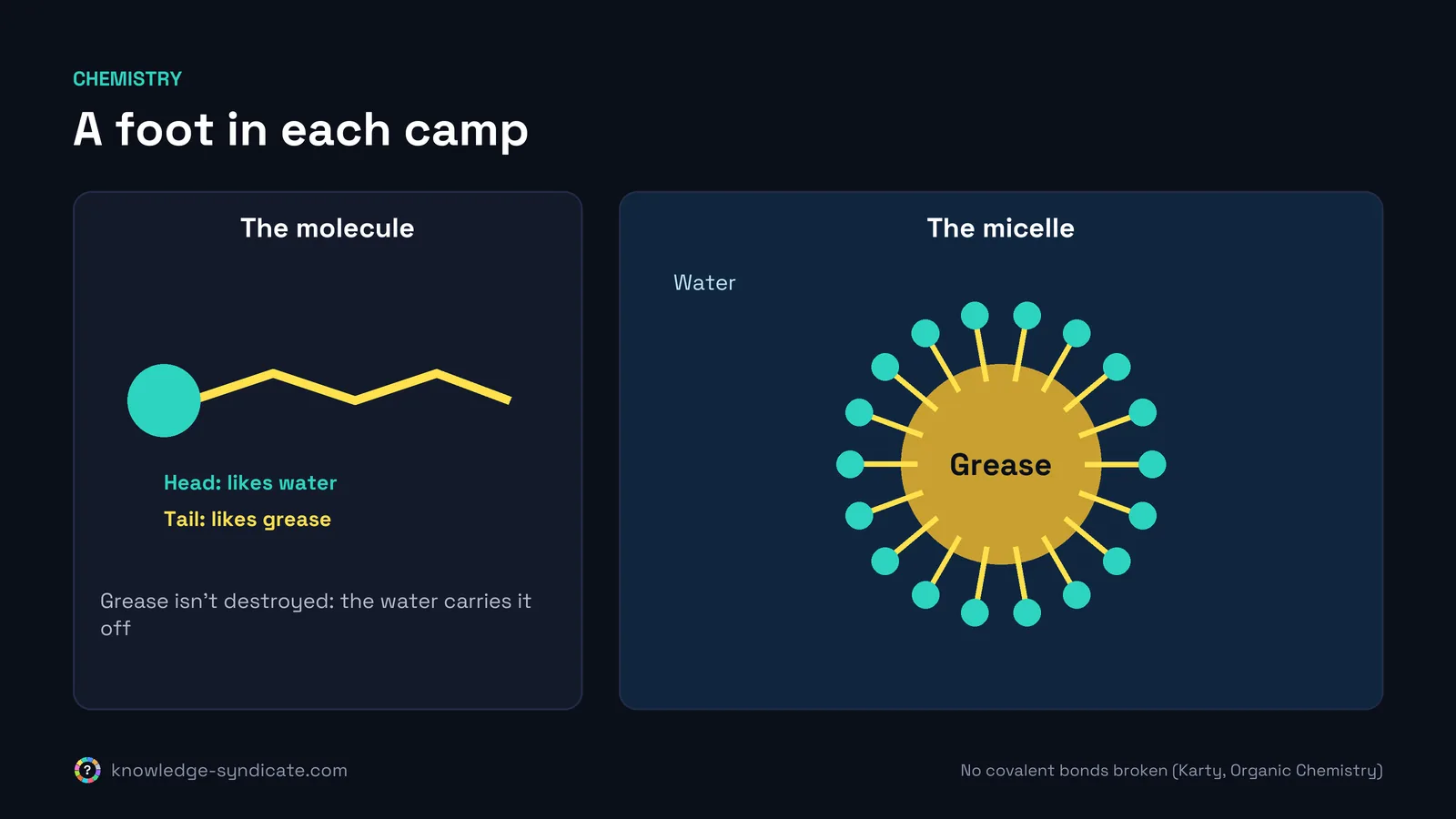
The charged head is hydrophilic: it loves water. The tail, a hydrocarbon chain, is hydrophobic: it runs from water and gets along very well with grease. The technical word is amphiphilic, which is Greek for having friends on both sides.
When there are enough soap molecules in the water, they group together by themselves. The tails all hide in the center, to avoid touching the water, and the heads stay on the outside. That ball is a micelle. According to Athabasca University, below a certain concentration the molecules wander around separately, and above it these aggregates form, usually spherical ones.
Now the grease. When the molecules reach a stain, the tails dig in and the heads stay outside, facing the water. After a while, the blob of grease is bristling with heads all over, and as far as water’s concerned, it’s no longer grease: it’s a little ball with a charged surface. It lets go of the fabric or skin and floats off. According to the Norton textbook, not one covalent bond is broken or formed in this process. Soap doesn’t destroy grease. It escorts it to the exit.
The molecules also collect at the water’s surface and lower its surface tension, so water spreads better and wets what it used to just skim over. That’s why soapy water soaks into a shirt while plain water beads up.
Soap and viruses: a crowbar
In March 2020, everybody found out this was good for something else too. Many viruses, such as the coronavirus, and some bacteria are wrapped in a fatty membrane. As the chemist Pall Thordarson of the University of New South Wales put it in a report by Ferris Jabr, soap molecules “act like crowbars and destabilize the whole system.” Their tails jam into that membrane, pry it open, and the proteins inside leak out. Whatever they don’t break, they loosen from the skin, and the micelles trap it.
According to the same report, alcohol gels with at least 60% ethanol also work against those membrane-wrapped microbes, but don’t remove germs from skin as well as soap and water. Some microbes with other kinds of coating resist both. That’s all that can properly be said here, and it’s mechanism, not advice: a dumb molecule breaks a very sophisticated structure because that structure relies, just like the stain on your shirt, on grease.
The idea of washing your hands so as not to die is also pretty new. Ignaz Semmelweis imposed it in May 1847 at a Vienna hospital, where maternal mortality in one ward fell, according to Britannica, from 18.27% to 1.27%. And here’s a detail hardly anyone mentions: he didn’t use soap, but a solution of chlorinated lime.
Thousands of years of boiling fat with ash
The basic recipe is very old, since it’s easy to stumble on. Boil fat or oil with an alkali and you get soap. Chemists call this reaction saponification, and in modern factories, according to Athabasca, fat is broken down with water at about 50 atmospheres and 200°C, then the fatty acids are converted into sodium salts.
The ancient history is much murkier than it seems. Robert Matthews, in BBC Science Focus, reports a Sumerian text from around 2200 BC describing the use of soap to wash someone with a skin complaint. It was used mainly as a remedy. Later, Babylonians and Egyptians expanded the method with plant ash, oils and animal fat.
The book Caveman Chemistry is more skeptical, and it’s fun to read on this. According to its survey, Sumerian tablets from the third millennium BC mention mixtures of ash and fat, but say nothing about detergent properties. The first writer to use the word sapo in Latin is Pliny the Elder, in the 1st century, who describes it as an invention of the Gallic provinces for dyeing hair red. The old Roman legend of soap forming in the runoff from a temple of Athena has no source anyone can find. The supposed soap from Pompeii, analyzed in 1882, turned out to be fuller’s earth, a type of clay. And the first detailed recipe doesn’t appear until the 12th century, in the Mappae Clavicula. In other words, the documented history of soap actually washing things is much shorter than the advertising suggests.
Galen, the 2nd-century physician, does mention sapo as a material made from goat tallow and ash that’s good for washing, but that amounts to a few sentences across his many volumes. A 2nd-century papyrus from Stockholm gives laundering instructions with nothing resembling soap. Early references are, in the book’s words, “brief at best and vague at worst.” People clearly got clean somehow, with clays and plant froths among other things. They just didn’t necessarily do it with what you’d call soap. So when an ad tells you a brand follows a recipe from ancient Babylon, you’re allowed to raise an eyebrow.
One more detail explains a lot: according to the same book, soda gives solid soap and potash gives liquid soap. That’s why, when Nicolas Leblanc devised a way of making soda from salt around 1791, cheap soap came within much closer reach. The process treated salt with sulfuric acid and heated the result with limestone and coal. As a bonus, it first released hydrogen chloride gas into the air on a grand scale, Britannica notes.
Soap’s enemy is hard water
If you live in a hard-water area, you know the problem: soap won’t lather and leaves a gray film behind. According to Norton, calcium and magnesium bind to soap’s head more strongly than sodium or potassium do, and the result is a salt that doesn’t dissolve in water: what we call scum, or the ring around the bathtub. That soap doesn’t wash anymore, and it sticks to you besides.
The fix arrived by an unexpected route. According to Encyclopaedia Britannica, during World War I, German chemists looked for substitutes because fats were needed for other purposes. That’s how the first synthetic detergents came about, around 1916, which weren’t much good as detergents but were fine wetting agents. The chemical idea was simple: swap soap’s head for a sulfate or sulfonate group, which calcium and magnesium cling to less strongly. That’s why dish liquid works in nearly any water, and an old-fashioned bar of soap doesn’t always.
What goes down the drain
When you wash your hands, you’re really running a physical chemistry experiment more than four thousand years old, carried out by an absurd number of tiny molecules with a split personality. None of them understands what it’s doing. A tail runs from water, a head goes looking for it, and between them they lift off the plate what water alone couldn’t touch. For something so simple, it took us quite a while to work out how it goes.