How do fireworks get their color? The trick Kirchhoff and Bunsen measured in 1860
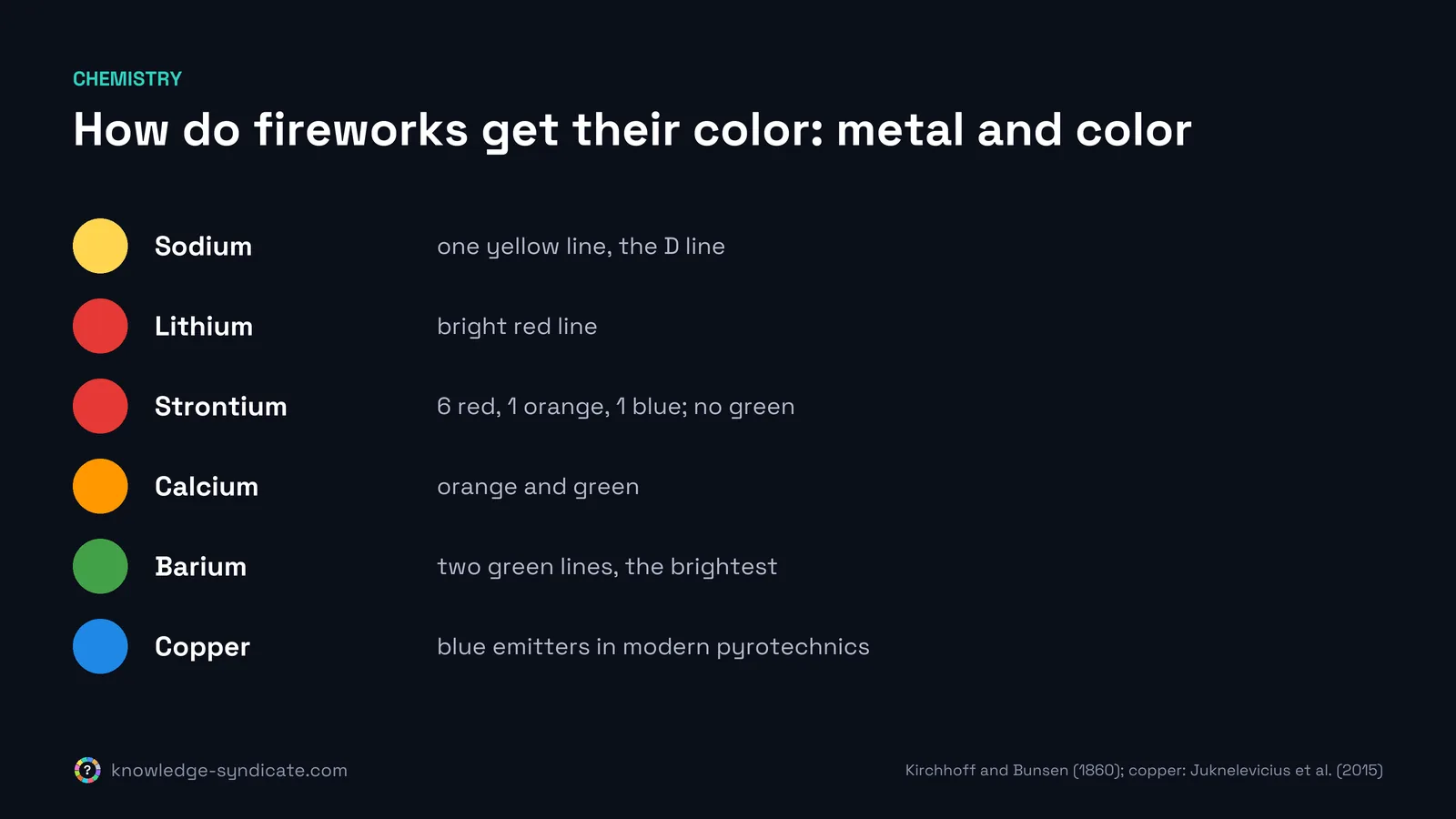
When a red burst opens up in the night sky, what you’re looking at is a chemical analysis. So how do fireworks get their color? Each shade comes from a different element burning inside the shell. That link between metal and color was measured in detail by two scientists in Heidelberg in 1860, with a gas burner and a prism. They were after something else: a new way of analyzing matter. Along the way they wrote down the palette of pyrotechnics.
A burner that barely glows
The paper is titled “Chemical analysis by spectrum observations.” It’s signed from Heidelberg in April 1860 and was published that year in Poggendorff’s Annalen, volume 110. The authors are Kirchhoff and Bunsen, and it can be read in an English translation collected in a 1901 anthology on the laws of radiation.
It opens with a familiar observation: many substances, when put into a flame, produce certain bright lines in the spectrum. On those lines, they say, a method of qualitative analysis can be founded. And they explain why they can see them so well. The lines show up more clearly the hotter the flame and the weaker its own light. The gas lamp described by one of them, Bunsen, gives a very hot and barely luminous flame. Perfect for seeing the colors of whatever burns in it without the flame drowning them out.
They prepared salts as pure as possible of potassium, sodium, lithium, strontium, calcium and barium. To purify the lithium salt, for instance, they precipitated it fourteen times. And they put them into the flame one by one, comparing each spectrum with the Sun’s.
Sodium: yellow even in the dust
Sodium was the most striking. Its spectrum has a single yellow line, which matches the one in the solar spectrum called line D, with a very sharp edge and extraordinary brilliance. And it is, according to the authors, the most sensitive reaction of all, beyond comparison with anything in the chemistry of their time.
To show it, they ran an almost playful experiment. In one corner of the laboratory, which held about 60 cubic meters of air, they burned three milligrams of sodium chlorate with milk sugar, far from the apparatus. After a few minutes the flame began to turn pale yellow and gave a strong sodium line, which vanished completely after ten minutes.
With that much sensitivity, they conclude, it’s rare not to see sodium in the air. A platinum wire cleaned of sodium in the flame shows it again if left out in the air for a few hours. And it’s enough, they write, to slap a dusty book a few paces away to produce brilliant flashes of the yellow line. Their explanation: more than two thirds of the Earth is covered by a solution of sodium chloride, the sea, and breaking waves fling up droplets that evaporate and leave specks of salt floating in the air.
Lithium: red and everywhere
Of lithium they say it gives two sharp lines: a very weak yellow one and a bright red one. And that the reaction beats every one known until then in analytical chemistry for certainty and delicacy. They burned nine milligrams of lithium carbonate with milk sugar and potassium chlorate in the same room, and the red line became clearly visible. With 0.05 grams, they saw it in the room’s air for more than an hour.
The surprise was how widespread it was. They found lithium in 40 cubic centimeters of Atlantic seawater, in the ashes of seaweed carried by the Gulf Stream to the Scottish coast, in the granite of the Odenwald, in a spring near Heidelberg, in the ashes of tobacco, vine leaves, vine wood and grapes, and even in the milk of animals fed on crops from the Rhine valley.
Strontium: red without green
Strontium gave a more complicated spectrum. According to Kirchhoff and Bunsen, it is characterized above all by having no green bands. It has eight notable lines: six red, one orange and one blue.
To measure its sensitivity they heated a solution of strontium chloride in a platinum dish until the salt began to burst into microscopic particles, a white smoke. Weighing what was left, they worked out that 0.077 grams had gone into the room’s air. They mixed the air thoroughly by moving an open umbrella around quickly, and the strontium lines appeared very beautifully outlined.
Barium: the green
Barium, they write, has the most complicated spectrum of the alkali and alkaline earth metals they studied. It stands out at first glance thanks to two green lines that outshine all the others, appearing first and vanishing last. They burned 0.3 grams of barium chlorate with milk sugar in the lab, stirred the air with the umbrella, and the green line was clearly visible for a long time.
Of calcium they report a very characteristic, intense green line and a very bright orange line, lying further toward the red than sodium’s yellow line and strontium’s orange one.
A metal nobody knew
The paper ends with two huge announcements. First: spectrum analysis will make it possible to discover elements not yet known, so scarce that ordinary chemical methods miss them. And they say they already have one. They believe they can state with certainty that besides potassium, sodium and lithium there is a fourth metal of the alkali group, with only two lines, both blue.
Second: since it’s enough to see a glowing gas to analyze it, the method also works on the atmosphere of the Sun and the brightest stars. The dark lines in the solar spectrum would be the reversed image of the bright lines of the elements in the Sun’s atmosphere. They checked it with a very visual test: the bright red line of a flame with lithium chloride turned black when full sunlight was passed through it.
From the lab to the sky
That same list of metals lives on in modern pyrotechnics, according to the chemistry papers that study it. A 2023 paper in Inorganic Chemistry, by a team from Beijing, refers to the characteristic elements that give color to the flame, strontium, barium and copper, and combines them with a new compound to make primary-color pyrotechnics.
Other papers make the point from the opposite direction, by hunting for substitutes. In 2011, a team from the US Army’s Picatinny Arsenal, with J. J. Sabatini first on the author list, published in Angewandte Chemie the use of boron carbide as a barium-free green light emitter. In 2018, J. Glück, T. M. Klapötke and Sabatini described a red composition free of chlorine and strontium, based on lithium nitrate, the very metal whose red line so impressed Kirchhoff and Bunsen. And in 2015 a team with Klapötke among the authors studied copper(I) bromide as an alternative emitter for blue flames, comparing its spectra with those of copper chloride.
Why look for substitutes
The search has an environmental motive. A 2013 study by Sabatini and J. D. Moretti, on military red and green flares, explains that the new perchlorate-free formulas address the environmental concerns tied to red and green flares that contain it, and that this matters for civilian fireworks too.
And the colored smoke ends up in the air. A 2021 study in Auckland, New Zealand, measured airborne particles around the Guy Fawkes celebrations in early November, when it’s common to set off fireworks in residential areas. The analyses found potassium and strontium, large amounts of chlorine, which may point to perchlorate oxidizers, and lead in particles from two colored sparklers marketed as safer alternatives.
How do fireworks get their color: the 1860 palette
Put the pieces together and the palette sorts itself out. The yellow of sodium, which according to Kirchhoff and Bunsen turns up in almost any flame because there’s salt even in dust. The red of strontium, with six red lines and no green, and the red of lithium. The green of barium, with its two green lines brighter than everything else. And the blue that modern chemistry looks for in copper compounds.
Every time a colored shell bursts, the sky repeats the Heidelberg experiment on a grand scale. They watched it through a prism, in a room with the air stirred by an open umbrella. You see it without a prism, but the principle is the same: each metal, as it burns, signs with its own color.